

Volume 36, Issue 258 (7-2026)
J Mazandaran Univ Med Sci 2026, 36(258): 40-51 |
Back to browse issues page



Download citation:
BibTeX | RIS | EndNote | Medlars | ProCite | Reference Manager | RefWorks
Send citation to:


BibTeX | RIS | EndNote | Medlars | ProCite | Reference Manager | RefWorks
Send citation to:
Najibi S, Ghazanfarpour M, Jahani Y, Dadshahi S. Preconception Lifestyle in Women with a History of Miscarriage and Women with a History of Live Birth in Kerman, Iran, 2024: A Case-Control Study. J Mazandaran Univ Med Sci 2026; 36 (258) :40-51
URL: http://jmums.mazums.ac.ir/article-1-22850-en.html
URL: http://jmums.mazums.ac.ir/article-1-22850-en.html


Abstract: (15 Views)
Background and purpose: Preconception lifestyle is a modifiable factor that may significantly affect pregnancy outcomes. The present study aimed to compare the preconception lifestyle of women with a history of miscarriage with that of women with a history of live birth in Kerman, Iran.
Materials and methods: This case-control study was conducted in 2024 and included 50 women with a history of miscarriage (case group) and 100 women with a history of live birth (control group) who attended health centers in Kerman. A multistage cluster random sampling method was used across five regions of the city. Data were collected using a demographic questionnaire and the standardized Lifestyle Questionnaire (LSQ). The validity and reliability of the questionnaire had previously been established. Statistical analyses were performed using SPSS version 22, including the independent t-test, Chi-square test, Mann-Whitney U test, and logistic regression. A P-value of <0.05 was considered statistically significant.
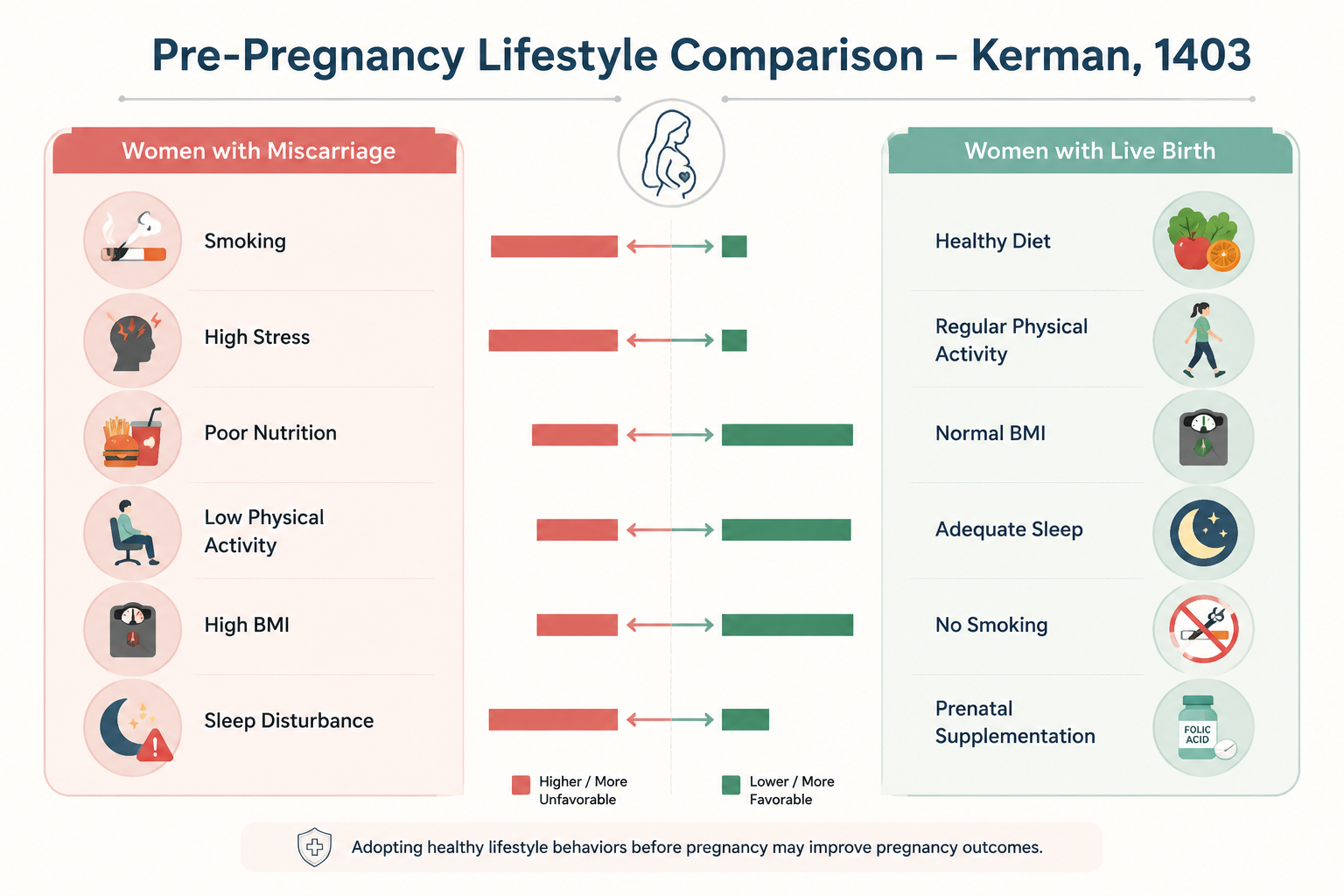
Results: The total lifestyle score differed significantly between the two groups (P = 0.002), with women who had a history of live birth achieving higher scores than those with a history of miscarriage. Logistic regression analysis showed that higher scores in physical activity and fitness (OR = 0.84, 95% CI: 0.77-0.92, P< 0.001), weight control and nutrition (OR= 0.83, 95% CI: 0.75-0.91, P< 0.001), and physical health (OR= 0.74, 95% CI: 0.65-0.84, P < 0.001) were associated with reduced odds of miscarriage. No statistically significant differences were observed in demographic characteristics between the two groups (P > 0.05), suggesting that these variables were unlikely to have confounded the findings.
Conclusion: Improving lifestyle factors related to physical activity and fitness, weight control and nutrition, and physical health may help reduce the risk of miscarriage
Materials and methods: This case-control study was conducted in 2024 and included 50 women with a history of miscarriage (case group) and 100 women with a history of live birth (control group) who attended health centers in Kerman. A multistage cluster random sampling method was used across five regions of the city. Data were collected using a demographic questionnaire and the standardized Lifestyle Questionnaire (LSQ). The validity and reliability of the questionnaire had previously been established. Statistical analyses were performed using SPSS version 22, including the independent t-test, Chi-square test, Mann-Whitney U test, and logistic regression. A P-value of <0.05 was considered statistically significant.
Results: The total lifestyle score differed significantly between the two groups (P = 0.002), with women who had a history of live birth achieving higher scores than those with a history of miscarriage. Logistic regression analysis showed that higher scores in physical activity and fitness (OR = 0.84, 95% CI: 0.77-0.92, P< 0.001), weight control and nutrition (OR= 0.83, 95% CI: 0.75-0.91, P< 0.001), and physical health (OR= 0.74, 95% CI: 0.65-0.84, P < 0.001) were associated with reduced odds of miscarriage. No statistically significant differences were observed in demographic characteristics between the two groups (P > 0.05), suggesting that these variables were unlikely to have confounded the findings.
Conclusion: Improving lifestyle factors related to physical activity and fitness, weight control and nutrition, and physical health may help reduce the risk of miscarriage
Type of Study: Research(Original) |
Subject:
Midwifery
Send email to the article author
| Rights and permissions | |
 |
This work is licensed under a Creative Commons Attribution-NonCommercial 4.0 International License. |

Articles Copyright © The Author(s). Owned by Mazandaran University of Medical Sciences.
Contact Us
Address: Journal Office, Building No. 2, Mazandaran University of Medical Sciences, Moallem Square, Sari.Tel: +98 (011)34484874 Postal code: 48175-866 E-Mail: jmums@mazums.ac.ir Telefax: +98 (011)33262679
