

Volume 36, Issue 262 (Special Issue 2026)
J Mazandaran Univ Med Sci 2026, 36(262): 105-118 |
Back to browse issues page



Download citation:
BibTeX | RIS | EndNote | Medlars | ProCite | Reference Manager | RefWorks
Send citation to:


BibTeX | RIS | EndNote | Medlars | ProCite | Reference Manager | RefWorks
Send citation to:
Nakhzari Khodakheir J, Rahdari T, Ghasemi E. Effects of High-Intensity Interval Training Combined with Green Tea Supplementation on Oxidative Balance and Muscular Performance in Overweight Older Men. , J Mazandaran Univ Med Sci. 2026; 36 (262) :105-118
URL: http://jmums.mazums.ac.ir/article-1-22863-en.html
URL: http://jmums.mazums.ac.ir/article-1-22863-en.html


Abstract: (37 Views)
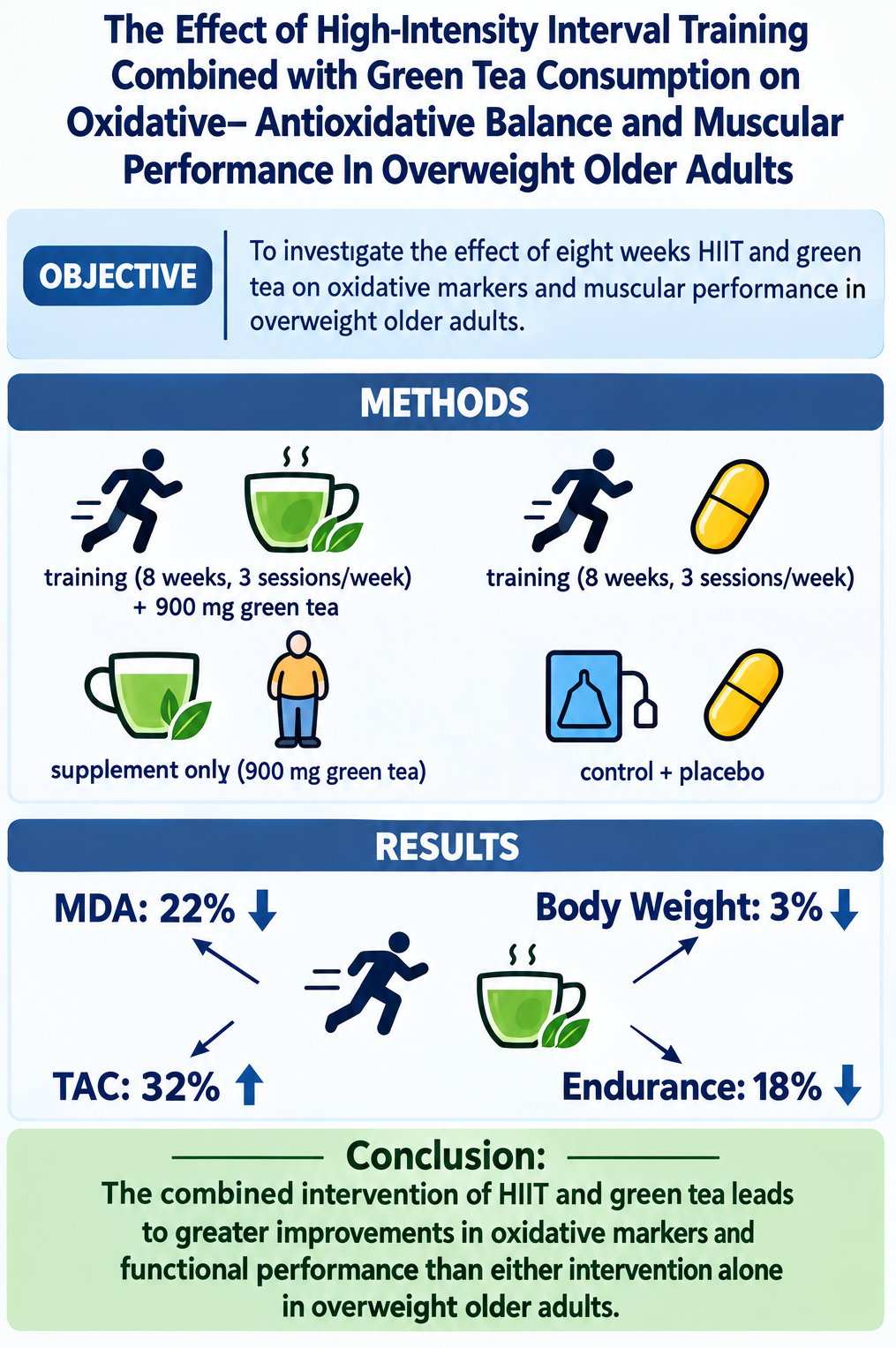
Background and purpose: The use of medicinal plants in combination with exercise has attracted increasing interest, particularly in overweight older adults, because of their potential effects on energy metabolism and oxidative balance. This study investigated the effects of eight weeks of high-intensity interval training (HIIT), with and without green tea supplementation, on oxidative–antioxidative balance and muscular performance in overweight older adults.
Materials and methods: This randomised controlled trial used a pretest–posttest design. A total of 48 overweight older men (mean age, 63.7 ± 7.54 years) were recruited through purposive sampling and randomly assigned to four equal groups: HIIT plus green tea supplementation, HIIT plus placebo, green tea supplementation alone, and control (placebo only). The training groups completed HIIT sessions three times per week for eight weeks, while the supplementation groups received two 450 mg green tea capsules daily. Study variables were assessed before and after the intervention. Data were analysed using two-way repeated-measures analysis of variance (ANOVA), followed by Tukey’s post hoc test, with statistical significance set at P≤ 0.05.
Results: After eight weeks, serum malondialdehyde (MDA) levels decreased significantly by 23% (P< 0.01), while total antioxidant capacity (TAC) increased significantly by 32% (P< 0.001) in the HIIT plus supplementation group compared with the HIIT plus placebo, supplementation-only, and control groups. The reported interaction among time, exercise, and supplementation was significant for both MDA and TAC (P< 0.001), with greater improvements in these indices in the combined-intervention group than in the other groups. Furthermore, body weight and body fat percentage decreased by 3% and 6%, respectively (both P < 0.001), while muscular strength increased by 10% ( P < 0.02) and muscular endurance increased by 15% (P< 0.03) in the combined-intervention group compared with the supplementation-only and control groups.
Conclusion: Combining HIIT with green tea supplementation may offer greater benefits for oxidative balance, body composition, and muscular performance than either intervention alone in overweight older men.
(Clinical Trials Registry Number: IRCT20220322054338N5)
Type of Study: Research(Original) |
Subject:
Sport Physiology
Send email to the article author
| Rights and permissions | |
 |
This work is licensed under a Creative Commons Attribution-NonCommercial 4.0 International License. |

Articles Copyright © The Author(s). Owned by Mazandaran University of Medical Sciences.
Contact Us
Address: Journal Office, Building No. 2, Mazandaran University of Medical Sciences, Moallem Square, Sari.Tel: +98 (011)34484874 Postal code: 48175-866 E-Mail: jmums@mazums.ac.ir Telefax: +98 (011)33262679
