

Volume 36, Issue 258 (7-2026)
J Mazandaran Univ Med Sci 2026, 36(258): 207-221 |
Back to browse issues page



Download citation:
BibTeX | RIS | EndNote | Medlars | ProCite | Reference Manager | RefWorks
Send citation to:


BibTeX | RIS | EndNote | Medlars | ProCite | Reference Manager | RefWorks
Send citation to:
Tabatabaei Aghda S J, Nasiri Formi E, Tabatabaei Aghda S A, Jafarpoor H. Comparative Efficacy of Sutures, Staples, and Tissue Adhesives for Skin Graft Fixation in Burn Patients: A Systematic Review and Meta-analysis. J Mazandaran Univ Med Sci 2026; 36 (258) :207-221
URL: http://jmums.mazums.ac.ir/article-1-22887-en.html
URL: http://jmums.mazums.ac.ir/article-1-22887-en.html
Seyyed Jamaleddin Tabatabaei Aghda 
 , Ebrahim Nasiri Formi , Seyyed Abolfazl Tabatabaei Aghda , Hasanali Jafarpoor
, Ebrahim Nasiri Formi , Seyyed Abolfazl Tabatabaei Aghda , Hasanali Jafarpoor
Abstract: (11 Views)
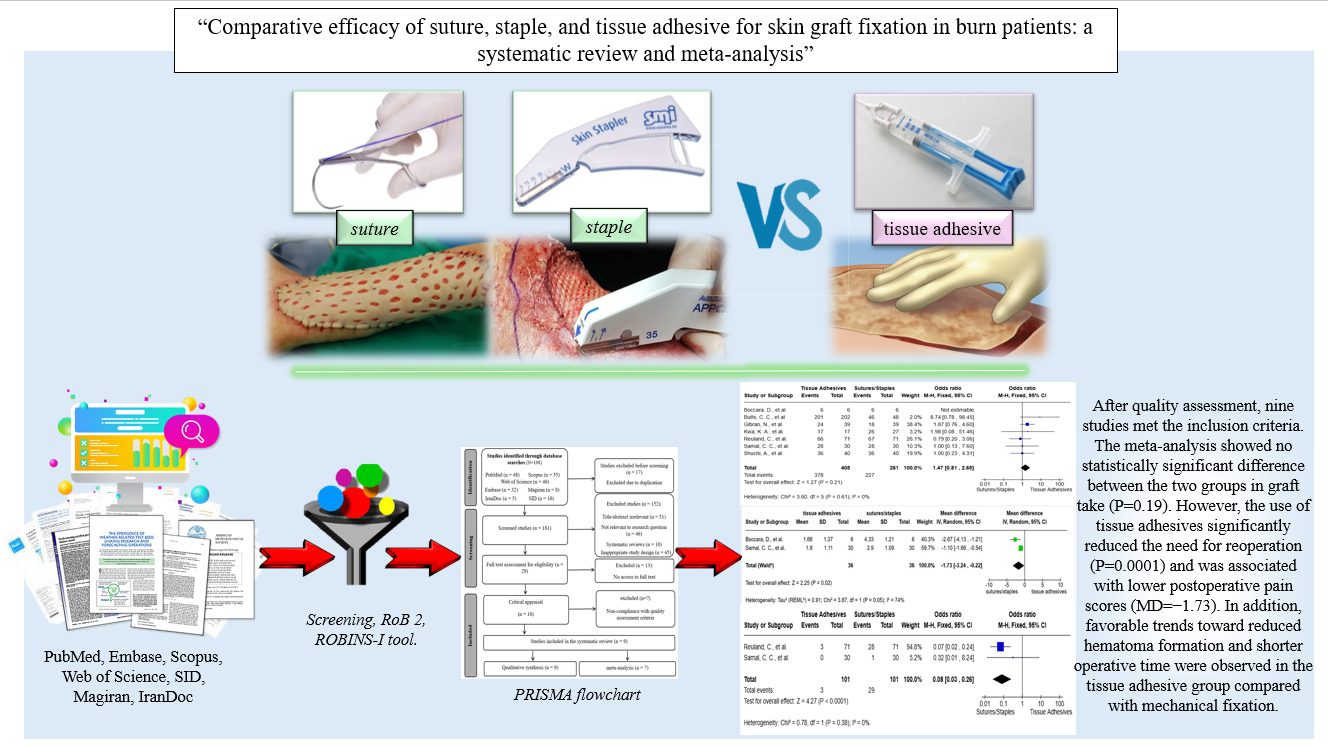
Background and purpose: Burns affect more than 11 million people worldwide annually, and split-thickness skin grafting remains the standard treatment for deep burns; however, the optimal method for securing skin grafts to the wound bed remains debated. This systematic review was conducted to compare the clinical efficacy of tissue adhesives (fibrin sealants) versus conventional mechanical fixation methods (sutures/staples) for skin graft stabilization in burn patients.
Materials and methods: A comprehensive search was conducted using international databases (PubMed, Embase, Scopus, and Web of Science) and national databases (SID, Magiran, and IranDoc) without language or date restrictions. Methodological quality was assessed using the RoB 2 and ROBINS-I tools, and data were synthesized using RevMan 5.4 software to calculate risk ratios (RRs) and mean differences (MDs).
Results: Of the 16 eligible studies, seven were excluded due to a high risk of bias, leaving nine studies in the qualitative review and seven studies comprising 545 patients in the meta-analysis. The results showed no significant difference in graft take between the two groups (RR = 1.03; P = 0.19); however, tissue adhesives significantly reduced the need for reoperation (RR = 0.12; P = 0.0001) and postoperative pain intensity (MD = −1.73; P = 0.02). A trend towards reduced hematoma formation and shorter operative time was also observed in the tissue adhesive group compared to mechanical fixation.
Conclusion: Fibrin tissue adhesives represent a safe and effective alternative to mechanical fixation for skin graft stabilization in burn patients. Graft take rates and complication rates were comparable between the two methods; however, tissue adhesives significantly reduced postoperative pain and the need for reoperation. Despite higher material costs, the reduction in secondary interventions may offset the overall expenditure. Higher-quality randomized controlled trials are warranted to confirm these findings.
(Registration ID (in PROSPERO): CRD420251248124)
Materials and methods: A comprehensive search was conducted using international databases (PubMed, Embase, Scopus, and Web of Science) and national databases (SID, Magiran, and IranDoc) without language or date restrictions. Methodological quality was assessed using the RoB 2 and ROBINS-I tools, and data were synthesized using RevMan 5.4 software to calculate risk ratios (RRs) and mean differences (MDs).
Results: Of the 16 eligible studies, seven were excluded due to a high risk of bias, leaving nine studies in the qualitative review and seven studies comprising 545 patients in the meta-analysis. The results showed no significant difference in graft take between the two groups (RR = 1.03; P = 0.19); however, tissue adhesives significantly reduced the need for reoperation (RR = 0.12; P = 0.0001) and postoperative pain intensity (MD = −1.73; P = 0.02). A trend towards reduced hematoma formation and shorter operative time was also observed in the tissue adhesive group compared to mechanical fixation.
Conclusion: Fibrin tissue adhesives represent a safe and effective alternative to mechanical fixation for skin graft stabilization in burn patients. Graft take rates and complication rates were comparable between the two methods; however, tissue adhesives significantly reduced postoperative pain and the need for reoperation. Despite higher material costs, the reduction in secondary interventions may offset the overall expenditure. Higher-quality randomized controlled trials are warranted to confirm these findings.
(Registration ID (in PROSPERO): CRD420251248124)
Type of Study: Review |
Subject:
dermatopathology
Send email to the article author
| Rights and permissions | |
 |
This work is licensed under a Creative Commons Attribution-NonCommercial 4.0 International License. |

Articles Copyright © The Author(s). Owned by Mazandaran University of Medical Sciences.
Contact Us
Address: Journal Office, Building No. 2, Mazandaran University of Medical Sciences, Moallem Square, Sari.Tel: +98 (011)34484874 Postal code: 48175-866 E-Mail: jmums@mazums.ac.ir Telefax: +98 (011)33262679
