

Volume 36, Issue 258 (7-2026)
J Mazandaran Univ Med Sci 2026, 36(258): 125-131 |
Back to browse issues page



Download citation:
BibTeX | RIS | EndNote | Medlars | ProCite | Reference Manager | RefWorks
Send citation to:


BibTeX | RIS | EndNote | Medlars | ProCite | Reference Manager | RefWorks
Send citation to:
Nasiri Formi E, Tabatabaei Aghda S A, Azizi S, Siahposht-Khachaki A, Darayee M, Ebrahimnejad P. Comparison of the Effects of Abukhalsa (Arnebia euchroma) Ointment and Silver Nanoparticle-Containing Mupirocin Ointment on Macroscopic and Histopathological Changes During Burn and Surgical Wound Healing in Rats. J Mazandaran Univ Med Sci 2026; 36 (258) :125-131
URL: http://jmums.mazums.ac.ir/article-1-22894-en.html
URL: http://jmums.mazums.ac.ir/article-1-22894-en.html
Ebrahim Nasiri Formi 
 , Seyyed Abolfazl Tabatabaei Aghda , Soheil Azizi , Ali Siahposht-Khachaki , Masood Darayee , Pedram Ebrahimnejad
, Seyyed Abolfazl Tabatabaei Aghda , Soheil Azizi , Ali Siahposht-Khachaki , Masood Darayee , Pedram Ebrahimnejad
Abstract: (11 Views)
Background and purpose: This service could not be searched because you are not connected to the Internet. Please connect and try again.
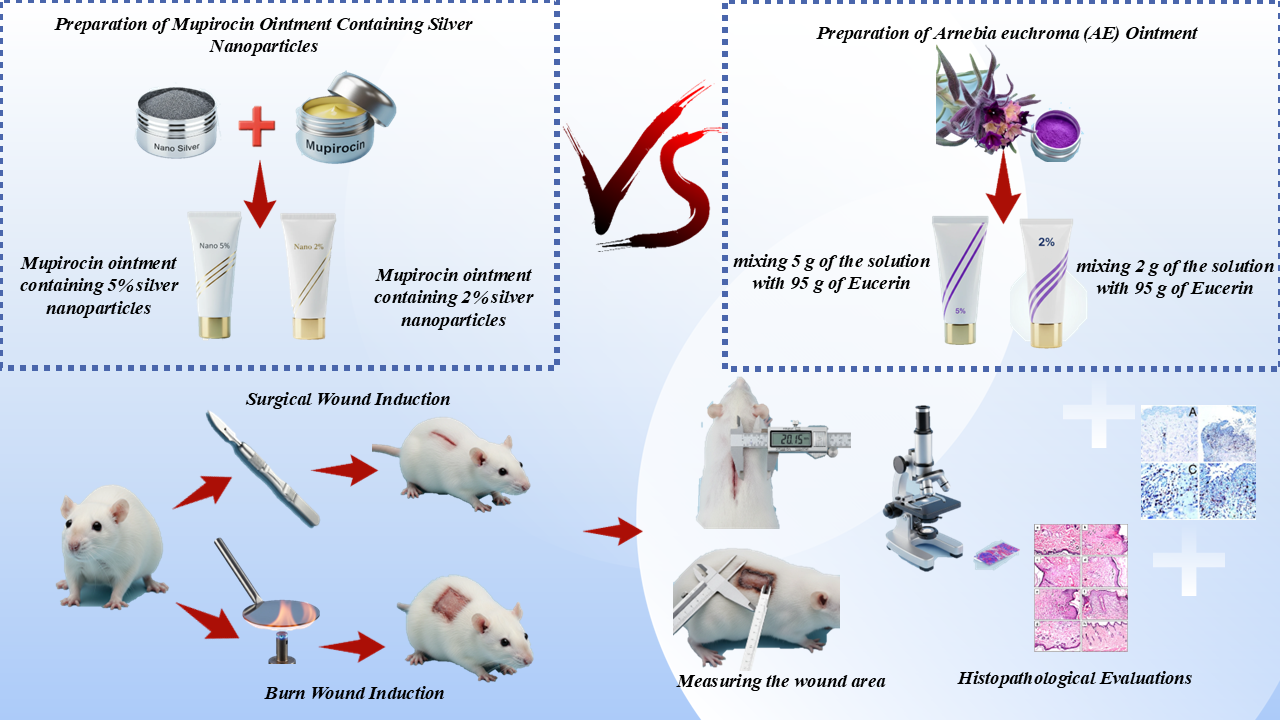
Materials and methods: In this experimental study, 72 male Wistar rats were divided into 12 groups (seven burn wound groups and five surgical wound groups). The healing process was evaluated by measuring wound area on days 3, 7, 14, and 21, together with qualitative histopathological evaluation using haematoxylin and eosin (H&E) staining on days 7 and 21 post-injury.
Results: In the burn wound model, no significant differences were observed on day 3; however, differences between the treatment groups became highly significant from day 7 onwards. By day 21, the Arnebia euchroma (2% and 5%) and nano-formulation (2% and 5%) treatment groups achieved complete wound healing, whereas the silver sulfadiazine group demonstrated the lowest efficacy. In the surgical wound model, all groups achieved complete healing by day 21, with the 2% nano-formulation group exhibiting the fastest healing rate. However, histopathological evaluation performed on day 21 revealed that the silver sulfadiazine, mupirocin, and 5% Arnebia euchroma groups exhibited greater collagen density and more organised collagen fibre orientation, indicating superior tissue quality, whereas tissue in the 2% nano-formulation group appeared less mature.
Conclusion: The efficacy of wound treatment depends on the wound type. Both the nano-formulation and the herbal ointment demonstrated superior efficacy in the treatment of burn wounds. In surgical wounds, a trade-off was observed between the rate of healing and the quality of the regenerated tissue, suggesting that faster healing does not necessarily lead to superior tissue regeneration.
Materials and methods: In this experimental study, 72 male Wistar rats were divided into 12 groups (seven burn wound groups and five surgical wound groups). The healing process was evaluated by measuring wound area on days 3, 7, 14, and 21, together with qualitative histopathological evaluation using haematoxylin and eosin (H&E) staining on days 7 and 21 post-injury.
Results: In the burn wound model, no significant differences were observed on day 3; however, differences between the treatment groups became highly significant from day 7 onwards. By day 21, the Arnebia euchroma (2% and 5%) and nano-formulation (2% and 5%) treatment groups achieved complete wound healing, whereas the silver sulfadiazine group demonstrated the lowest efficacy. In the surgical wound model, all groups achieved complete healing by day 21, with the 2% nano-formulation group exhibiting the fastest healing rate. However, histopathological evaluation performed on day 21 revealed that the silver sulfadiazine, mupirocin, and 5% Arnebia euchroma groups exhibited greater collagen density and more organised collagen fibre orientation, indicating superior tissue quality, whereas tissue in the 2% nano-formulation group appeared less mature.
Conclusion: The efficacy of wound treatment depends on the wound type. Both the nano-formulation and the herbal ointment demonstrated superior efficacy in the treatment of burn wounds. In surgical wounds, a trade-off was observed between the rate of healing and the quality of the regenerated tissue, suggesting that faster healing does not necessarily lead to superior tissue regeneration.
Keywords: Abukhalsa, Arnebia Euchroma, ointment, Mupirocin, silver nanoparticles, macroscopic, burn wound, surgical wound, wound healing
Type of Study: Brief Report |
Subject:
Reconstructive and Burn, Plastic surgery
Send email to the article author
| Rights and permissions | |
 |
This work is licensed under a Creative Commons Attribution-NonCommercial 4.0 International License. |

Articles Copyright © The Author(s). Owned by Mazandaran University of Medical Sciences.
Contact Us
Address: Journal Office, Building No. 2, Mazandaran University of Medical Sciences, Moallem Square, Sari.Tel: +98 (011)34484874 Postal code: 48175-866 E-Mail: jmums@mazums.ac.ir Telefax: +98 (011)33262679
