

Volume 36, Issue 259 (8-2026)
J Mazandaran Univ Med Sci 2026, 36(259): 253-265 |
Back to browse issues page



Download citation:
BibTeX | RIS | EndNote | Medlars | ProCite | Reference Manager | RefWorks
Send citation to:


BibTeX | RIS | EndNote | Medlars | ProCite | Reference Manager | RefWorks
Send citation to:
Shahhosseini Z, Nazari N. Educational Interventions for Delivering Bad News in Midwifery: A Scoping Review. J Mazandaran Univ Med Sci 2026; 36 (259) :253-265
URL: http://jmums.mazums.ac.ir/article-1-22953-en.html
URL: http://jmums.mazums.ac.ir/article-1-22953-en.html


Abstract: (24 Views)
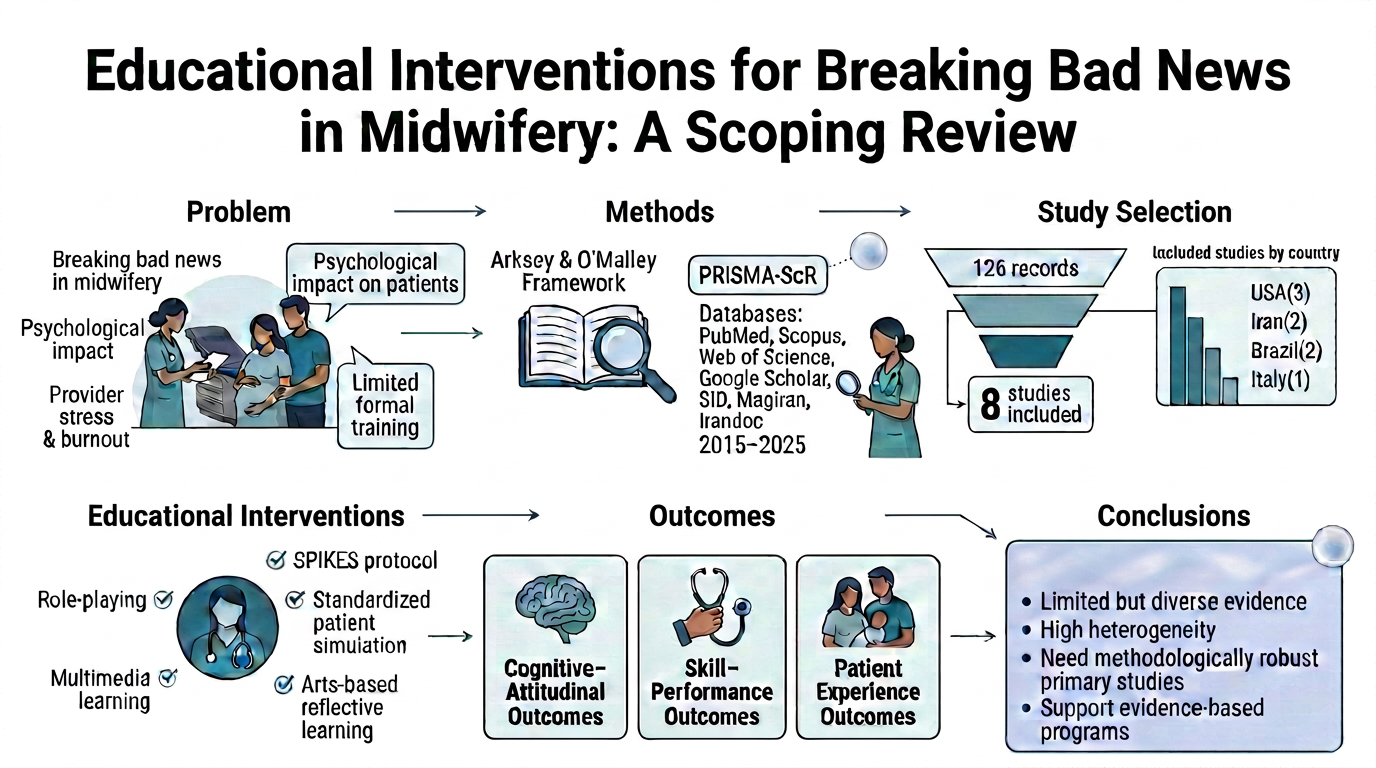
Background and purpose: Delivering bad news in midwifery is challenging and can affect patients' psychological well-being and care experiences. The lack of formal training in this area may increase stress and burnout among healthcare providers. Despite the importance of this topic, evidence on educational interventions for teaching healthcare professionals how to deliver bad news in midwifery is scattered and heterogeneous. This scoping review aimed to identify and map educational interventions for teaching midwives and midwifery students how to deliver bad news.
Materials and methods: This scoping review followed the Arksey and O'Malley framework and the PRISMA-ScR checklist. A systematic search was conducted in the English-language databases Google Scholar, PubMed, Scopus, and Web of Science, as well as the Persian-language databases SID, Magiran, and Irandoc, for studies published between 2015 and 2025, using keywords related to breaking bad news and midwifery.
Results: Of the 126 identified records, 8 studies were included after duplicate removal and screening. These studies were conducted in the United States (n=3), Iran (n=2), Brazil (n=2), and Italy (n=1). Midwifery students were the most common study participants. Educational interventions were mainly based on the SPIKES protocol and incorporated active learning methods, including role-playing, simulated patient encounters, multimedia education, and arts-based reflective methods. The outcomes assessed were classified into three domains: cognitive-attitudinal, skill-performance, and patient experience.
Conclusion: This review showed that evidence on educational interventions for delivering bad news in midwifery is limited but diverse. Heterogeneity in study designs, target populations, intervention types, and outcome measures makes it difficult to draw consistent conclusions. The lack of studies assessing outcomes from the patients' perspective remains a major research gap. Future studies with more robust methodological designs, as well as systematic reviews, may strengthen the evidence base and support the development of evidence-based educational programmes.
Materials and methods: This scoping review followed the Arksey and O'Malley framework and the PRISMA-ScR checklist. A systematic search was conducted in the English-language databases Google Scholar, PubMed, Scopus, and Web of Science, as well as the Persian-language databases SID, Magiran, and Irandoc, for studies published between 2015 and 2025, using keywords related to breaking bad news and midwifery.
Results: Of the 126 identified records, 8 studies were included after duplicate removal and screening. These studies were conducted in the United States (n=3), Iran (n=2), Brazil (n=2), and Italy (n=1). Midwifery students were the most common study participants. Educational interventions were mainly based on the SPIKES protocol and incorporated active learning methods, including role-playing, simulated patient encounters, multimedia education, and arts-based reflective methods. The outcomes assessed were classified into three domains: cognitive-attitudinal, skill-performance, and patient experience.
Conclusion: This review showed that evidence on educational interventions for delivering bad news in midwifery is limited but diverse. Heterogeneity in study designs, target populations, intervention types, and outcome measures makes it difficult to draw consistent conclusions. The lack of studies assessing outcomes from the patients' perspective remains a major research gap. Future studies with more robust methodological designs, as well as systematic reviews, may strengthen the evidence base and support the development of evidence-based educational programmes.
Keywords: breaking bad news, delivering bad news, education, midwifery, obstetrics and gynaecology, scoping review
Send email to the article author
| Rights and permissions | |
 |
This work is licensed under a Creative Commons Attribution-NonCommercial 4.0 International License. |

Articles Copyright © The Author(s). Owned by Mazandaran University of Medical Sciences.
Contact Us
Address: Journal Office, Building No. 2, Mazandaran University of Medical Sciences, Moallem Square, Sari.Tel: +98 (011)34484874 Postal code: 48175-866 E-Mail: jmums@mazums.ac.ir Telefax: +98 (011)33262679
