

Volume 36, Issue 262 (Special Issue 2026)
J Mazandaran Univ Med Sci 2026, 36(262): 51-64 |
Back to browse issues page



Download citation:
BibTeX | RIS | EndNote | Medlars | ProCite | Reference Manager | RefWorks
Send citation to:


BibTeX | RIS | EndNote | Medlars | ProCite | Reference Manager | RefWorks
Send citation to:
Abdullah Ali R, Babagoltabar-Samakoush H. Effects of an Eight-Week Neuromuscular Training Programme on Functional Disability, Movement Competency, and Balance in Volleyball Players with Chronic Ankle Instability: A Randomised Controlled Trial. , J Mazandaran Univ Med Sci. 2026; 36 (262) :51-64
URL: http://jmums.mazums.ac.ir/article-1-22962-en.html
URL: http://jmums.mazums.ac.ir/article-1-22962-en.html


Abstract: (40 Views)
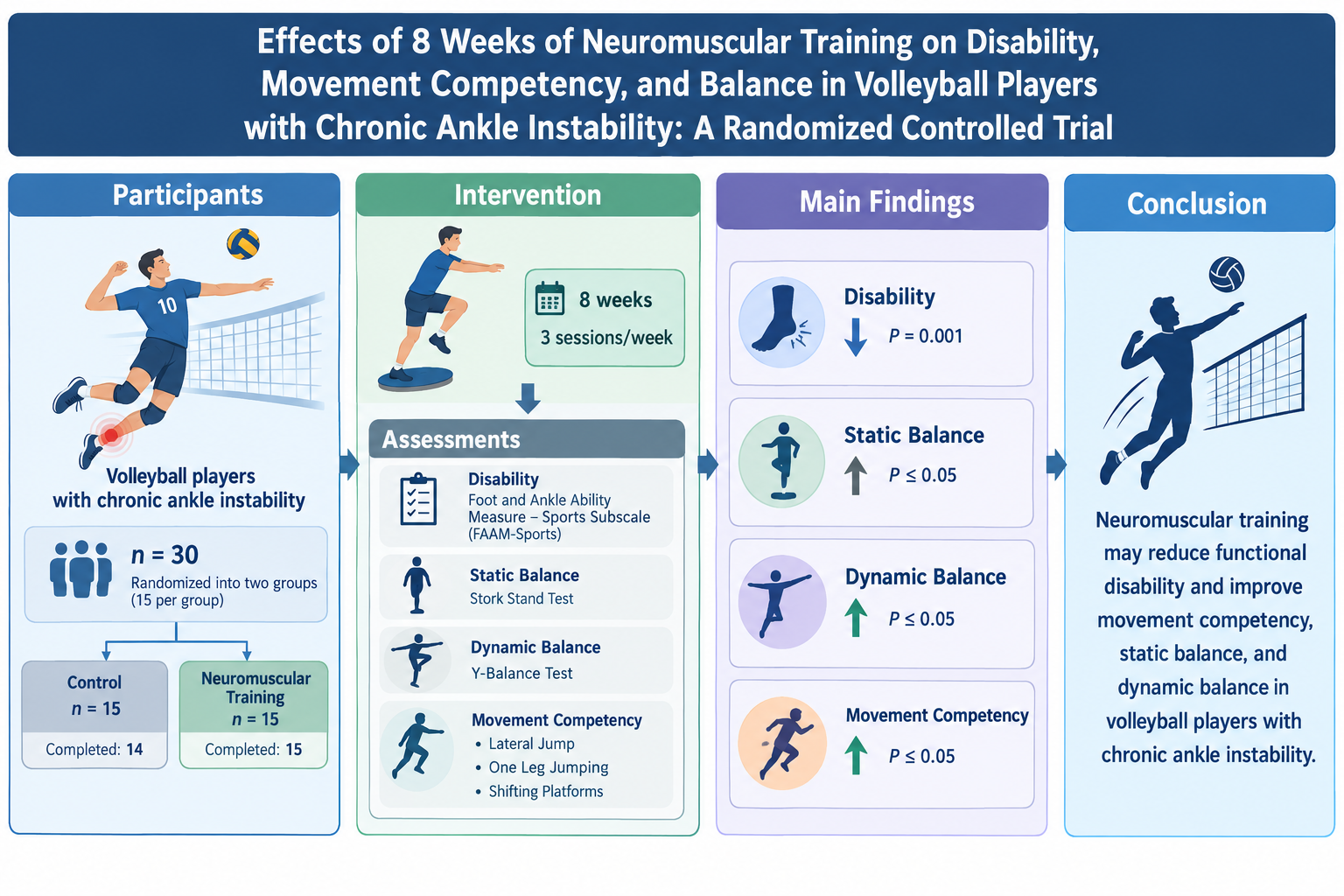
Background and purpose: Chronic ankle instability (CAI) is a common sports-related condition among volleyball players and may be associated with impaired postural stability and functional performance. This study aimed to investigate the effects of an eight-week neuromuscular training programme on functional disability, movement competency, and balance in volleyball players with CAI.
Materials and methods: This randomised controlled clinical trial included male volleyball players with CAI. Thirty athletes were randomly assigned to the control and intervention groups, with 15 participants in each group. Twenty-nine participants completed the study: 14 in the control group and 15 in the intervention group. Functional disability was assessed using the Foot and Ankle Ability Measure-Sports Subscale (FAAM-Sports). Static and dynamic balance were assessed using the Stork Stand Test and Y-Balance Test, respectively. Movement competency was evaluated using the Lateral Jump, One-Leg Jumping, and Shifting Platforms tests. Participants in the intervention group completed neuromuscular training three times per week for eight weeks. Data were analysed using paired-samples t-tests, analysis of covariance (ANCOVA), Mann-Whitney U tests, and Wilcoxon signed-rank tests. All statistical analyses were performed using SPSS version 24.
Results: The groups did not differ significantly in demographic characteristics at baseline (P > 0.05). Following the intervention, functional disability decreased significantly (P = 0.001). Static balance, dynamic balance, and movement competency also improved significantly (P ≤ 0.05). Between-group comparisons showed statistically significant differences in all outcome measures (P ≤ 0.05).
Conclusion: The findings suggest that an eight-week neuromuscular training programme may reduce functional disability and improve movement competency, static balance, and dynamic balance in volleyball players with CAI
(Clinical Trials Registry Number: UMIN000055128)
Type of Study: Research(Original) |
Subject:
Sport Medicine
Send email to the article author
| Rights and permissions | |
 |
This work is licensed under a Creative Commons Attribution-NonCommercial 4.0 International License. |

Articles Copyright © The Author(s). Owned by Mazandaran University of Medical Sciences.
Contact Us
Address: Journal Office, Building No. 2, Mazandaran University of Medical Sciences, Moallem Square, Sari.Tel: +98 (011)34484874 Postal code: 48175-866 E-Mail: jmums@mazums.ac.ir Telefax: +98 (011)33262679
