

Volume 36, Issue 263 (11-2026)
J Mazandaran Univ Med Sci 2026, 36(263): 181-194 |
Back to browse issues page



Download citation:
BibTeX | RIS | EndNote | Medlars | ProCite | Reference Manager | RefWorks
Send citation to:


BibTeX | RIS | EndNote | Medlars | ProCite | Reference Manager | RefWorks
Send citation to:
abdollahi F, zarghami M, Rohani Otaghsara S, shabankhani B, Yazdani Charati J. Postpartum Depression, Parenting Self-Efficacy, and Associated Factors during the COVID-19 Pandemic: A Descriptive-Analytical Study in Mazandaran Province. , J Mazandaran Univ Med Sci. 2026; 36 (263) :181-194
URL: http://jmums.mazums.ac.ir/article-1-23099-en.html
URL: http://jmums.mazums.ac.ir/article-1-23099-en.html
Fatemeh Abdollahi 
 , Mehran Zarghami , Samad Rohani Otaghsara , Bizhan Shabankhani , Jamshid Yazdani Charati *
Abstract: (25 Views)
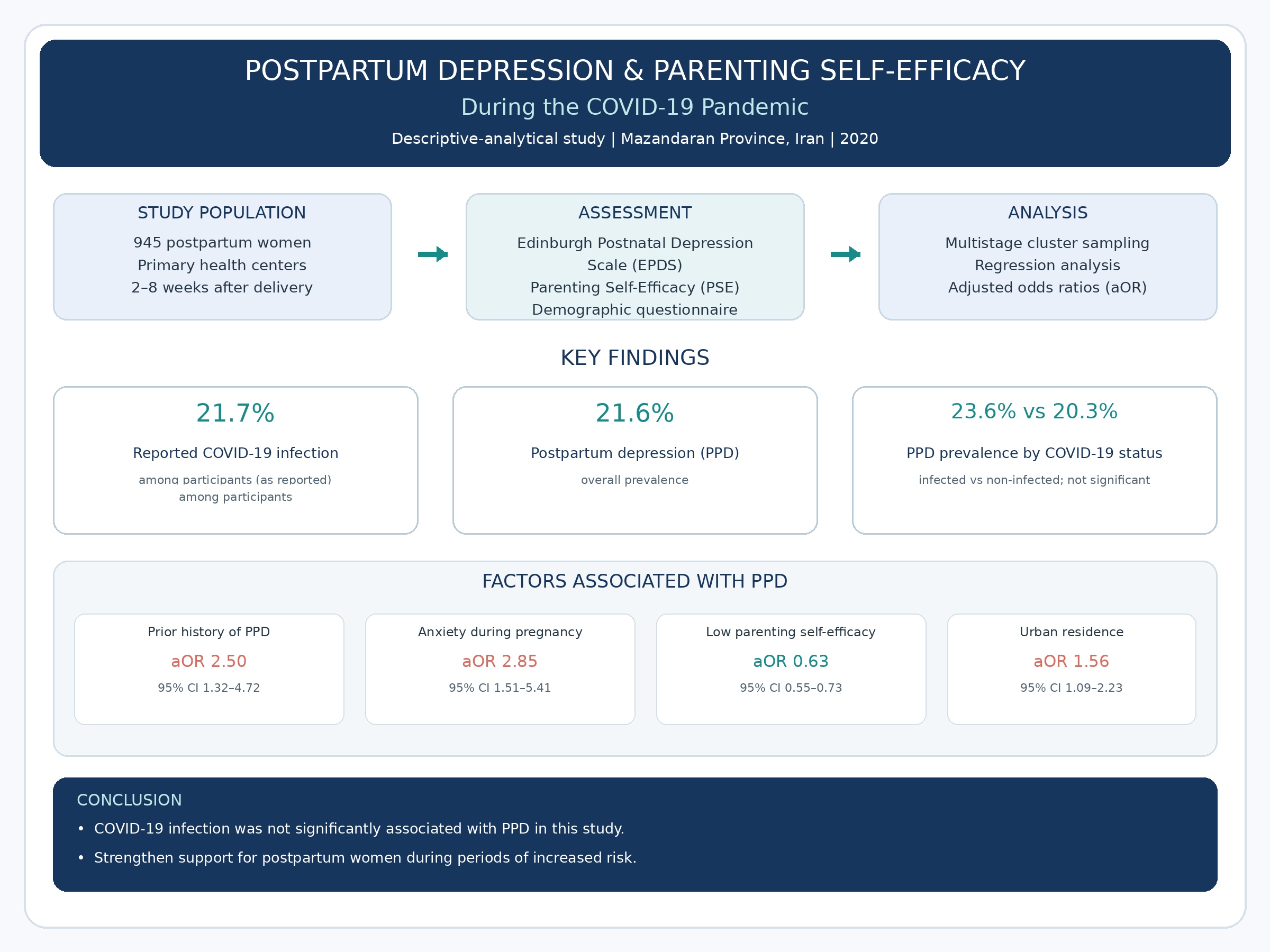
Background and purpose: Studies have suggested that the COVID-19 pandemic was associated with an increased risk of mental health problems, particularly among vulnerable populations such as women. This study aimed to assess psychological outcomes among postpartum women during the COVID-19 pandemic.
Materials and methods: This descriptive-analytical study included 945 women attending primary healthcare centres in Mazandaran Province in 2020. Participants were recruited using a multistage cluster sampling method and assessed 2-8 weeks after delivery. Data were collected using the Edinburgh Postnatal Depression Scale (EPDS), the Parenting Self-Efficacy Questionnaire (PSE), and a demographic questionnaire. Regression analysis was performed to identify factors associated with postpartum depression (PPD) during the pandemic, with adjusted odds ratios (aORs) calculated.
Results: Overall, 21.7% of the women reported having been infected with COVID-19. COVID-19 infection was significantly more prevalent among employed women with less than a high school education, living in extended families and having spouses with higher educational attainment, than among housewives with higher educational attainment, living in nuclear families and having spouses with higher educational attainment (P < 0.05). The prevalence of PPD was 21.6%. Although PPD was more prevalent among women with COVID-19 than among those without infection, the difference was not statistically significant (23.6% vs. 20.3%). Factors associated with PPD included a history of PPD (aOR = 2.50, 95% CI: 1.32-4.72), anxiety during pregnancy (aOR = 2.85, 95% CI: 1.51-5.41), lower parenting self-efficacy (aOR = 0.63, 95% CI: 0.55-0.73), and urban residence (aOR = 1.56, 95% CI: 1.09-2.23).
Conclusion: COVID-19 infection was not significantly associated with an increased prevalence of PPD among postpartum women. The factors associated with PPD were broadly consistent with those identified before the pandemic. Strengthening support mechanisms for women during periods of increased vulnerability, such as epidemics, is therefore recommended.
Type of Study: Research(Original) |
Subject:
health
| Rights and permissions | |
 |
This work is licensed under a Creative Commons Attribution-NonCommercial 4.0 International License. |

Articles Copyright © The Author(s). Owned by Mazandaran University of Medical Sciences.
Contact Us
Address: Journal Office, Building No. 2, Mazandaran University of Medical Sciences, Moallem Square, Sari.Tel: +98 (011)34484874 Postal code: 48175-866 E-Mail: jmums@mazums.ac.ir Telefax: +98 (011)33262679
