

Volume 36, Issue 262 (Special Issue 2026)
J Mazandaran Univ Med Sci 2026, 36(262): 4-14 |
Back to browse issues page



Download citation:
BibTeX | RIS | EndNote | Medlars | ProCite | Reference Manager | RefWorks
Send citation to:


BibTeX | RIS | EndNote | Medlars | ProCite | Reference Manager | RefWorks
Send citation to:
Semnani A, Yadollahi B, Pourjavad A, Taghian M, Nahvi A. Comparison of 2.5% Lidocaine/2.5% Prilocaine Gel and 20% Benzocaine Gel for Pain Reduction during Palatal Local Anaesthetic Injection in Children Aged 9-12 Years: A Randomised, Double-Blind, Crossover Clinical Trial. , J Mazandaran Univ Med Sci. 2026; 36 (262) :4-14
URL: http://jmums.mazums.ac.ir/article-1-23151-en.html
URL: http://jmums.mazums.ac.ir/article-1-23151-en.html


Abstract: (46 Views)
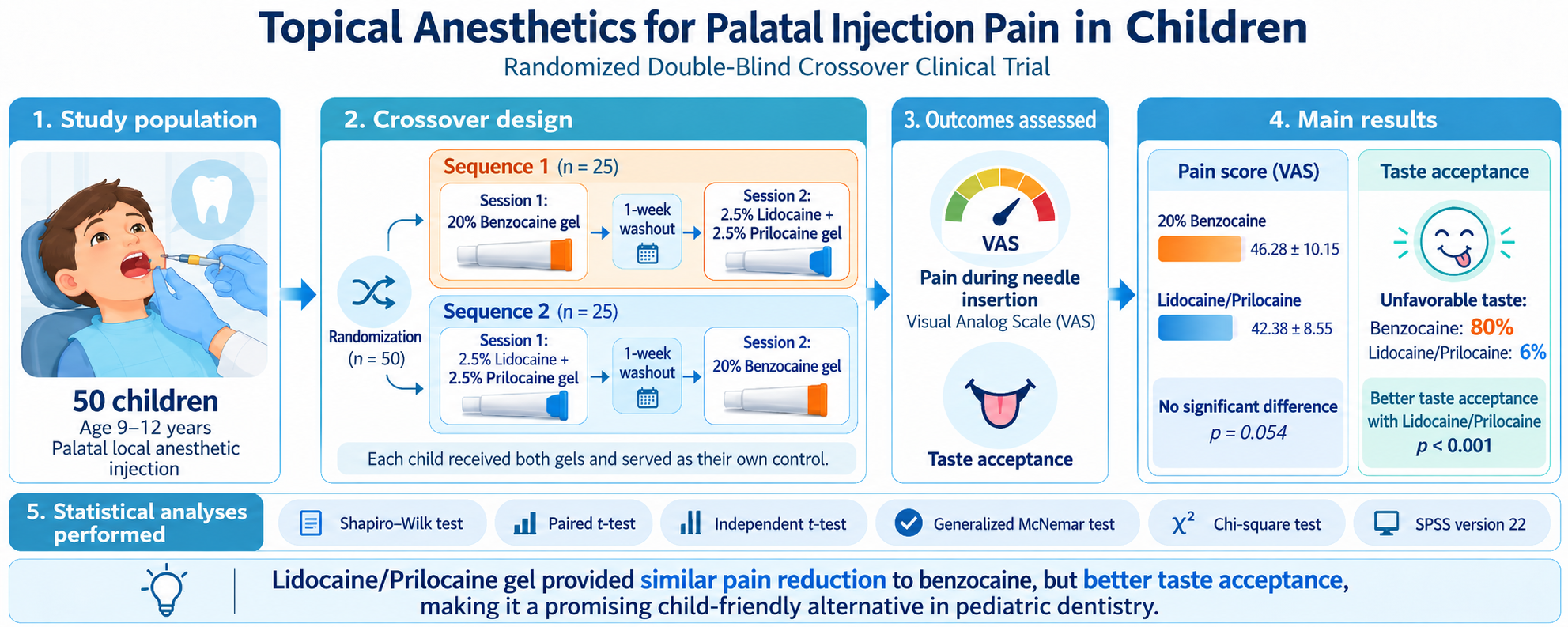
Background and purpose: Pain and anxiety associated with local anaesthetic injections remain important challenges in paediatric dentistry, particularly during palatal injections. Given the inconsistent evidence regarding the comparative effectiveness of topical anaesthetic agents, this study aimed to compare the effectiveness of 2.5% lidocaine/2.5% prilocaine gel and 20% benzocaine gel in reducing injection-related pain and to compare their taste acceptability in children aged 9-12 years.
Materials and methods: This randomised, double-blind, crossover trial included 50 children aged 9-12 years. Each participant received both topical anaesthetic gels in a randomised sequence during two separate treatment sessions, with a one-week washout period between sessions. Pain associated with needle insertion during palatal injection was assessed immediately after injection using the visual analogue scale (VAS). Taste acceptability was assessed based on the children's reported responses to each gel. Data were analysed using SPSS version 22. Between-treatment differences in pain scores were analysed using a paired t-test, while taste acceptability was compared using the generalised McNemar test. Statistical significance was set at P < 0.05.
Results: The mean VAS pain scores were 46.28 ± 10.15 for 20% benzocaine gel and 42.38 ± 8.55 for 2.5% lidocaine/2.5% prilocaine gel. Although the mean pain score was numerically lower with lidocaine/prilocaine gel, the difference between treatments was not statistically significant (reported 95% CI: -0.06 to 7.86; P = 0.054). Taste acceptability differed significantly between the two gels (P < 0.001), with unfavourable taste reported more frequently following the use of benzocaine gel.
Conclusion: The 2.5% lidocaine/2.5% prilocaine gel and 20% benzocaine gel did not differ significantly in their effectiveness in reducing pain associated with palatal injections in children aged 9-12 years. However, lidocaine/prilocaine gel had better taste acceptability and may therefore be a useful alternative to benzocaine gel in paediatric dentistry.
(Clinical Trials Registry Number: IRCT20250715066500N1)
Keywords: EMLA, benzocaine, lidocaine, prilocaine, topical anaesthetics, paediatric dentistry, palatal injection, pain control
Type of Study: Research(Original) |
Subject:
Pediatric Dentistry
Send email to the article author
| Rights and permissions | |
 |
This work is licensed under a Creative Commons Attribution-NonCommercial 4.0 International License. |

Articles Copyright © The Author(s). Owned by Mazandaran University of Medical Sciences.
Contact Us
Address: Journal Office, Building No. 2, Mazandaran University of Medical Sciences, Moallem Square, Sari.Tel: +98 (011)34484874 Postal code: 48175-866 E-Mail: jmums@mazums.ac.ir Telefax: +98 (011)33262679
