




BibTeX | RIS | EndNote | Medlars | ProCite | Reference Manager | RefWorks
Send citation to:


URL: http://jmums.mazums.ac.ir/article-1-23165-en.html

 , Mohammadjavad Roshanfekr * , Fatemeh Ghaffari Rad , Mohammadreza Sadr , Alireza Mogharrar
Background and purpose: Datura stramonium poisoning, caused by its potent anticholinergic alkaloids, can manifest as acute psychosis and may be mistaken for a primary psychiatric disorder. This report highlights the diagnostic challenges and management considerations associated with this poisoning in an older patient who ingested the plant for self-medication.
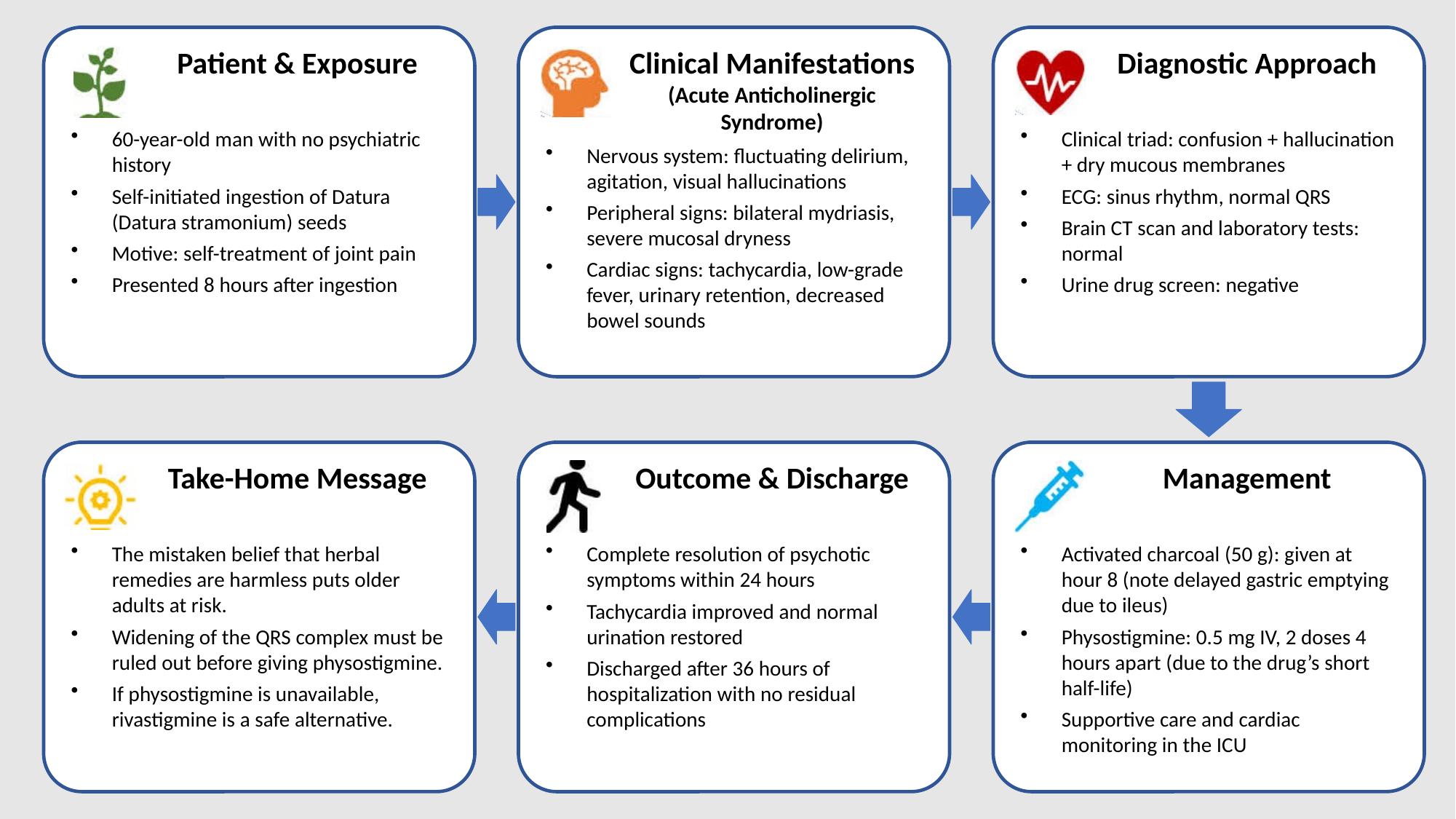
Case Presentation: A 60-year-old man with no previous psychiatric history chewed and swallowed an unknown number of Datura stramonium seeds in an attempt to relieve joint pain. He was brought to the emergency department 8 hours later with confusion, delirium, and visual and auditory hallucinations (Glasgow Coma Scale [GCS] score: 13). Physical examination revealed tachycardia (125 beats/min), low-grade fever (37.8 °C), bilateral fixed, dilated pupils, severe mucosal dryness, warm, dry skin, decreased bowel sounds, and urinary retention (800 mL). Urine toxicology screening was negative, and brain computed tomography (CT) showed no abnormalities. The diagnosis was established on the basis of the exposure history and the characteristic clinical triad of confusion, hallucinations, and dryness. Management included supportive care (continuous cardiac monitoring, intravenous fluid administration, urinary catheterisation, and temperature control), activated charcoal, and slow intravenous administration of physostigmine following confirmation of a normal QRS duration. There was marked improvement in the patient's mental status and tachycardia within 10-15 minutes. Owing to mild recurrence of symptoms, a second dose was administered 4 hours later. Following 36 hours of hospitalisation, including monitoring in the intensive care unit (ICU), the patient was discharged fully alert and with no residual complications.
Conclusion: Anticholinergic poisoning should be considered in patients presenting with acute-onset psychosis accompanied by mydriasis and dry mucous membranes. A negative urine toxicology screen does not exclude anticholinergic poisoning, and a thorough history of possible plant exposure is essential. When administered under appropriate monitoring conditions, physostigmine is an effective diagnostic and therapeutic agent. The misconception that natural plants are inherently harmless may expose individuals, including older adults, to serious toxic effects.
| Rights and permissions | |
 |
This work is licensed under a Creative Commons Attribution-NonCommercial 4.0 International License. |

Articles Copyright © The Author(s). Owned by Mazandaran University of Medical Sciences.
Contact Us
Address: Journal Office, Building No. 2, Mazandaran University of Medical Sciences, Moallem Square, Sari.Tel: +98 (011)34484874 Postal code: 48175-866 E-Mail: jmums@mazums.ac.ir Telefax: +98 (011)33262679
