

Volume 36, Issue 263 (11-2026)
J Mazandaran Univ Med Sci 2026, 36(263): 315-329 |
Back to browse issues page



Download citation:
BibTeX | RIS | EndNote | Medlars | ProCite | Reference Manager | RefWorks
Send citation to:


BibTeX | RIS | EndNote | Medlars | ProCite | Reference Manager | RefWorks
Send citation to:
Emadi Majd F S, Kashi Z, Molania T, Langari S F. Oral Health and Diabetes Mellitus: A Narrative Review of the Bidirectional Association, Shared Pathophysiological Mechanisms, and Clinical Implications. , J Mazandaran Univ Med Sci. 2026; 36 (263) :315-329
URL: http://jmums.mazums.ac.ir/article-1-23374-en.html
URL: http://jmums.mazums.ac.ir/article-1-23374-en.html


Abstract: (25 Views)
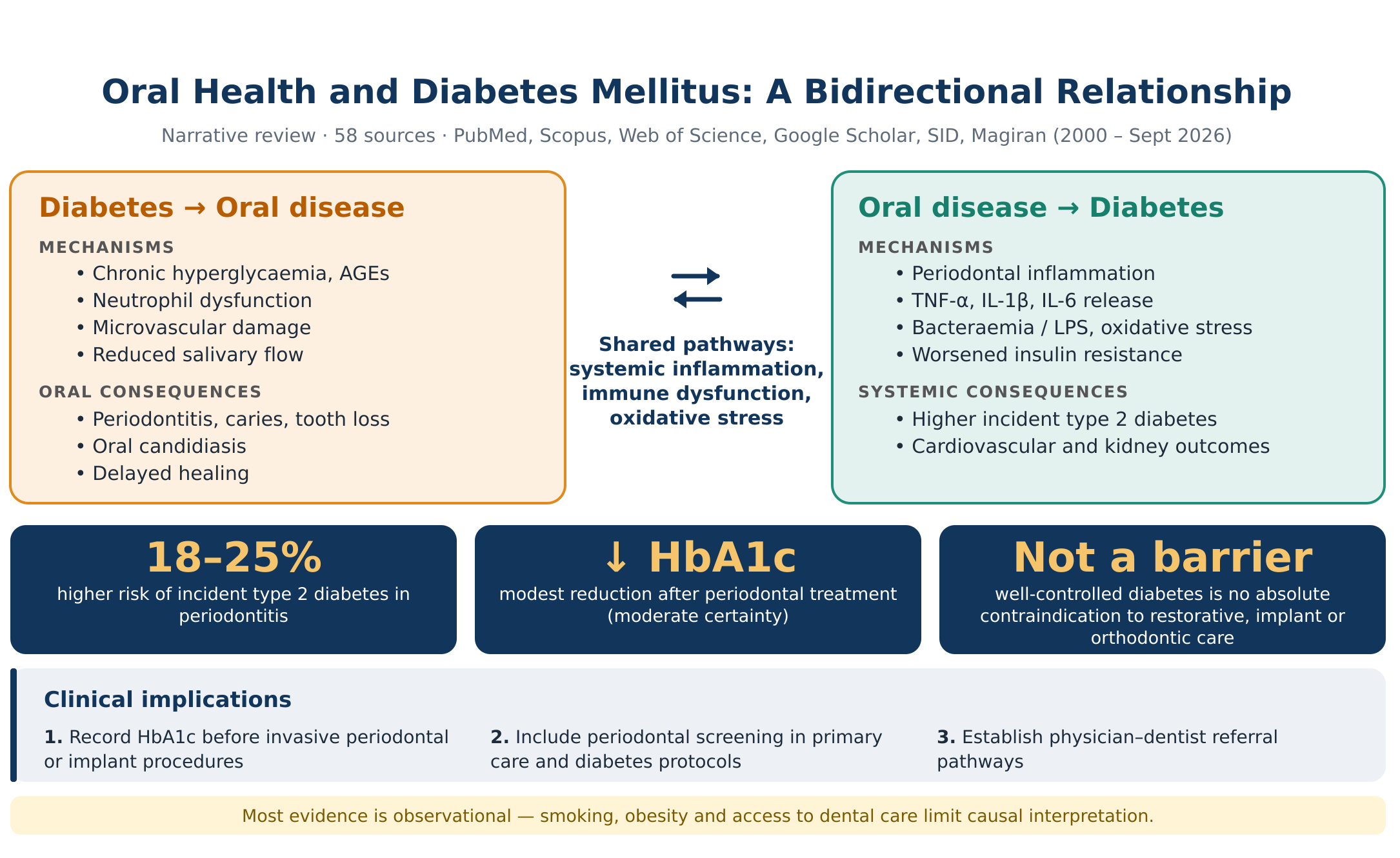
Background and purpose: Diabetes mellitus and oral diseases are common public health problems that share several underlying pathophysiological mechanisms, including systemic inflammation, immune dysfunction and oxidative stress. However, oral health is often overlooked in routine diabetes management. This narrative review aimed to examine the bidirectional association between diabetes and oral health, explore the underlying shared pathophysiological mechanisms, and discuss their clinical implications.
Materials and methods: PubMed, Scopus, Web of Science, Google Scholar, SID and Magiran were searched for relevant literature published between January 2000 and September 2026, using Medical Subject Headings (MeSH) terms and keywords combined using Boolean operators (AND and OR). Conference abstracts, articles for which full texts were unavailable, and duplicate records were excluded. A total of 58 sources were included in the qualitative synthesis.
Results: Chronic hyperglycaemia increases susceptibility to periodontitis, dental caries, candidiasis and delayed wound healing through mechanisms involving advanced glycation end-products (AGEs), neutrophil dysfunction, microvascular damage and reduced salivary flow. Conversely, periodontal inflammation promotes the release of pro-inflammatory cytokines, including TNF-α, IL-1β and IL-6, which may contribute to insulin resistance. Longitudinal studies have reported a 19-26% increase in the risk of developing type 2 diabetes among individuals with periodontitis. Periodontal treatment is associated with a modest reduction in HbA1c, although the certainty of the supporting evidence is moderate. Periodontitis and tooth loss are also associated with an increased risk of cardiovascular outcomes and chronic kidney disease. Well-controlled diabetes is not an absolute contraindication to restorative, implant or orthodontic treatment. Saliva and the oral microbiome are emerging areas of research with potential applications in metabolic monitoring. However, most available evidence is observational, and confounding factors, including smoking, obesity and access to dental care, limit causal interpretation.
Conclusion: Diabetes and oral diseases are bidirectionally associated, although causal relationships and the effects of dental interventions on systemic health outcomes remain incompletely established. The integration of oral health assessment into diabetes care is warranted. Recommended measures include documenting HbA1c levels before invasive periodontal and implant procedures, incorporating periodontal screening into primary care and diabetes management protocols, and establishing effective referral pathways between physicians and dental professionals.
Keywords: diabetes mellitus, periodontitis, oral health, bidirectional association, saliva, xerostomia, dental caries, tooth loss, oral candidiasis, glycaemic control
Send email to the article author
| Rights and permissions | |
 |
This work is licensed under a Creative Commons Attribution-NonCommercial 4.0 International License. |

Articles Copyright © The Author(s). Owned by Mazandaran University of Medical Sciences.
Contact Us
Address: Journal Office, Building No. 2, Mazandaran University of Medical Sciences, Moallem Square, Sari.Tel: +98 (011)34484874 Postal code: 48175-866 E-Mail: jmums@mazums.ac.ir Telefax: +98 (011)33262679
