

Volume 36, Issue 260 (9-2026)
J Mazandaran Univ Med Sci 2026, 36(260): 94-104 |
Back to browse issues page



Download citation:
BibTeX | RIS | EndNote | Medlars | ProCite | Reference Manager | RefWorks
Send citation to:


BibTeX | RIS | EndNote | Medlars | ProCite | Reference Manager | RefWorks
Send citation to:
Rahmati Kukandeh M, Fakhteh R, Shokrzadeh M. Investigatig of the Effects of N-Acetylcysteine on Cyclophosphamide-Induced Oxidative Stress in HeLa Cells. J Mazandaran Univ Med Sci 2026; 36 (260) :94-104
URL: http://jmums.mazums.ac.ir/article-1-21342-en.html
URL: http://jmums.mazums.ac.ir/article-1-21342-en.html


Abstract: (21 Views)
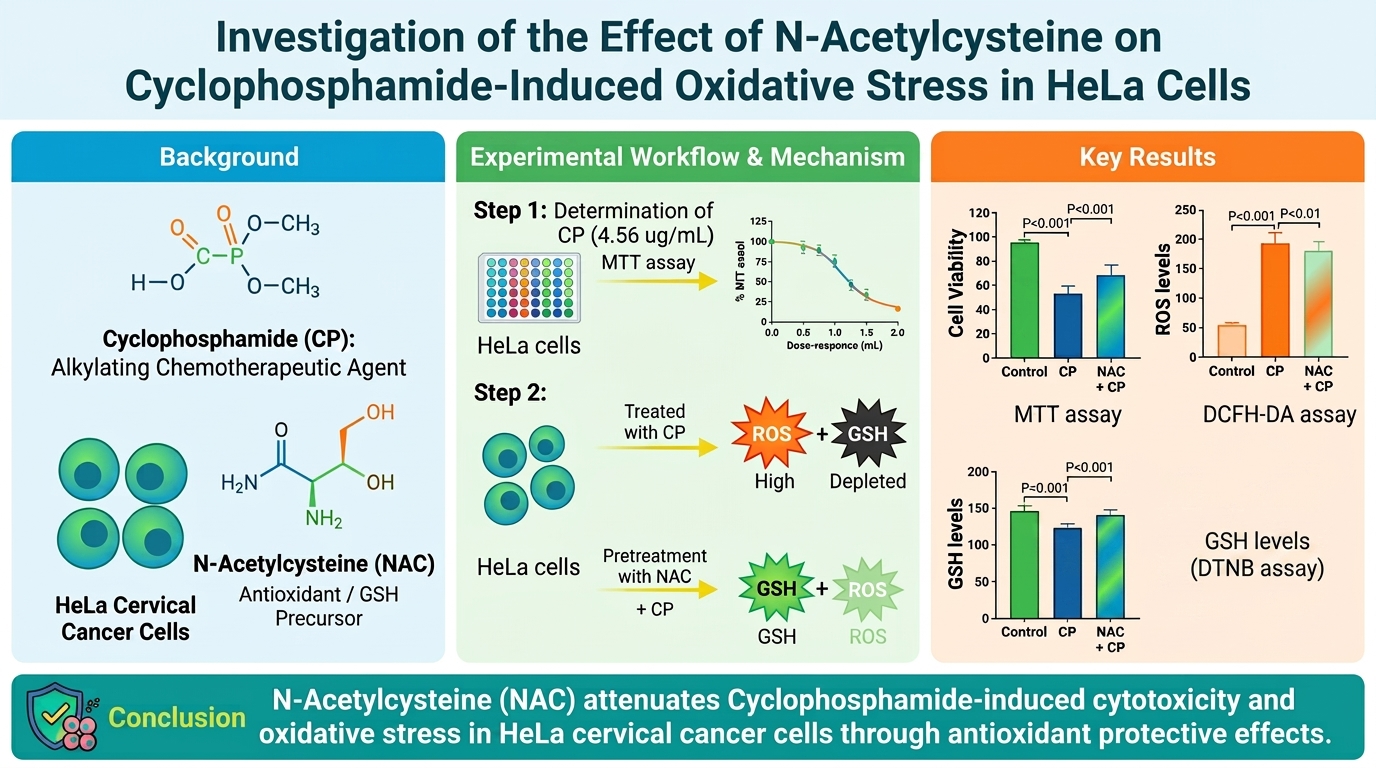
Background and purpose: Cyclophosphamide (CP) is an alkylating agent widely used in the treatment of hematological malignancies, various epithelial tumors, and certain non-malignant diseases. N-Acetylcysteine (NAC) is an antioxidant with free radical scavenging activity that helps restore intracellular reduced glutathione (GSH) levels, which are often depleted under conditions of increased oxidative stress and inflammation. Therefore, this study was designed to investigate the protective effect of N-acetylcysteine against cyclophosphamide-induced oxidative stress in the HeLa cell line.
Materials and methods: In the first phase of this study, HeLa cells were treated with increasing concentrations of cyclophosphamide, which was used as a cytotoxic model agent, to determine the optimal toxic concentration corresponding to the half-maximal inhibitory concentration (IC₅₀). Subsequently, the effects of different concentrations of N-acetylcysteine (NAC), administered as a pretreatment before exposure to cyclophosphamide at its IC₅₀ concentration, were evaluated. Cell viability and survival were assessed using the MTT assay, while oxidative stress was examined by measuring reactive oxygen species (ROS) levels and GSH content.
Results: Cyclophosphamide at a concentration of 4.56 µg/mL significantly reduced HeLa cell viability, increased ROS levels, and decreased GSH levels compared with the control group (P < 0.001). Pretreatment with NAC before cyclophosphamide exposure increased cell viability, reduced ROS production, and elevated GSH levels in a concentration-dependent manner. These changes were significant at NAC concentrations ranging from 31.25 to 250 µg/mL compared with cyclophosphamide treatment alone (P < 0.001).
Conclusion: The findings of this study suggest that N-acetylcysteine (NAC) may attenuate cyclophosphamide-induced cytotoxicity and oxidative stress in cervical cancer cells and may exert a protective effect.
Materials and methods: In the first phase of this study, HeLa cells were treated with increasing concentrations of cyclophosphamide, which was used as a cytotoxic model agent, to determine the optimal toxic concentration corresponding to the half-maximal inhibitory concentration (IC₅₀). Subsequently, the effects of different concentrations of N-acetylcysteine (NAC), administered as a pretreatment before exposure to cyclophosphamide at its IC₅₀ concentration, were evaluated. Cell viability and survival were assessed using the MTT assay, while oxidative stress was examined by measuring reactive oxygen species (ROS) levels and GSH content.
Results: Cyclophosphamide at a concentration of 4.56 µg/mL significantly reduced HeLa cell viability, increased ROS levels, and decreased GSH levels compared with the control group (P < 0.001). Pretreatment with NAC before cyclophosphamide exposure increased cell viability, reduced ROS production, and elevated GSH levels in a concentration-dependent manner. These changes were significant at NAC concentrations ranging from 31.25 to 250 µg/mL compared with cyclophosphamide treatment alone (P < 0.001).
Conclusion: The findings of this study suggest that N-acetylcysteine (NAC) may attenuate cyclophosphamide-induced cytotoxicity and oxidative stress in cervical cancer cells and may exert a protective effect.
Type of Study: Research(Original) |
Subject:
toxicology
Send email to the article author
| Rights and permissions | |
 |
This work is licensed under a Creative Commons Attribution-NonCommercial 4.0 International License. |

Articles Copyright © The Author(s). Owned by Mazandaran University of Medical Sciences.
Contact Us
Address: Journal Office, Building No. 2, Mazandaran University of Medical Sciences, Moallem Square, Sari.Tel: +98 (011)34484874 Postal code: 48175-866 E-Mail: jmums@mazums.ac.ir Telefax: +98 (011)33262679
