

Volume 36, Issue 260 (9-2026)
J Mazandaran Univ Med Sci 2026, 36(260): 160-169 |
Back to browse issues page



Download citation:
BibTeX | RIS | EndNote | Medlars | ProCite | Reference Manager | RefWorks
Send citation to:


BibTeX | RIS | EndNote | Medlars | ProCite | Reference Manager | RefWorks
Send citation to:
Pourabdollah F, Hosseinnataj A, Azimi Lolaty H. Investigating the Predictive Role of Perceived Parenting Styles in Active and Passive Procrastination Among Medical Students at Mazandaran University of Medical Sciences. J Mazandaran Univ Med Sci 2026; 36 (260) :160-169
URL: http://jmums.mazums.ac.ir/article-1-21666-en.html
URL: http://jmums.mazums.ac.ir/article-1-21666-en.html


Abstract: (23 Views)
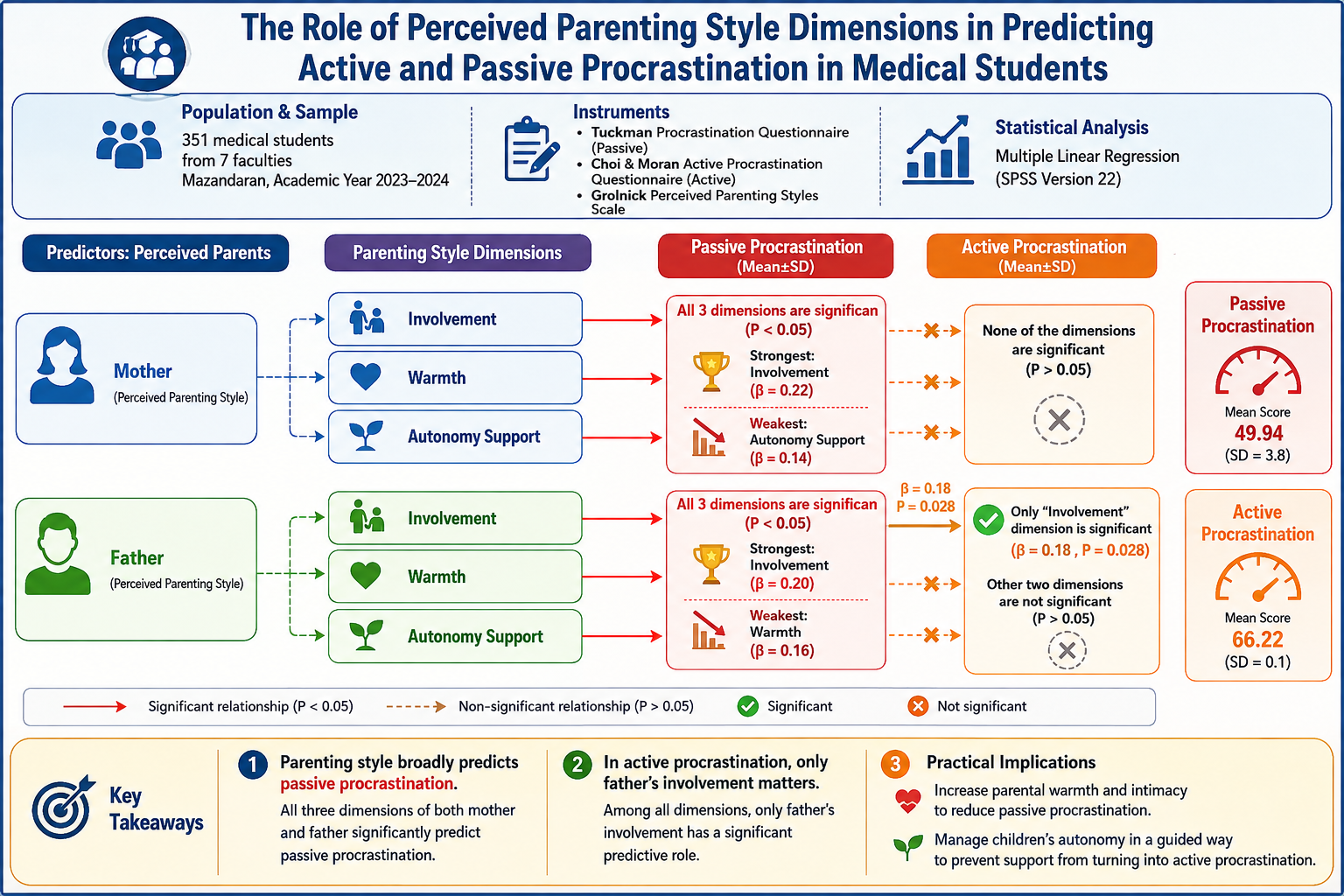
Background and purpose: Active and passive procrastination involve intentional and unintentional delays in completing important tasks, respectively, and may negatively affect academic performance and students’ psychological well-being. Given the influence of parenting styles on children’s personality and behaviour, this study examined the role of perceived parenting style dimensions in predicting the severity of procrastination among medical students at Mazandaran University of Medical Sciences during the 2023–2024 academic year.
Materials and methods: This cross-sectional, descriptive-analytical study involved 351 students from seven faculties, who were selected using multistage cluster random sampling. Data were collected using Tuckman’s Procrastination Scale, Choi and Moran’s Active Procrastination Scale, and Grolnick’s Perceived Parenting Styles Questionnaire and analyzed using SPSS version 22 and multiple linear regression.
Results: The mean passive and active procrastination scores were 49.94 ± 3.8 and 66.22 ± 0.1, respectively. The results showed that the three dimensions of parenting style differed in their ability to predict procrastination. For passive procrastination, all dimensions of both maternal and paternal parenting styles were significant predictors (P< 0.05). Among maternal parenting dimensions, involvement had the highest standardized beta coefficient (β = 0.22) and therefore the strongest predictive association, whereas autonomy support had the lowest (β = 0.14). Among paternal parenting dimensions, involvement had the highest standardized beta coefficient (β= 0.20), whereas warmth had the lowest (β= 0.16). In contrast, the parenting style dimensions had more limited predictive value for active procrastination. Only the involvement dimension of paternal parenting style was a significant predictor (β= 0.18, P= 0.028). None of the other dimensions of maternal or paternal parenting styles was significantly associated with active procrastination.
Conclusion: Perceived parenting style dimensions were associated with both active and passive procrastination, although their predictive patterns differed. Enhancing parental warmth and supporting children's autonomy appropriately may help reduce passive procrastination; however, further research is needed to determine whether these factors have a causal role in procrastination.
Materials and methods: This cross-sectional, descriptive-analytical study involved 351 students from seven faculties, who were selected using multistage cluster random sampling. Data were collected using Tuckman’s Procrastination Scale, Choi and Moran’s Active Procrastination Scale, and Grolnick’s Perceived Parenting Styles Questionnaire and analyzed using SPSS version 22 and multiple linear regression.
Results: The mean passive and active procrastination scores were 49.94 ± 3.8 and 66.22 ± 0.1, respectively. The results showed that the three dimensions of parenting style differed in their ability to predict procrastination. For passive procrastination, all dimensions of both maternal and paternal parenting styles were significant predictors (P< 0.05). Among maternal parenting dimensions, involvement had the highest standardized beta coefficient (β = 0.22) and therefore the strongest predictive association, whereas autonomy support had the lowest (β = 0.14). Among paternal parenting dimensions, involvement had the highest standardized beta coefficient (β= 0.20), whereas warmth had the lowest (β= 0.16). In contrast, the parenting style dimensions had more limited predictive value for active procrastination. Only the involvement dimension of paternal parenting style was a significant predictor (β= 0.18, P= 0.028). None of the other dimensions of maternal or paternal parenting styles was significantly associated with active procrastination.
Conclusion: Perceived parenting style dimensions were associated with both active and passive procrastination, although their predictive patterns differed. Enhancing parental warmth and supporting children's autonomy appropriately may help reduce passive procrastination; however, further research is needed to determine whether these factors have a causal role in procrastination.
Type of Study: Research(Original) |
Subject:
psychology
Send email to the article author
| Rights and permissions | |
 |
This work is licensed under a Creative Commons Attribution-NonCommercial 4.0 International License. |

Articles Copyright © The Author(s). Owned by Mazandaran University of Medical Sciences.
Contact Us
Address: Journal Office, Building No. 2, Mazandaran University of Medical Sciences, Moallem Square, Sari.Tel: +98 (011)34484874 Postal code: 48175-866 E-Mail: jmums@mazums.ac.ir Telefax: +98 (011)33262679
