

Volume 35, Issue 253 (1-2026)
J Mazandaran Univ Med Sci 2026, 35(253): 146-169 |
Back to browse issues page



Download citation:
BibTeX | RIS | EndNote | Medlars | ProCite | Reference Manager | RefWorks
Send citation to:


BibTeX | RIS | EndNote | Medlars | ProCite | Reference Manager | RefWorks
Send citation to:
Morshedi Yekta M, Bahrami Y, Maleki F, Kakaie E. Endophytic Actinobacteria: Emerging Sources of Bioactive Metabolites with Therapeutic Potential. J Mazandaran Univ Med Sci 2026; 35 (253) :146-169
URL: http://jmums.mazums.ac.ir/article-1-22283-en.html
URL: http://jmums.mazums.ac.ir/article-1-22283-en.html


Abstract: (30 Views)
Endophytic actinobacteria, which establish symbiotic relationships within plant tissues, are now recognized as prolific producers of structurally diverse secondary metabolites, including polyketides, terpenoids, alkaloids, and peptides, with activities ranging from potent antimicrobial and anticancer effects to plant growth promotion. In this comprehensive review, we present an integrative synthesis of over two decades of research, describing the taxonomic diversity, ecological significance, and biosynthetic capabilities of these microorganisms.
Our findings consolidate reports of 111 distinct metabolites isolated from endophytic actinobacteria, many of which exhibit strong activity against multidrug-resistant (MDR) pathogens or modulate critical disease pathways or display potent antibacterial, antifungal, anticancer, antimalarial, anti-inflammatory, and plant growth-promoting activities. Among these substances, polyketides emerged as the predominant class, reflecting the versatility and complexity of biosynthetic gene cluster (BGC) networks associated with the production of these compounds in endophytic actinobacteria, shaped by intimate host–microbe interactions and ecological adaptations, which indicates the high capability of these bacteria in the production of compounds with sophisticated chemical structures.
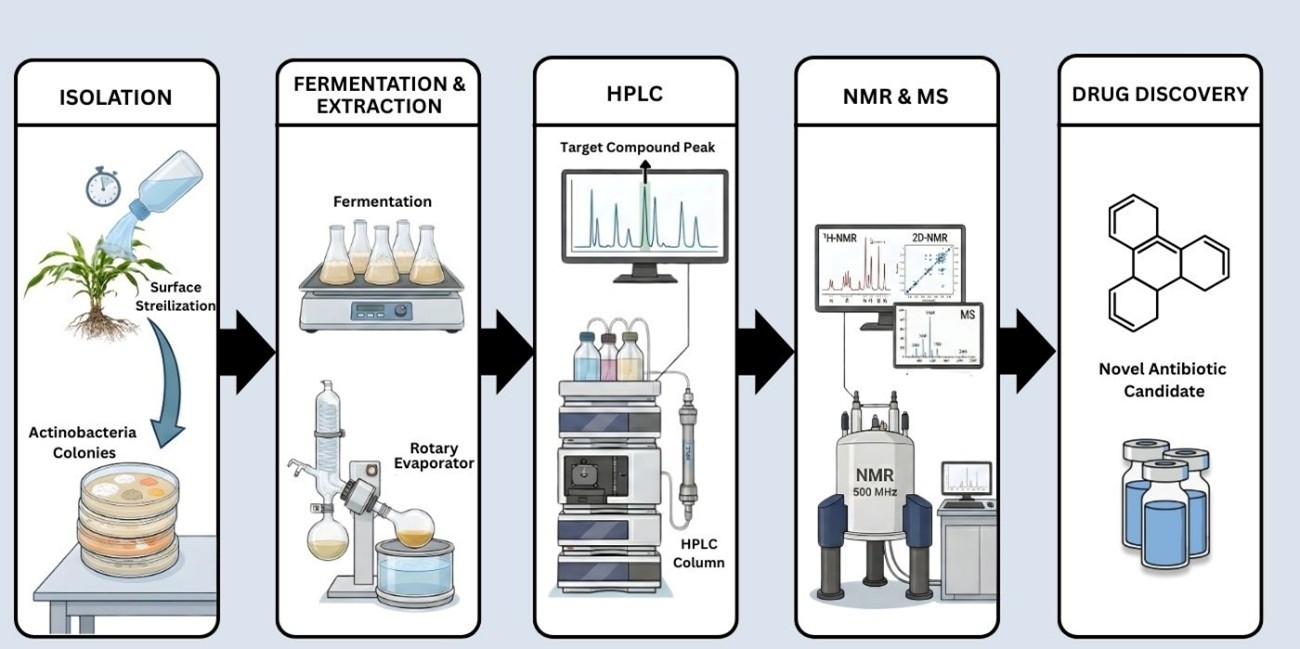
We also discuss recent advances in isolation strategies, cultivation approaches, genome mining, and co-cultivation techniques, and pathway engineering that have enabled the activation of silent biosynthetic gene clusters and the expansion of chemical space accessible from these microorganisms. Finally, this study not only addresses key challenges, including low culturability of many strains, host specificity, silent biosynthetic gene clusters, and scalability issues, but also explores a cutting-edge roadmap that integrates multi-omics, synthetic biology, ecological perspectives, and metabolic engineering for pathway activation and yield optimization to accelerate the translation of these natural products into next-generation therapeutics.
Our findings consolidate reports of 111 distinct metabolites isolated from endophytic actinobacteria, many of which exhibit strong activity against multidrug-resistant (MDR) pathogens or modulate critical disease pathways or display potent antibacterial, antifungal, anticancer, antimalarial, anti-inflammatory, and plant growth-promoting activities. Among these substances, polyketides emerged as the predominant class, reflecting the versatility and complexity of biosynthetic gene cluster (BGC) networks associated with the production of these compounds in endophytic actinobacteria, shaped by intimate host–microbe interactions and ecological adaptations, which indicates the high capability of these bacteria in the production of compounds with sophisticated chemical structures.
We also discuss recent advances in isolation strategies, cultivation approaches, genome mining, and co-cultivation techniques, and pathway engineering that have enabled the activation of silent biosynthetic gene clusters and the expansion of chemical space accessible from these microorganisms. Finally, this study not only addresses key challenges, including low culturability of many strains, host specificity, silent biosynthetic gene clusters, and scalability issues, but also explores a cutting-edge roadmap that integrates multi-omics, synthetic biology, ecological perspectives, and metabolic engineering for pathway activation and yield optimization to accelerate the translation of these natural products into next-generation therapeutics.
Keywords: Endophytic actinobacteria, secondary metabolites, polyketides, terpenoids, genome mining, antimicrobial resistance, drug discovery
Type of Study: Review |
Subject:
Pharmacognosy
Send email to the article author
| Rights and permissions | |
 |
This work is licensed under a Creative Commons Attribution-NonCommercial 4.0 International License. |

Articles Copyright © The Author(s). Owned by Mazandaran University of Medical Sciences.
Contact Us
Address: Journal Office, Building No. 2, Mazandaran University of Medical Sciences, Moallem Square, Sari.Tel: +98 (011)34484874 Postal code: 48175-866 E-Mail: jmums@mazums.ac.ir Telefax: +98 (011)33262679
