

Volume 35, Issue 253 (1-2026)
J Mazandaran Univ Med Sci 2026, 35(253): 110-128 |
Back to browse issues page



Download citation:
BibTeX | RIS | EndNote | Medlars | ProCite | Reference Manager | RefWorks
Send citation to:


BibTeX | RIS | EndNote | Medlars | ProCite | Reference Manager | RefWorks
Send citation to:
Hashempour Y, Zazouli M A, Jabari A. The Plastisphere: Microbial Communities and Their Role in Microplastic Biodegradation in Aquatic Environments: A Review
A Review. J Mazandaran Univ Med Sci 2026; 35 (253) :110-128
URL: http://jmums.mazums.ac.ir/article-1-22357-en.html
URL: http://jmums.mazums.ac.ir/article-1-22357-en.html


Abstract: (40 Views)
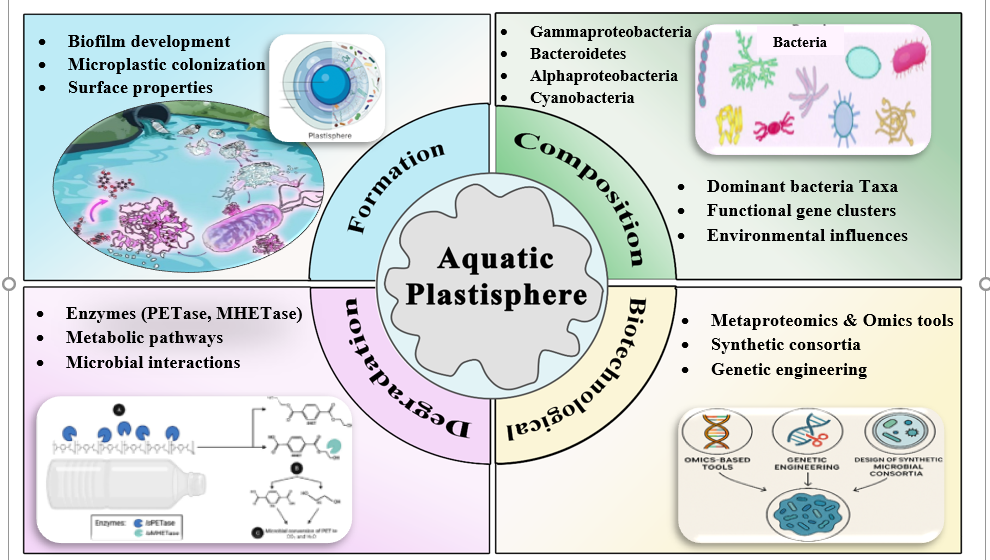
Microplastic pollution has become a major environmental concern in aquatic ecosystems, posing significant risks to biodiversity and public health. These polymeric particles originate either from the fragmentation of larger plastic debris or from direct industrial production and exhibit a strong capacity to adsorb contaminants, including heavy metals, pathogens, and persistent organic pollutants. The plastisphere refers to the complex microbial communities colonizing plastic surfaces, including bacteria, fungi, algae, and other microorganisms, and mediates their interactions with the surrounding environment. This review examines the role of plastisphere-associated microbial communities in the biodegradation of microplastics in aquatic environments, with a focus on microbial diversity, colonization dynamics, and enzymatic degradation mechanisms. The study was based on a review of articles published in PubMed, Scopus, Web of Science, and ScienceDirect up to July 2025. Keywords included “Microplastic,” “Plastisphere,” “Biodegradation,” and “Microbial Communities.” Only English-language, full-text studies addressing aquatic microbial communities and their biodegradation potential were included, whereas non-biological and terrestrial studies were excluded. Data were extracted and evaluated using the SANRA checklist. Plastisphere-associated microorganisms, such as cyanobacteria (Phormidium, Stanieria) and diatoms, play key roles in microplastic colonization and potential biodegradation.
Plastisphere-associated microorganisms, such as cyanobacteria (Phormidium, Stanieria), diatoms (Mastogloia, Nitzschia), and proteobacteria (Pseudomonas, Vibrio), form biofilms on microplastic (MP) surfaces and can utilize recalcitrant polymers, such as polyethylene and polypropylene, as carbon sources. These microbes secrete enzymes, including hydrolases and oxidoreductases, which facilitate the breakdown of polymers into simpler compounds such as carbon dioxide and water. Environmental factors, including salinity, temperature, and surface properties, strongly influence the composition of plastisphere communities. However, the enrichment of pathogenic taxa and the dissemination of antibiotic resistance genes raise ecological and public health concerns.
Overall, the findings underscore the significant potential of plastisphere microorganisms, particularly Pseudomonas and Bacillus species, in microplastic degradation. Future research should focus on identifying efficient strains, optimizing enzymatic activity, and developing biodegradable materials to support sustainable management of aquatic ecosystems.
Plastisphere-associated microorganisms, such as cyanobacteria (Phormidium, Stanieria), diatoms (Mastogloia, Nitzschia), and proteobacteria (Pseudomonas, Vibrio), form biofilms on microplastic (MP) surfaces and can utilize recalcitrant polymers, such as polyethylene and polypropylene, as carbon sources. These microbes secrete enzymes, including hydrolases and oxidoreductases, which facilitate the breakdown of polymers into simpler compounds such as carbon dioxide and water. Environmental factors, including salinity, temperature, and surface properties, strongly influence the composition of plastisphere communities. However, the enrichment of pathogenic taxa and the dissemination of antibiotic resistance genes raise ecological and public health concerns.
Overall, the findings underscore the significant potential of plastisphere microorganisms, particularly Pseudomonas and Bacillus species, in microplastic degradation. Future research should focus on identifying efficient strains, optimizing enzymatic activity, and developing biodegradable materials to support sustainable management of aquatic ecosystems.
Keywords: plastisphere, microplastic, biodegradation, microbial communities, aquatic environments, degrading enzymes, biofilm
Type of Study: Review |
Subject:
Environmental Health
Send email to the article author
| Rights and permissions | |
 |
This work is licensed under a Creative Commons Attribution-NonCommercial 4.0 International License. |

Articles Copyright © The Author(s). Owned by Mazandaran University of Medical Sciences.
Contact Us
Address: Journal Office, Building No. 2, Mazandaran University of Medical Sciences, Moallem Square, Sari.Tel: +98 (011)34484874 Postal code: 48175-866 E-Mail: jmums@mazums.ac.ir Telefax: +98 (011)33262679
