

Volume 35, Issue 252 (12-2025)
J Mazandaran Univ Med Sci 2025, 35(252): 4-17 |
Back to browse issues page


Download citation:
BibTeX | RIS | EndNote | Medlars | ProCite | Reference Manager | RefWorks
Send citation to:


BibTeX | RIS | EndNote | Medlars | ProCite | Reference Manager | RefWorks
Send citation to:
Saberi-Hasanabadi P, Saberi-Hasanabadi M, Aliyari Z, Ghazvini H, Akhtari J, Ebrahimnejad P et al . Investigating the synergistic effects of piperine and curcumin nanoparticles on learning disorders, spatial memory, and oxidative damage induced by methamphetamines in mice. J Mazandaran Univ Med Sci 2025; 35 (252) :4-17
URL: http://jmums.mazums.ac.ir/article-1-22402-en.html
URL: http://jmums.mazums.ac.ir/article-1-22402-en.html
Parisa Saberi-Hasanabadi 
 , Mohammad Saberi-Hasanabadi , Zahra Aliyari , Hamed Ghazvini , Javad Akhtari , Pedram Ebrahimnejad , Hamidreza Mohammadi
, Mohammad Saberi-Hasanabadi , Zahra Aliyari , Hamed Ghazvini , Javad Akhtari , Pedram Ebrahimnejad , Hamidreza Mohammadi
Abstract: (92 Views)
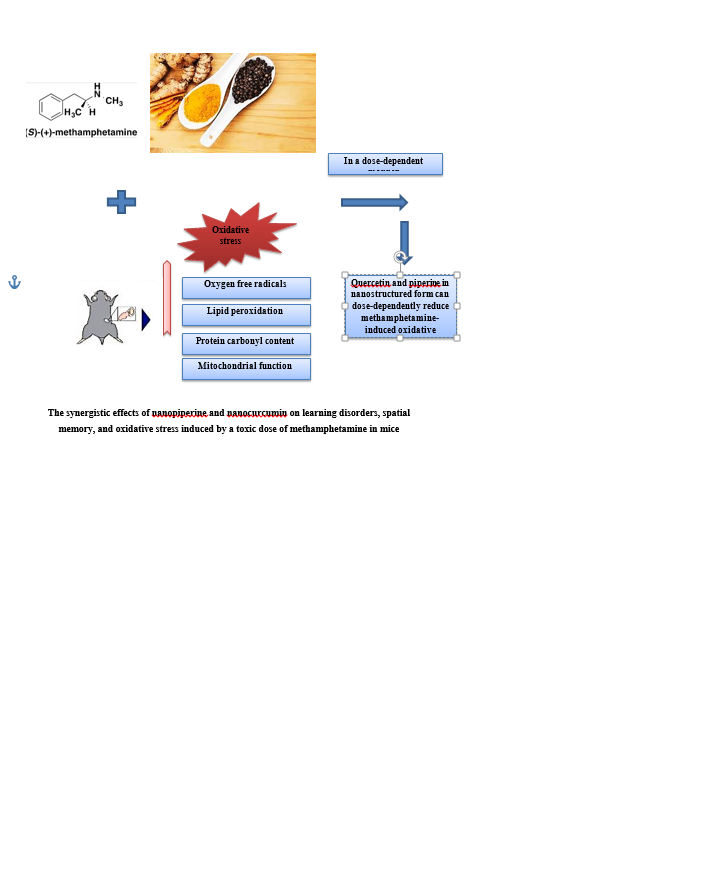
Background and purpose: The shift in drug consumption patterns from traditional compounds to industrial chemical substances and the use of stimulants and psychotropic substances is considered a serious problem. Industrial drugs are a combination of traditional drugs with chemical compounds, among which methamphetamine being a notable example. Due to the antioxidant effects and higher bioavailability of nanocurcumin and nanopiperine, this study investigated their synergistic effects on behavioral impairment, learning, and spatial memory through the reduction of oxidative stress induced by a toxic dose of methamphetamine.
Materials and methods: In this experimental study, 104 male mice were randomly divided into 13 groups and treated with curcumin and piperine nanoparticles. The acute toxicity of methamphetamine was evaluated in comparison with a control group. To assess learning and memory abilities, the Morris Water Maze (MWM) test was used. Additionally, key markers of oxidative stress, including glutathione (GSH), protein carbonyl levels (PC), lipid peroxidation (LPO), and reactive oxygen species (ROS), were measured. The MTT test was used to evaluate cellular metabolic activity.
Results: Methamphetamine significantly increased ROS levels, lipid peroxidation, protein carbonyls, while greatly reducing mitochondrial function and glutathione compared to the control group (p<0.001). Cellular function improved and oxidative stress decreased in the mice treated with curcumin and piperine.
Conclusion: This study demonstrated that methamphetamine causes alterations in spatial memory and learning impairment, and oxidative damage in mice, leading to increased ROS production and mitochondrial damage. In addition to enhancing cellular function and attenuating oxidative stress, curcumin and piperine exhibited protective effects against methamphetamine-induced toxicity. Notably, their nanostructured formulations demonstrated significantly greater protective efficacy, likely attributable to improved cellular permeability and enhanced antioxidant capacity.
Materials and methods: In this experimental study, 104 male mice were randomly divided into 13 groups and treated with curcumin and piperine nanoparticles. The acute toxicity of methamphetamine was evaluated in comparison with a control group. To assess learning and memory abilities, the Morris Water Maze (MWM) test was used. Additionally, key markers of oxidative stress, including glutathione (GSH), protein carbonyl levels (PC), lipid peroxidation (LPO), and reactive oxygen species (ROS), were measured. The MTT test was used to evaluate cellular metabolic activity.
Results: Methamphetamine significantly increased ROS levels, lipid peroxidation, protein carbonyls, while greatly reducing mitochondrial function and glutathione compared to the control group (p<0.001). Cellular function improved and oxidative stress decreased in the mice treated with curcumin and piperine.
Conclusion: This study demonstrated that methamphetamine causes alterations in spatial memory and learning impairment, and oxidative damage in mice, leading to increased ROS production and mitochondrial damage. In addition to enhancing cellular function and attenuating oxidative stress, curcumin and piperine exhibited protective effects against methamphetamine-induced toxicity. Notably, their nanostructured formulations demonstrated significantly greater protective efficacy, likely attributable to improved cellular permeability and enhanced antioxidant capacity.
Type of Study: Research(Original) |
Subject:
toxicology
| Rights and permissions | |
 |
This work is licensed under a Creative Commons Attribution-NonCommercial 4.0 International License. |

Articles Copyright © The Author(s). Owned by Mazandaran University of Medical Sciences.
Contact Us
Address: Journal Office, Building No. 2, Mazandaran University of Medical Sciences, Moallem Square, Sari.Tel: +98 (011)34484874 Postal code: 48175-866 E-Mail: jmums@mazums.ac.ir Telefax: +98 (011)33262679
