

Volume 35, Issue 253 (1-2026)
J Mazandaran Univ Med Sci 2026, 35(253): 32-41 |
Back to browse issues page



Download citation:
BibTeX | RIS | EndNote | Medlars | ProCite | Reference Manager | RefWorks
Send citation to:


BibTeX | RIS | EndNote | Medlars | ProCite | Reference Manager | RefWorks
Send citation to:
Mahboudi H, Salehinia A H, Sadeghi Ghadi Z. Extraction and Separation of Collagen from Fish Skin: A Comparative Evaluation of Processing Methods. J Mazandaran Univ Med Sci 2026; 35 (253) :32-41
URL: http://jmums.mazums.ac.ir/article-1-22411-en.html
URL: http://jmums.mazums.ac.ir/article-1-22411-en.html
Extraction and Separation of Collagen from Fish Skin: A Comparative Evaluation of Processing Methods


Abstract: (41 Views)
Background and purpose: Collagen has widespread applications across diverse fields, including tissue engineering, pharmaceutics, and the food industry. In recent years, the extraction of collagen from marine sources, particularly fish skin, has attracted increasing attention due to advantages such as biocompatibility and accessibility. Given the broad applications of collagen, its growing economic value in the global market, and the country’s reliance on imported sources of this protein, this study utilised modern extraction approaches, including homogenisation and protocol optimisation, to extract and purify type I collagen from minced rainbow trout (Oncorhynchus mykiss) skin.
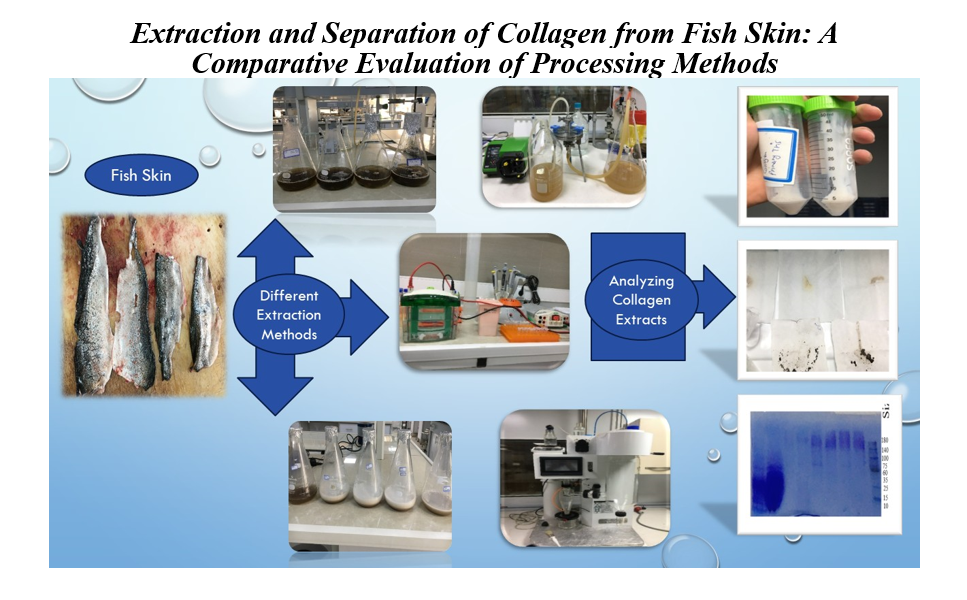
Materials and methods: This experimental study compared nine different extraction protocols for obtaining acid-soluble collagen (ASC) and pepsin-soluble collagen (PSC) from minced rainbow trout (Oncorhynchus mykiss) skin. The principal procedures included alkaline pretreatment with 0.1 M NaOH, defatting with 10% (v/v) butanol, extraction using 0.5 M acetic acid with or without pepsin, salting-out precipitation with 2 M NaCl, and centrifugation for precipitate recovery. Selected protocols incorporated homogenisation to enhance extraction yield. Collagen yield was calculated as the ratio of dry collagen weight to dry skin weight. In addition, sodium dodecyl sulfate–polyacrylamide gel electrophoresis (SDS-PAGE) was performed to characterise the extracted collagens following spray drying.
Results: The highest extraction yield (47.95%) was achieved using the optimised protocol incorporating homogenisation and pepsin treatment. The resulting collagen precipitates ranged in colour from white to light brown. SDS–PAGE analysis of both ASC and PSC revealed characteristic bands corresponding to α1 and α2 chains (approximately 110 kDa), β components (approximately 210 kDa), and low-molecular-weight smears below 25 kDa, consistent with type I collagen.
Conclusion: Type I collagen and its peptides were successfully extracted and purified from minced rainbow trout (Oncorhynchus mykiss) skin using nine different protocols, including both homogenised and non-homogenised approaches. The optimised method incorporating homogenisation and pepsin treatment produced the highest extraction yield.
Materials and methods: This experimental study compared nine different extraction protocols for obtaining acid-soluble collagen (ASC) and pepsin-soluble collagen (PSC) from minced rainbow trout (Oncorhynchus mykiss) skin. The principal procedures included alkaline pretreatment with 0.1 M NaOH, defatting with 10% (v/v) butanol, extraction using 0.5 M acetic acid with or without pepsin, salting-out precipitation with 2 M NaCl, and centrifugation for precipitate recovery. Selected protocols incorporated homogenisation to enhance extraction yield. Collagen yield was calculated as the ratio of dry collagen weight to dry skin weight. In addition, sodium dodecyl sulfate–polyacrylamide gel electrophoresis (SDS-PAGE) was performed to characterise the extracted collagens following spray drying.
Results: The highest extraction yield (47.95%) was achieved using the optimised protocol incorporating homogenisation and pepsin treatment. The resulting collagen precipitates ranged in colour from white to light brown. SDS–PAGE analysis of both ASC and PSC revealed characteristic bands corresponding to α1 and α2 chains (approximately 110 kDa), β components (approximately 210 kDa), and low-molecular-weight smears below 25 kDa, consistent with type I collagen.
Conclusion: Type I collagen and its peptides were successfully extracted and purified from minced rainbow trout (Oncorhynchus mykiss) skin using nine different protocols, including both homogenised and non-homogenised approaches. The optimised method incorporating homogenisation and pepsin treatment produced the highest extraction yield.
Type of Study: Research(Original) |
Subject:
Pharmaceutics
Send email to the article author
| Rights and permissions | |
 |
This work is licensed under a Creative Commons Attribution-NonCommercial 4.0 International License. |

Articles Copyright © The Author(s). Owned by Mazandaran University of Medical Sciences.
Contact Us
Address: Journal Office, Building No. 2, Mazandaran University of Medical Sciences, Moallem Square, Sari.Tel: +98 (011)34484874 Postal code: 48175-866 E-Mail: jmums@mazums.ac.ir Telefax: +98 (011)33262679
