

Volume 35, Issue 253 (1-2026)
J Mazandaran Univ Med Sci 2026, 35(253): 3-16 |
Back to browse issues page



Download citation:
BibTeX | RIS | EndNote | Medlars | ProCite | Reference Manager | RefWorks
Send citation to:


BibTeX | RIS | EndNote | Medlars | ProCite | Reference Manager | RefWorks
Send citation to:
Morteza-Semnani K, Ahmadipour S, Akbari J, Sohrab Rostamkalaei S, Saeedi K, Hashemi S M H et al . Preparation of Ascorbic Acid-Loaded Niosomes Using the Thin-Layer Hydration Method for Enhanced Percutaneous. J Mazandaran Univ Med Sci 2026; 35 (253) :3-16
URL: http://jmums.mazums.ac.ir/article-1-22484-en.html
URL: http://jmums.mazums.ac.ir/article-1-22484-en.html
Katayoun Morteza-Semnani 
 , Saghar Ahmadipour , Jafar Akbari , Seyyed Sohrab Rostamkalaei , Kimia Saeedi , Seyyed Mohammad Hasan Hashemi , Majid Saeedi
, Saghar Ahmadipour , Jafar Akbari , Seyyed Sohrab Rostamkalaei , Kimia Saeedi , Seyyed Mohammad Hasan Hashemi , Majid Saeedi
Abstract: (30 Views)
Background and purpose: Ascorbic acid is a crystalline, water-soluble powder that is used in topical preparations as an antioxidant, a skin lightener, a wound-healing agent, and an anti-wrinkle agent. However, skin penetration following topical administration is limited due to its hydrophilic characteristics and high-water solubility, and this challenge is further exacerbated by the vitamin’s low chemical stability in aqueous solutions. In this study, a niosomal delivery system was employed to enhance the skin permeability of ascorbic acid.
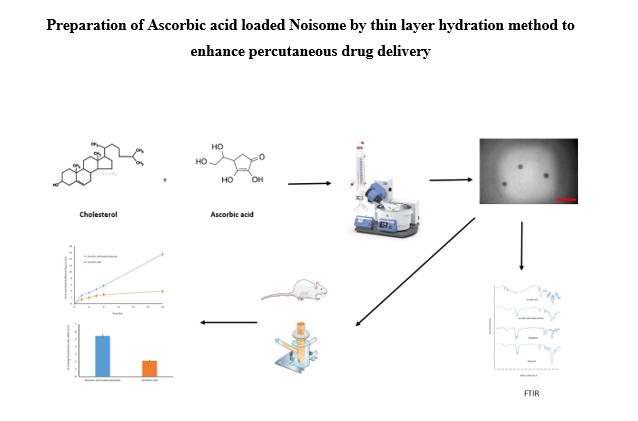
Materials and methods: In this experimental study, ascorbic acid-loaded niosomes were prepared by the thin-layer hydration method, followed by sonication. The effects of the surfactant system and the sonication process on nanoparticle properties were investigated. An optimal formulation, based on particle size, polydispersity index (PDI), zeta potential (ZP), and entrapment efficiency (EE), was selected for evaluation of transdermal absorption and drug release across a dialysis membrane.
Results: The results showed that the optimal formulation had a mean particle size of 168.15 ± 7.3 nm, a PDI of 0.31 ± 0.06, and an entrapment efficiency (EE) of 34.7 ± 5.2%. Transmission electron microscopy (TEM) images demonstrated the homogeneity and morphology of the niosomes. Attenuated total reflectance–Fourier transform infrared (ATR-FTIR) spectra and differential scanning calorimetry (DSC) thermograms showed successful drug loading without any chemical interactions. Drug release studies demonstrated a slow and controlled release pattern from ascorbic acid-loaded niosomes compared with the drug solution. Percutaneous absorption studies using rat abdominal skin in Franz diffusion cells showed enhanced skin penetration and increased skin retention after 24 h for ascorbic acid-loaded nanoparticles.
Conclusion: These results indicate that the niosomal system is a suitable and stable delivery vehicle for the topical delivery of ascorbic acid.
Materials and methods: In this experimental study, ascorbic acid-loaded niosomes were prepared by the thin-layer hydration method, followed by sonication. The effects of the surfactant system and the sonication process on nanoparticle properties were investigated. An optimal formulation, based on particle size, polydispersity index (PDI), zeta potential (ZP), and entrapment efficiency (EE), was selected for evaluation of transdermal absorption and drug release across a dialysis membrane.
Results: The results showed that the optimal formulation had a mean particle size of 168.15 ± 7.3 nm, a PDI of 0.31 ± 0.06, and an entrapment efficiency (EE) of 34.7 ± 5.2%. Transmission electron microscopy (TEM) images demonstrated the homogeneity and morphology of the niosomes. Attenuated total reflectance–Fourier transform infrared (ATR-FTIR) spectra and differential scanning calorimetry (DSC) thermograms showed successful drug loading without any chemical interactions. Drug release studies demonstrated a slow and controlled release pattern from ascorbic acid-loaded niosomes compared with the drug solution. Percutaneous absorption studies using rat abdominal skin in Franz diffusion cells showed enhanced skin penetration and increased skin retention after 24 h for ascorbic acid-loaded nanoparticles.
Conclusion: These results indicate that the niosomal system is a suitable and stable delivery vehicle for the topical delivery of ascorbic acid.
Type of Study: Research(Original) |
Subject:
Pharmaceutics
Send email to the article author
| Rights and permissions | |
 |
This work is licensed under a Creative Commons Attribution-NonCommercial 4.0 International License. |

Articles Copyright © The Author(s). Owned by Mazandaran University of Medical Sciences.
Contact Us
Address: Journal Office, Building No. 2, Mazandaran University of Medical Sciences, Moallem Square, Sari.Tel: +98 (011)34484874 Postal code: 48175-866 E-Mail: jmums@mazums.ac.ir Telefax: +98 (011)33262679
