

Volume 36, Issue 260 (9-2026)
J Mazandaran Univ Med Sci 2026, 36(260): 234-248 |
Back to browse issues page



Download citation:
BibTeX | RIS | EndNote | Medlars | ProCite | Reference Manager | RefWorks
Send citation to:


BibTeX | RIS | EndNote | Medlars | ProCite | Reference Manager | RefWorks
Send citation to:
Moradi M, Pazhouhi M, Amini M, Shahveisi K. Plant Compounds Targeting the PI3K/Akt/mTOR Pathway in Cancer: A Systematic Review of Preclinical Studies. J Mazandaran Univ Med Sci 2026; 36 (260) :234-248
URL: http://jmums.mazums.ac.ir/article-1-22578-en.html
URL: http://jmums.mazums.ac.ir/article-1-22578-en.html


Abstract: (13 Views)
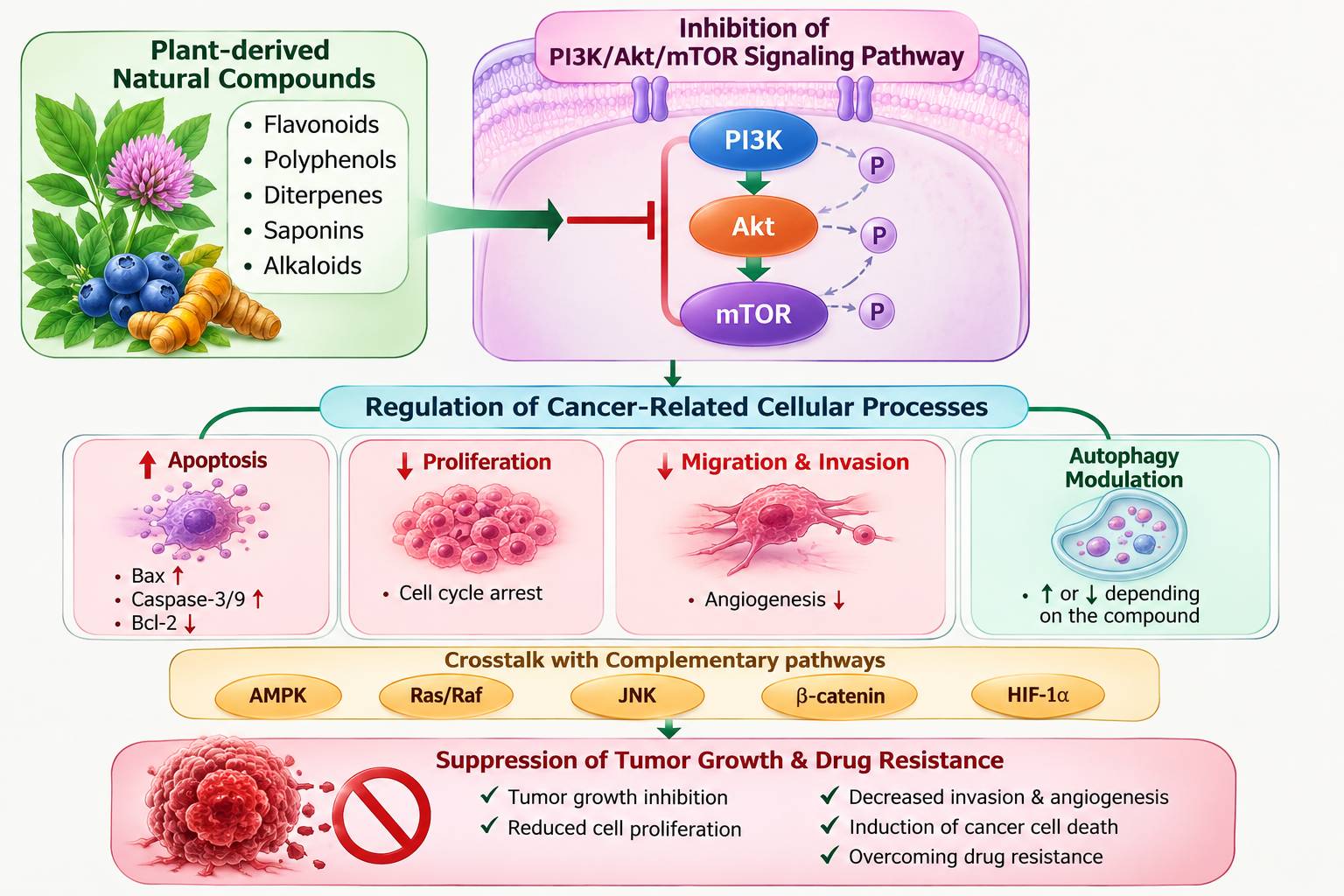
Background and purpose: The PI3K/Akt/mTOR pathway is one of the major signaling pathways involved in cancer and plays a role in tumor cell growth, proliferation, survival, metabolism, invasion, and drug resistance. Inhibition of this pathway may therefore represent an effective multitargeted strategy for controlling tumor progression. Plant-derived compounds have attracted increasing attention because of their potentially favorable safety profiles and ability to modulate multiple molecular targets. This study aimed to conduct a systematic review of plant-derived compounds that modulate the PI3K/Akt/mTOR pathway and to evaluate their potential roles in cancer inhibition.
Materials and methods: A systematic search was conducted in the PubMed, Scopus, Web of Science, and Google Scholar databases for articles published from 2009 to 2025. A total of 34 studies were included, of which 29 used in vitro cell models, four used in vivo animal models, and one combined in silico and in vitro approaches. Therapeutic mechanisms and the effects of the identified compounds were evaluated primarily on the basis of cell and animal studies.
Results: The results showed that a wide variety of plant-derived compounds can directly or indirectly inhibit components of the PI3K/Akt/mTOR pathway. The main effects of pathway inhibition included induction of mitochondrial apoptosis, suppression of cell proliferation and cell cycle arrest, modulation of autophagy, reduced migration and invasion, inhibition of angiogenesis, and suppression of tumor growth. In addition to the PI3K/Akt/mTOR pathway, some compounds also modulated related signaling pathways, including AMPK, Ras/Raf, JNK, β-catenin, and HIF-1α. The limited number of animal studies also reported reductions in tumor volume.
Conclusion: Inhibition of the PI3K/Akt/mTOR pathway appears to be an important mechanism underlying the anticancer effects of several plant-derived compounds. By simultaneously targeting multiple molecular pathways, these compounds may inhibit tumor cell proliferation, promote cell death, reduce invasion, and potentially overcome drug resistance. However, the available evidence is predominantly based on in vitro studies, highlighting the need for further in vivo and clinical research to establish their therapeutic potential.
Materials and methods: A systematic search was conducted in the PubMed, Scopus, Web of Science, and Google Scholar databases for articles published from 2009 to 2025. A total of 34 studies were included, of which 29 used in vitro cell models, four used in vivo animal models, and one combined in silico and in vitro approaches. Therapeutic mechanisms and the effects of the identified compounds were evaluated primarily on the basis of cell and animal studies.
Results: The results showed that a wide variety of plant-derived compounds can directly or indirectly inhibit components of the PI3K/Akt/mTOR pathway. The main effects of pathway inhibition included induction of mitochondrial apoptosis, suppression of cell proliferation and cell cycle arrest, modulation of autophagy, reduced migration and invasion, inhibition of angiogenesis, and suppression of tumor growth. In addition to the PI3K/Akt/mTOR pathway, some compounds also modulated related signaling pathways, including AMPK, Ras/Raf, JNK, β-catenin, and HIF-1α. The limited number of animal studies also reported reductions in tumor volume.
Conclusion: Inhibition of the PI3K/Akt/mTOR pathway appears to be an important mechanism underlying the anticancer effects of several plant-derived compounds. By simultaneously targeting multiple molecular pathways, these compounds may inhibit tumor cell proliferation, promote cell death, reduce invasion, and potentially overcome drug resistance. However, the available evidence is predominantly based on in vitro studies, highlighting the need for further in vivo and clinical research to establish their therapeutic potential.
Type of Study: Review |
Subject:
general practitioner
Send email to the article author
| Rights and permissions | |
 |
This work is licensed under a Creative Commons Attribution-NonCommercial 4.0 International License. |

Articles Copyright © The Author(s). Owned by Mazandaran University of Medical Sciences.
Contact Us
Address: Journal Office, Building No. 2, Mazandaran University of Medical Sciences, Moallem Square, Sari.Tel: +98 (011)34484874 Postal code: 48175-866 E-Mail: jmums@mazums.ac.ir Telefax: +98 (011)33262679
