

Volume 36, Issue 260 (9-2026)
J Mazandaran Univ Med Sci 2026, 36(260): 139-150 |
Back to browse issues page



Download citation:
BibTeX | RIS | EndNote | Medlars | ProCite | Reference Manager | RefWorks
Send citation to:


BibTeX | RIS | EndNote | Medlars | ProCite | Reference Manager | RefWorks
Send citation to:
Safaie A, Bagherpour A, Bayat M, Salehi M, Ebrahimi Kelachaye M. Evaluation of the Relationship Between Sex and Mastoid Process Dimensions in an Iranian Population Using Computed Tomography Scans. J Mazandaran Univ Med Sci 2026; 36 (260) :139-150
URL: http://jmums.mazums.ac.ir/article-1-22657-en.html
URL: http://jmums.mazums.ac.ir/article-1-22657-en.html


Abstract: (21 Views)
Background and purpose: The mastoid process, a part of the temporal bone, is resistant to physical damage and can be used for sex determination in forensic medicine in cases involving severe burns or advanced decomposition. Given the influence of ethnic and racial differences on skeletal morphology, population-specific studies are essential. This research aimed to investigate the relationship between sex and mastoid process dimensions in an Iranian population using computed tomography (CT) images.
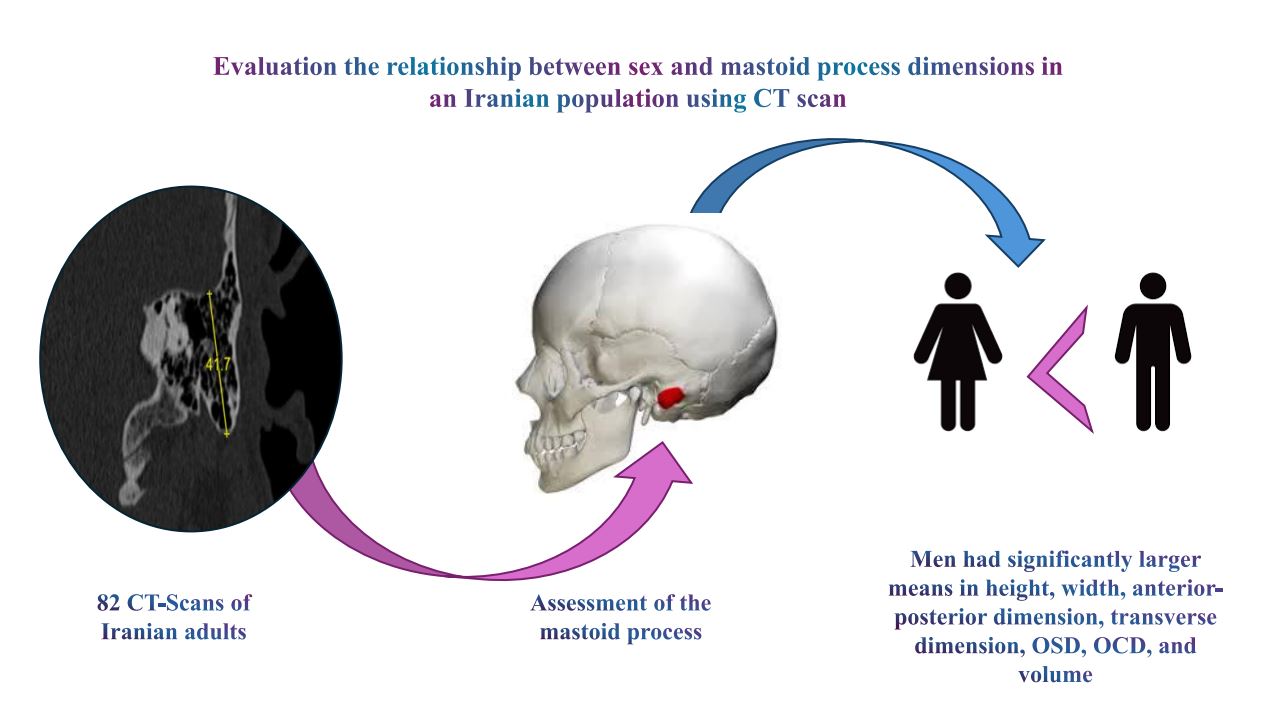
Materials and methods: This analytical cross-sectional study was conducted on 82 Iranian individuals (49 males and 33 females) aged 18 to 92 years who underwent head CT scans at a private radiology clinic in Mashhad from November 2021 to July 2022. Measured variables included mastoid process height, mastoid width, greatest anteroposterior dimension, greatest transverse dimension, oblique sagittal dimension (OSD), oblique coronal dimension (OCD), mediolateral inclination angle, anterior inclination angle, and mastoid volume. Measurements were performed using 3DimViewer and Marco DICOM Viewer software, and data were analysed using appropriate statistical tests.
Results: Mean values of height, mastoid width, greatest anteroposterior dimension, greatest transverse dimension, OSD, OCD, and mastoid volume were significantly higher in males than in females (P < 0.05). The inclination angles did not differ significantly between males and females (P > 0.05). The best predictor of sex was mastoid width (P < 0.001). Overall sex determination accuracy using discriminant analysis was 80.5% (89.8% for males and 66.7% for females).
Conclusion: Measurement of mastoid process dimensions using CT scans can serve as a reliable, non-invasive method for sex determination in the Iranian population, particularly in forensic contexts.
Materials and methods: This analytical cross-sectional study was conducted on 82 Iranian individuals (49 males and 33 females) aged 18 to 92 years who underwent head CT scans at a private radiology clinic in Mashhad from November 2021 to July 2022. Measured variables included mastoid process height, mastoid width, greatest anteroposterior dimension, greatest transverse dimension, oblique sagittal dimension (OSD), oblique coronal dimension (OCD), mediolateral inclination angle, anterior inclination angle, and mastoid volume. Measurements were performed using 3DimViewer and Marco DICOM Viewer software, and data were analysed using appropriate statistical tests.
Results: Mean values of height, mastoid width, greatest anteroposterior dimension, greatest transverse dimension, OSD, OCD, and mastoid volume were significantly higher in males than in females (P < 0.05). The inclination angles did not differ significantly between males and females (P > 0.05). The best predictor of sex was mastoid width (P < 0.001). Overall sex determination accuracy using discriminant analysis was 80.5% (89.8% for males and 66.7% for females).
Conclusion: Measurement of mastoid process dimensions using CT scans can serve as a reliable, non-invasive method for sex determination in the Iranian population, particularly in forensic contexts.
Type of Study: Research(Original) |
Subject:
Dentistry
Send email to the article author
| Rights and permissions | |
 |
This work is licensed under a Creative Commons Attribution-NonCommercial 4.0 International License. |

Articles Copyright © The Author(s). Owned by Mazandaran University of Medical Sciences.
Contact Us
Address: Journal Office, Building No. 2, Mazandaran University of Medical Sciences, Moallem Square, Sari.Tel: +98 (011)34484874 Postal code: 48175-866 E-Mail: jmums@mazums.ac.ir Telefax: +98 (011)33262679
