

Volume 36, Issue 260 (9-2026)
J Mazandaran Univ Med Sci 2026, 36(260): 316-327 |
Back to browse issues page



Download citation:
BibTeX | RIS | EndNote | Medlars | ProCite | Reference Manager | RefWorks
Send citation to:


BibTeX | RIS | EndNote | Medlars | ProCite | Reference Manager | RefWorks
Send citation to:
Yazdani Charati J, Norzad F, Ghahari F, Jafari S, Alinasab Z. Strategies for Reducing Voluntary Discharge in Teaching Hospitals: Evidence from a Qualitative Study in Mazandaran Province, Iran. J Mazandaran Univ Med Sci 2026; 36 (260) :316-327
URL: http://jmums.mazums.ac.ir/article-1-23036-en.html
URL: http://jmums.mazums.ac.ir/article-1-23036-en.html


Abstract: (27 Views)
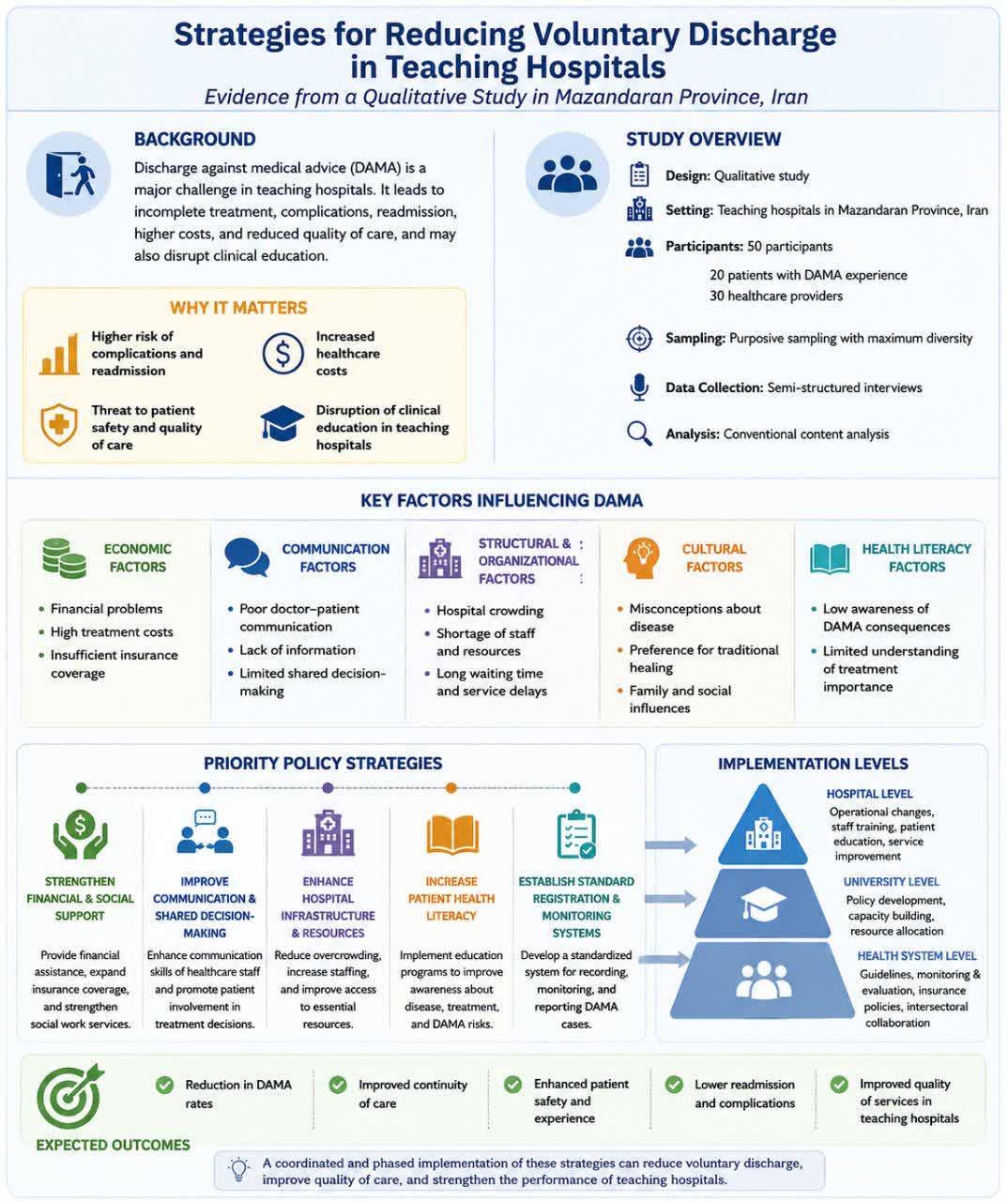
Discharge Against Medical Advice (DAMA) is a major challenge in teaching hospitals and may be associated with adverse outcomes, including incomplete continuity of care, disease complications, readmission, increased healthcare costs, and reduced quality of services. This policy brief was developed based on a qualitative study conducted in teaching hospitals in Mazandaran Province, Iran. The study included 50 participants, comprising 20 patients with previous experience of DAMA and 30 healthcare providers, who were selected using purposive maximum-variation sampling. Data were collected through semi-structured interviews and analyzed using conventional qualitative content analysis. The findings indicated that DAMA is a multifactorial phenomenon influenced by economic, communication, structural, organizational, cultural, and health literacy-related factors. The main contributing factors identified were patients’ financial difficulties, inadequate patient–provider communication, overcrowding and limited hospital resources, and insufficient patient awareness of the potential consequences of early discharge. Based on these findings, key policy strategies include strengthening financial support and social work services, enhancing healthcare providers’ communication and shared decision-making skills, improving hospital structural and organizational conditions, promoting patients’ health literacy, and establishing a standardized system for recording and monitoring DAMA. In addition, targeted education for patients and families, early identification of patients at risk of DAMA, and the use of communication interventions tailored to their needs may enhance the effectiveness of these measures. Prioritizing interventions according to their feasibility, effectiveness, and the actual needs of patients and hospitals can facilitate evidence-informed policymaking and appropriate resource allocation. Coordinated and phased implementation of these interventions at the hospital, medical university, and health-system levels may reduce DAMA, improve continuity of care, increase patient satisfaction, and enhance the quality of services in teaching hospitals.
Keywords: Discharge Against Medical Advice, Teaching Hospitals, Patient Discharge, Patient Satisfaction, Hospital Management, Quality of Health Care, Qualitative Study
Type of Study: Policy Brief |
Subject:
Health Services Management
Send email to the article author
| Rights and permissions | |
 |
This work is licensed under a Creative Commons Attribution-NonCommercial 4.0 International License. |

Articles Copyright © The Author(s). Owned by Mazandaran University of Medical Sciences.
Contact Us
Address: Journal Office, Building No. 2, Mazandaran University of Medical Sciences, Moallem Square, Sari.Tel: +98 (011)34484874 Postal code: 48175-866 E-Mail: jmums@mazums.ac.ir Telefax: +98 (011)33262679
