

Volume 36, Issue 260 (9-2026)
J Mazandaran Univ Med Sci 2026, 36(260): 170-184 |
Back to browse issues page



Download citation:
BibTeX | RIS | EndNote | Medlars | ProCite | Reference Manager | RefWorks
Send citation to:


BibTeX | RIS | EndNote | Medlars | ProCite | Reference Manager | RefWorks
Send citation to:
Kaveh O, Sharifi A, Fenderski A, Jafari H. The relationship between attitudes towards death and missed nursing care among intensive care unit nurses: A descriptive-analytical study. J Mazandaran Univ Med Sci 2026; 36 (260) :170-184
URL: http://jmums.mazums.ac.ir/article-1-23087-en.html
URL: http://jmums.mazums.ac.ir/article-1-23087-en.html


Abstract: (35 Views)
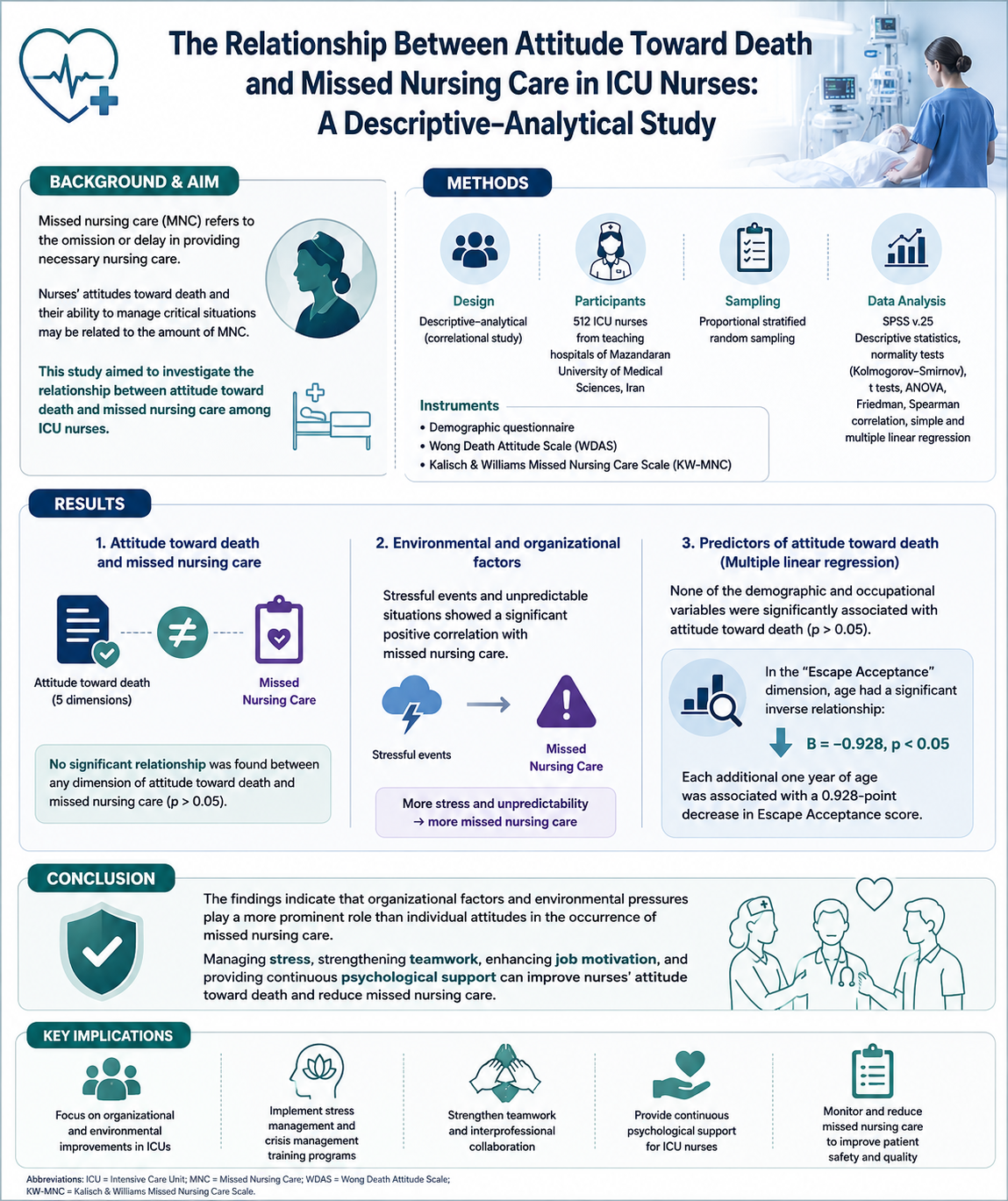
Background and purpose: Missed nursing care is one of the key concepts in the field of nursing care and patient safety. Since nurses’ attitudes toward death may be related to the extent of missed nursing care, this study aimed to investigate the relationship between attitudes toward death and missed nursing care among nurses working in intensive care units (ICUs).
Materials and methods: This descriptive–analytical correlational study was conducted among 215 ICU nurses working in teaching and treatment hospitals affiliated with Mazandaran University of Medical Sciences. Stratified random sampling proportional to the size of each hospital stratum was used. Data collection tools included a demographic characteristics form, the Wong et al. Death Attitude Profile-Revised (DAP-R), and the Kalisch and Williams Missed Nursing Care Questionnaire. Data were analyzed using SPSS version 26 through descriptive statistics, normality tests (Kolmogorov–Smirnov), comparative tests (independent t-test, ANOVA, and Friedman test), Spearman correlation, and simple and multiple linear regression analyses.
Results: None of the dimensions of attitudes toward death were significantly related to missed nursing care (P > 0.05). Stressful events and unpredictable situations had a positive and significant relationship with missed nursing care. The results of multivariate regression analysis showed that none of the demographic and occupational factors studied had a statistically significant relationship with the dimensions of attitudes toward death (P < 0.005). However, for the “escape acceptance” dimension, age had an inverse and significant relationship with the dimension score, such that each additional year of age was associated with an average decrease of 0.829 points in the score (B = -0.829, P = 0.005).
Conclusion: Organizational factors and environmental pressures may play a greater role than nurses’ individual attitudes in the occurrence of missed nursing care. Therefore, training courses on stress and crisis management, strengthening teamwork and job motivation, and providing continuous psychological support may help improve nurses’ attitudes toward death and reduce missed care.
Materials and methods: This descriptive–analytical correlational study was conducted among 215 ICU nurses working in teaching and treatment hospitals affiliated with Mazandaran University of Medical Sciences. Stratified random sampling proportional to the size of each hospital stratum was used. Data collection tools included a demographic characteristics form, the Wong et al. Death Attitude Profile-Revised (DAP-R), and the Kalisch and Williams Missed Nursing Care Questionnaire. Data were analyzed using SPSS version 26 through descriptive statistics, normality tests (Kolmogorov–Smirnov), comparative tests (independent t-test, ANOVA, and Friedman test), Spearman correlation, and simple and multiple linear regression analyses.
Results: None of the dimensions of attitudes toward death were significantly related to missed nursing care (P > 0.05). Stressful events and unpredictable situations had a positive and significant relationship with missed nursing care. The results of multivariate regression analysis showed that none of the demographic and occupational factors studied had a statistically significant relationship with the dimensions of attitudes toward death (P < 0.005). However, for the “escape acceptance” dimension, age had an inverse and significant relationship with the dimension score, such that each additional year of age was associated with an average decrease of 0.829 points in the score (B = -0.829, P = 0.005).
Conclusion: Organizational factors and environmental pressures may play a greater role than nurses’ individual attitudes in the occurrence of missed nursing care. Therefore, training courses on stress and crisis management, strengthening teamwork and job motivation, and providing continuous psychological support may help improve nurses’ attitudes toward death and reduce missed care.
Keywords: attitude toward death, intensive care nurses, missed nursing care, intensive care unit, death
Type of Study: Research(Original) |
Subject:
Nursing Education
Send email to the article author
| Rights and permissions | |
 |
This work is licensed under a Creative Commons Attribution-NonCommercial 4.0 International License. |

Articles Copyright © The Author(s). Owned by Mazandaran University of Medical Sciences.
Contact Us
Address: Journal Office, Building No. 2, Mazandaran University of Medical Sciences, Moallem Square, Sari.Tel: +98 (011)34484874 Postal code: 48175-866 E-Mail: jmums@mazums.ac.ir Telefax: +98 (011)33262679
