

Volume 36, Issue 260 (9-2026)
J Mazandaran Univ Med Sci 2026, 36(260): 249-257 |
Back to browse issues page



Download citation:
BibTeX | RIS | EndNote | Medlars | ProCite | Reference Manager | RefWorks
Send citation to:


BibTeX | RIS | EndNote | Medlars | ProCite | Reference Manager | RefWorks
Send citation to:
Najafi M, ahmadi ., khankeh H. Barriers, Facilitators, and Experiences of Implementing Priority 1 of the Sendai Framework (Understanding Disaster Risk): A Scoping Review Protocol. J Mazandaran Univ Med Sci 2026; 36 (260) :249-257
URL: http://jmums.mazums.ac.ir/article-1-22849-en.html
URL: http://jmums.mazums.ac.ir/article-1-22849-en.html


Abstract: (24 Views)
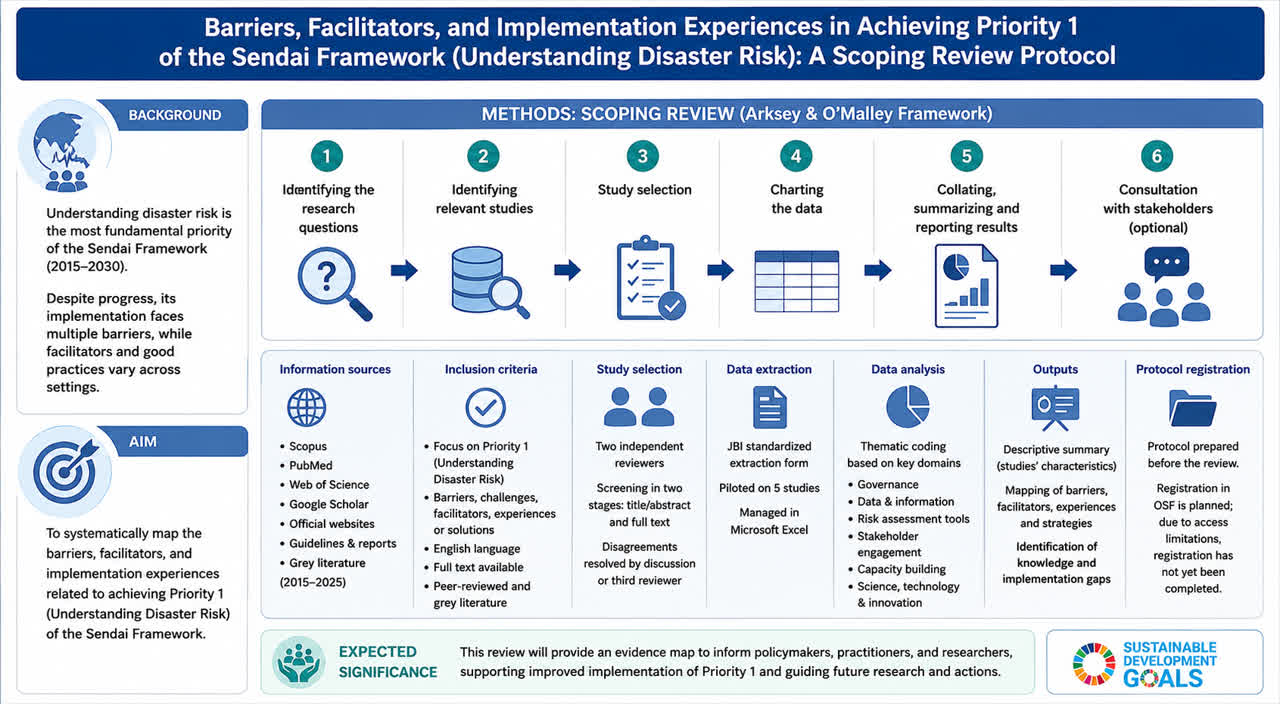
Background and purpose: The Sendai Framework for Disaster Risk Reduction (2015–2030) identifies understanding disaster risk as its first and most fundamental priority for action. Nearly a decade after its adoption, implementation of this priority continues to face substantial challenges across different settings. This protocol describes the methodology for a scoping review designed to systematically map the barriers, facilitators, and implementation experiences associated with achieving Priority 1 of the Sendai Framework.
Materials and methods: This scoping review protocol has been developed in accordance with the methodological framework proposed by Arksey and O'Malley, the recommendations of Levac et al., the JBI methodology for scoping reviews, and the PRISMA Extension for Scoping Reviews (PRISMA-ScR) reporting guideline. The protocol will be registered with the Open Science Framework (OSF) (registration number to be provided following registration). A systematic search will be conducted in Scopus, PubMed, and Web of Science, supplemented by searches of Google Scholar, official websites of relevant organizations, relevant guidelines, and grey literature published between 2015 and 2025. Only English-language publications will be included. All retrieved records will be managed using EndNote. Eligible studies will include those that directly address Priority 1 of the Sendai Framework and examine barriers, challenges, facilitators, or implementation experiences. Study selection will be performed independently by two reviewers. Data will be extracted using the JBI standardized data extraction form and synthesized through thematic coding and descriptive analysis to map the available evidence and identify key themes.
Conclusion: Nearly a decade after the adoption of the Sendai Framework, evidence regarding the implementation of its first priority remains fragmented and heterogeneous. This scoping review is expected to systematically map the existing evidence, identify barriers, facilitators, implementation experiences, and knowledge gaps, and provide an evidence-informed foundation for policymaking and future research.
Materials and methods: This scoping review protocol has been developed in accordance with the methodological framework proposed by Arksey and O'Malley, the recommendations of Levac et al., the JBI methodology for scoping reviews, and the PRISMA Extension for Scoping Reviews (PRISMA-ScR) reporting guideline. The protocol will be registered with the Open Science Framework (OSF) (registration number to be provided following registration). A systematic search will be conducted in Scopus, PubMed, and Web of Science, supplemented by searches of Google Scholar, official websites of relevant organizations, relevant guidelines, and grey literature published between 2015 and 2025. Only English-language publications will be included. All retrieved records will be managed using EndNote. Eligible studies will include those that directly address Priority 1 of the Sendai Framework and examine barriers, challenges, facilitators, or implementation experiences. Study selection will be performed independently by two reviewers. Data will be extracted using the JBI standardized data extraction form and synthesized through thematic coding and descriptive analysis to map the available evidence and identify key themes.
Conclusion: Nearly a decade after the adoption of the Sendai Framework, evidence regarding the implementation of its first priority remains fragmented and heterogeneous. This scoping review is expected to systematically map the existing evidence, identify barriers, facilitators, implementation experiences, and knowledge gaps, and provide an evidence-informed foundation for policymaking and future research.
Keywords: Sendai Framework, understanding disaster risk, scoping review, disaster risk reduction, barriers, facilitators
Type of Study: Review |
Subject:
Policy and Management
Send email to the article author
| Rights and permissions | |
 |
This work is licensed under a Creative Commons Attribution-NonCommercial 4.0 International License. |

Articles Copyright © The Author(s). Owned by Mazandaran University of Medical Sciences.
Contact Us
Address: Journal Office, Building No. 2, Mazandaran University of Medical Sciences, Moallem Square, Sari.Tel: +98 (011)34484874 Postal code: 48175-866 E-Mail: jmums@mazums.ac.ir Telefax: +98 (011)33262679
