

Volume 36, Issue 261 (10-2026)
J Mazandaran Univ Med Sci 2026, 36(261): 158-165 |
Back to browse issues page



Download citation:
BibTeX | RIS | EndNote | Medlars | ProCite | Reference Manager | RefWorks
Send citation to:


BibTeX | RIS | EndNote | Medlars | ProCite | Reference Manager | RefWorks
Send citation to:
Zamanpoor P, Akbarzadeh K, Sharififard M, Vazirianzadeh B. Biodiversity and Seasonal Activity Patterns of Medically Important Flies in the Karkheh Protected Area, Southwestern Iran. J Mazandaran Univ Med Sci 2026; 36 (261) :158-165
URL: http://jmums.mazums.ac.ir/article-1-18120-en.html
URL: http://jmums.mazums.ac.ir/article-1-18120-en.html


Abstract: (19 Views)
Background and purpose: Flies are important medical and veterinary vectors because of their ability to transmit pathogens and cause myiasis. This study aimed to investigate the species composition, seasonal activity patterns, and biodiversity of medically important flies in the Karkheh Protected Area, southwestern Iran.
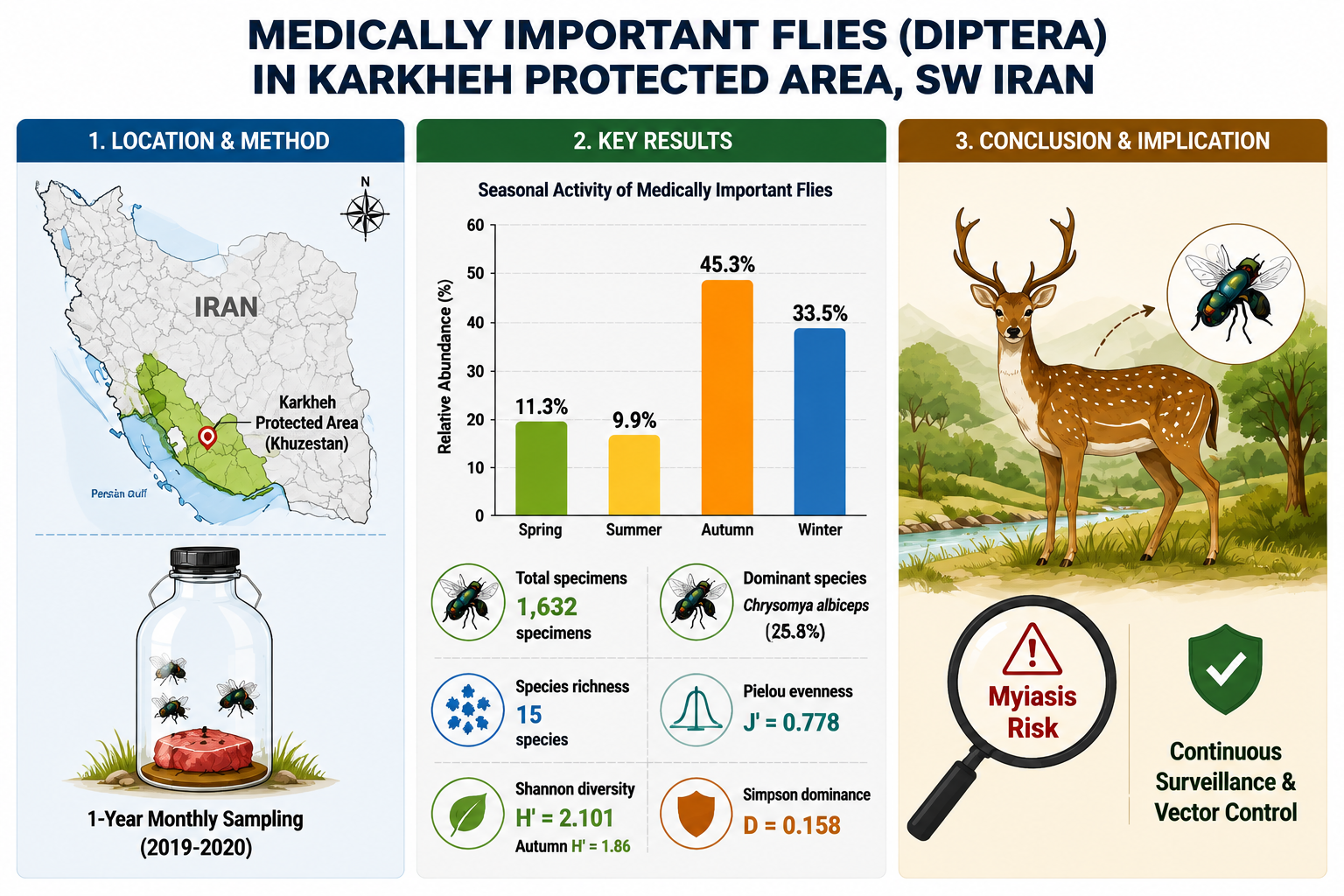
Materials and methods: This descriptive cross-sectional study was conducted monthly over a one-year period between 2019 and 2020 in the Karkheh Protected Area. Adult flies were collected using meat-baited bottle traps. Species identification was performed using standard and valid taxonomic keys. Species abundance, seasonal activity patterns, and ecological indices, including the Shannon-Wiener diversity index (H′), Pielou’s evenness index (J′), species richness (S), and Simpson’s dominance index (D), were calculated and evaluated.
Results: total of 1,632 fly specimens belonging to 15 species and three families - Calliphoridae, Muscidae, and Sarcophagidae - were identified. Chrysomya albiceps, with a relative abundance of 25.8%, was the dominant species in the study area. The highest fly abundance was recorded in autumn, accounting for 45.3% of all collected specimens. The overall ecological indices during the study period were as follows: Shannon-Wiener diversity index (H′ = 2.101), Pielou’s evenness index (J′ = 0.778), Simpson’s dominance index (D = 0.158), and species richness (S = 15). The highest species diversity was observed in autumn (H′ = 1.86), whereas the highest evenness was recorded in summer and winter.
Conclusion: The findings indicate that the species composition, seasonal activity patterns, and biodiversity indices of medically important flies in the Karkheh Protected Area vary seasonally. The dominance of C. albiceps and the high level of fly activity recorded in autumn highlight the importance of continuous surveillance and integrated fly-control programmes, particularly for reducing the risk of myiasis in livestock.
Materials and methods: This descriptive cross-sectional study was conducted monthly over a one-year period between 2019 and 2020 in the Karkheh Protected Area. Adult flies were collected using meat-baited bottle traps. Species identification was performed using standard and valid taxonomic keys. Species abundance, seasonal activity patterns, and ecological indices, including the Shannon-Wiener diversity index (H′), Pielou’s evenness index (J′), species richness (S), and Simpson’s dominance index (D), were calculated and evaluated.
Results: total of 1,632 fly specimens belonging to 15 species and three families - Calliphoridae, Muscidae, and Sarcophagidae - were identified. Chrysomya albiceps, with a relative abundance of 25.8%, was the dominant species in the study area. The highest fly abundance was recorded in autumn, accounting for 45.3% of all collected specimens. The overall ecological indices during the study period were as follows: Shannon-Wiener diversity index (H′ = 2.101), Pielou’s evenness index (J′ = 0.778), Simpson’s dominance index (D = 0.158), and species richness (S = 15). The highest species diversity was observed in autumn (H′ = 1.86), whereas the highest evenness was recorded in summer and winter.
Conclusion: The findings indicate that the species composition, seasonal activity patterns, and biodiversity indices of medically important flies in the Karkheh Protected Area vary seasonally. The dominance of C. albiceps and the high level of fly activity recorded in autumn highlight the importance of continuous surveillance and integrated fly-control programmes, particularly for reducing the risk of myiasis in livestock.
Type of Study: Brief Report |
Subject:
Medical Entomology
Send email to the article author
| Rights and permissions | |
 |
This work is licensed under a Creative Commons Attribution-NonCommercial 4.0 International License. |

Articles Copyright © The Author(s). Owned by Mazandaran University of Medical Sciences.
Contact Us
Address: Journal Office, Building No. 2, Mazandaran University of Medical Sciences, Moallem Square, Sari.Tel: +98 (011)34484874 Postal code: 48175-866 E-Mail: jmums@mazums.ac.ir Telefax: +98 (011)33262679
