

Volume 36, Issue 260 (9-2026)
J Mazandaran Univ Med Sci 2026, 36(260): 54-67 |
Back to browse issues page



Download citation:
BibTeX | RIS | EndNote | Medlars | ProCite | Reference Manager | RefWorks
Send citation to:


BibTeX | RIS | EndNote | Medlars | ProCite | Reference Manager | RefWorks
Send citation to:
Morshedloo R, Jorjani E, Sabouri H, Pezeshkian Z, Salehi M. Identification of Key Genes and MicroRNAs in Gastric Cancer Through Comparative Analysis of Gene Expression Profiles. J Mazandaran Univ Med Sci 2026; 36 (260) :54-67
URL: http://jmums.mazums.ac.ir/article-1-21561-en.html
URL: http://jmums.mazums.ac.ir/article-1-21561-en.html


Abstract: (17 Views)
Background and purpose: Gastric cancer is one of the leading causes of cancer-related mortality worldwide. Identifying the genes and functional pathways involved in gastric cancer can help improve prognosis and facilitate the identification of appropriate and timely therapeutic strategies. The aim of this study was to identify key pathways, hub genes, and key microRNAs associated with gastric cancer.
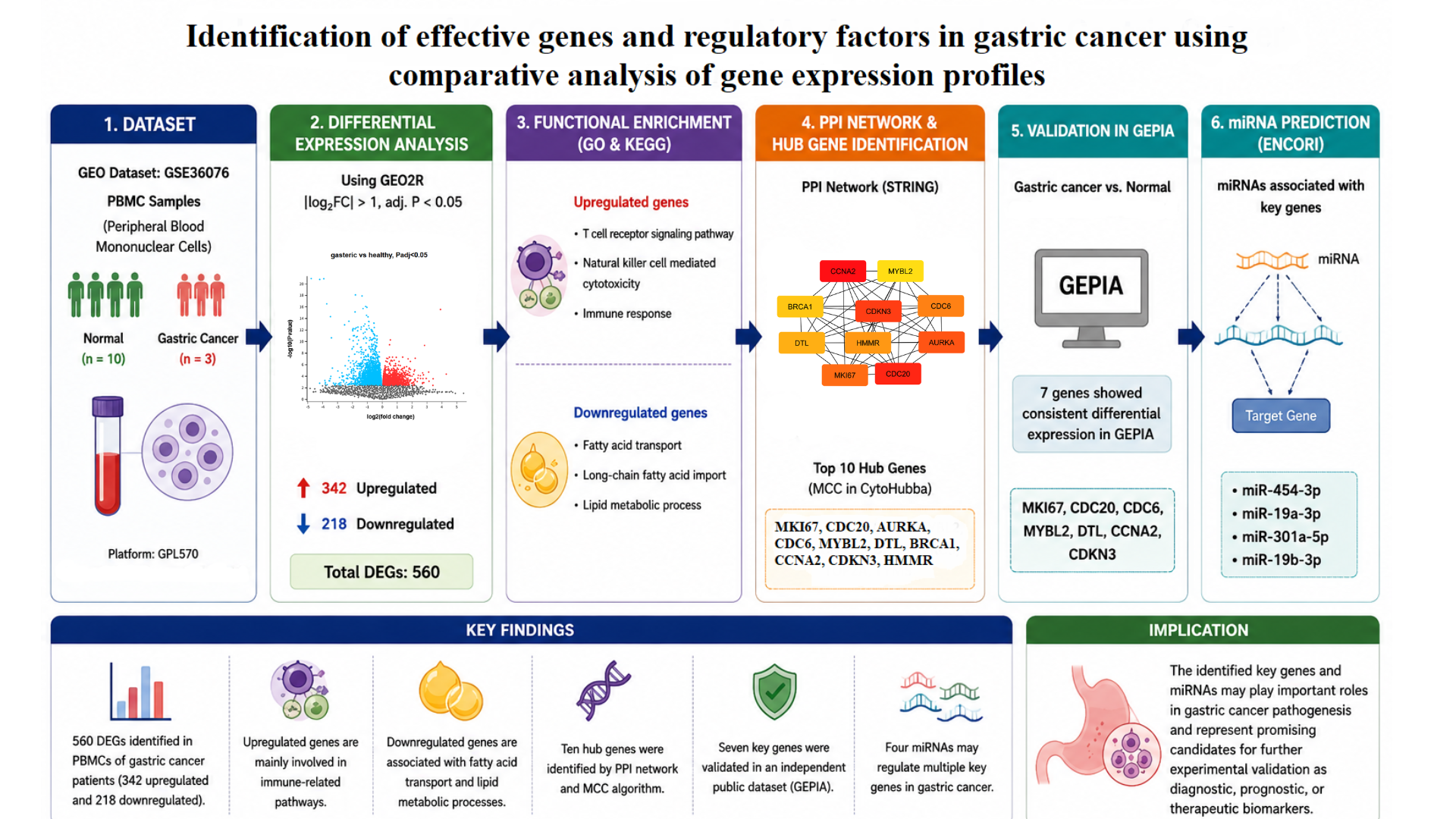
Materials and methods: Transcriptome data from healthy individuals and patients with gastric cancer were analyzed using the GEO2R tool. In this study, 560 genes with significantly different expression levels between patients with gastric cancer and healthy individuals were identified. Of these, 342 genes were upregulated and 218 genes were downregulated. Pathway and gene ontology analyses of these genes showed that upregulated genes in patients with gastric cancer were predominantly involved in pathways and processes such as the “T-cell receptor signaling pathway,” “natural killer cell-mediated cytotoxicity,” and “immune system response.” In contrast, downregulated genes were predominantly involved in processes such as “fatty acid transport” and “long-chain fatty acid entry.”
Results: Using the CytoHubba extension in Cytoscape software, 10 key genes were selected. Of these, 7 key genes, including MKI67, CDC20, CDC6, MYBL2, DTL, CCNA2, and CDKN3, were further validated using clinical information available in the GEPIA database. MicroRNAs associated with these key genes were identified, and a gene-microRNA interaction network was constructed. The key microRNAs included miR-454-3p, miR-19a-3p, miR-301-5p, and miR-19b-3p.
Conclusion: This study identified several genes and microRNAs that may serve as candidate diagnostic and therapeutic biomarkers for gastric cancer. Further investigation of the biological functions, gene ontology, and enrichment profiles of these genes may provide insights into potential therapeutic strategies and contribute to efforts to reduce gastric cancer-related mortality.
Materials and methods: Transcriptome data from healthy individuals and patients with gastric cancer were analyzed using the GEO2R tool. In this study, 560 genes with significantly different expression levels between patients with gastric cancer and healthy individuals were identified. Of these, 342 genes were upregulated and 218 genes were downregulated. Pathway and gene ontology analyses of these genes showed that upregulated genes in patients with gastric cancer were predominantly involved in pathways and processes such as the “T-cell receptor signaling pathway,” “natural killer cell-mediated cytotoxicity,” and “immune system response.” In contrast, downregulated genes were predominantly involved in processes such as “fatty acid transport” and “long-chain fatty acid entry.”
Results: Using the CytoHubba extension in Cytoscape software, 10 key genes were selected. Of these, 7 key genes, including MKI67, CDC20, CDC6, MYBL2, DTL, CCNA2, and CDKN3, were further validated using clinical information available in the GEPIA database. MicroRNAs associated with these key genes were identified, and a gene-microRNA interaction network was constructed. The key microRNAs included miR-454-3p, miR-19a-3p, miR-301-5p, and miR-19b-3p.
Conclusion: This study identified several genes and microRNAs that may serve as candidate diagnostic and therapeutic biomarkers for gastric cancer. Further investigation of the biological functions, gene ontology, and enrichment profiles of these genes may provide insights into potential therapeutic strategies and contribute to efforts to reduce gastric cancer-related mortality.
Type of Study: Research(Original) |
Subject:
genetic
Send email to the article author
| Rights and permissions | |
 |
This work is licensed under a Creative Commons Attribution-NonCommercial 4.0 International License. |

Articles Copyright © The Author(s). Owned by Mazandaran University of Medical Sciences.
Contact Us
Address: Journal Office, Building No. 2, Mazandaran University of Medical Sciences, Moallem Square, Sari.Tel: +98 (011)34484874 Postal code: 48175-866 E-Mail: jmums@mazums.ac.ir Telefax: +98 (011)33262679
