

Volume 35, Issue 251 (12-2025)
J Mazandaran Univ Med Sci 2025, 35(251): 122-130 |
Back to browse issues page


Download citation:
BibTeX | RIS | EndNote | Medlars | ProCite | Reference Manager | RefWorks
Send citation to:


BibTeX | RIS | EndNote | Medlars | ProCite | Reference Manager | RefWorks
Send citation to:
Zarrinkamar M, Ghorbani A A, Khosravi P, Amini F, Geran M, Shirazi N. Evaluation of the Educational Environment of Residents Using the D-RECT Questionnaire at Mazandaran University of Medical Sciences, Iran, 2024-2025. J Mazandaran Univ Med Sci 2025; 35 (251) :122-130
URL: http://jmums.mazums.ac.ir/article-1-22000-en.html
URL: http://jmums.mazums.ac.ir/article-1-22000-en.html
Maryam Zarrinkamar 
 , Ali Asghar Ghorbani , Pejman Khosravi , Farzaneh Amini , Mojgan Geran , Narges Shirazi
, Ali Asghar Ghorbani , Pejman Khosravi , Farzaneh Amini , Mojgan Geran , Narges Shirazi
Abstract: (1122 Views)
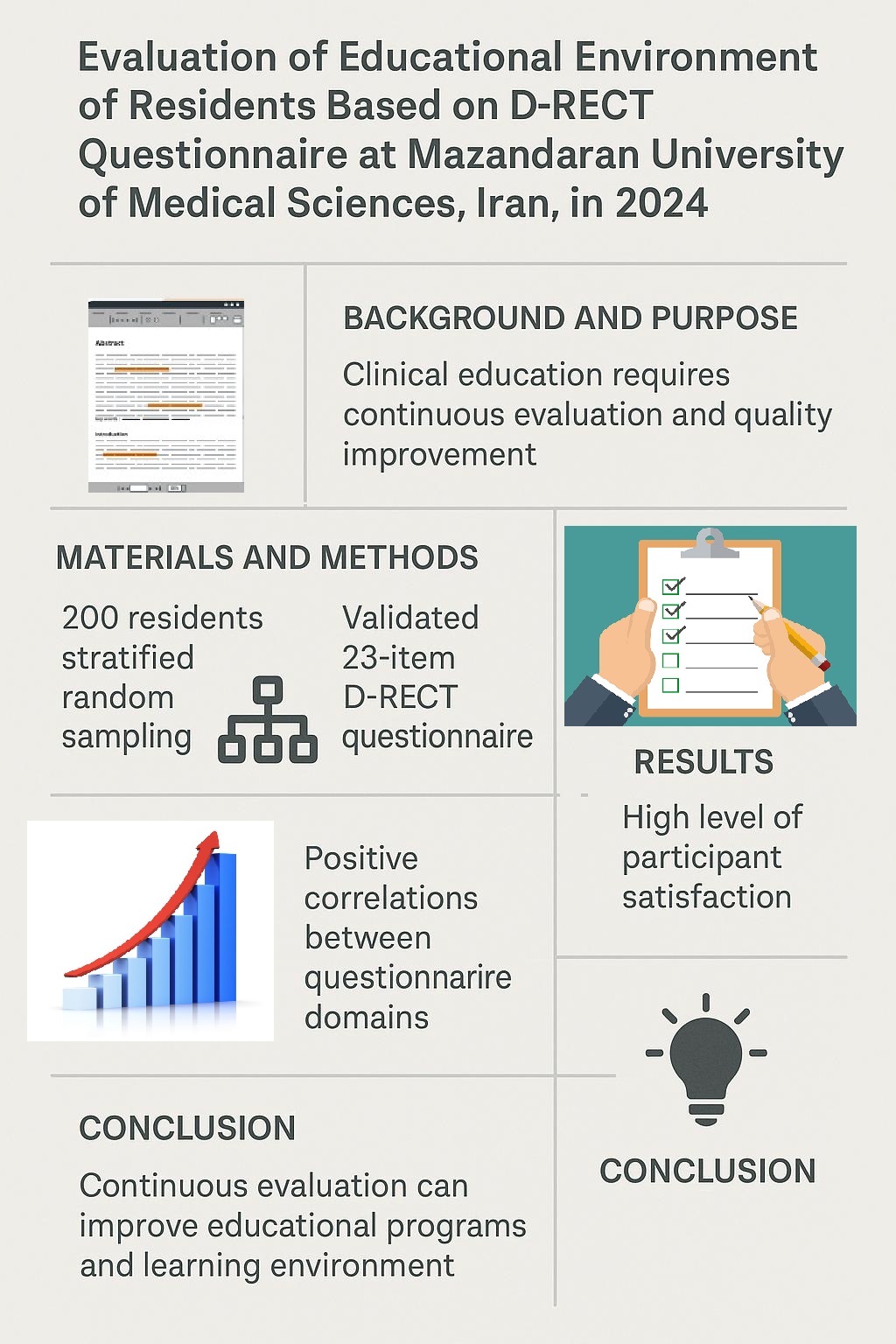
Background and purpose: Clinical education, as the cornerstone of medical education, plays a fundamental role in shaping the professional competencies of students and necessitates ongoing evaluation and quality improvement in accordance with relevant standards.
Materials and methods: This descriptive-analytical study examines the educational environment of residents at Mazandaran University of Medical Sciences in 2024-2025. The statistical population consisted of 200 residents selected through stratified random sampling. The inclusion criterion was completion of at least six months since beginning the residency program. Data collection tools comprised two parts: demographic information and a validated 23-item D-RECT questionnaire.
Results: Scores across different educational domains averaged between 7.94 and 16.33. Also, there was a significant positive correlation between all domains. The highest correlation was observed between the roles of instructors and formal education. The mean total questionnaire score was 13.07 ± 4.43, corresponding to approximately 70% of the maximum achievable score, indicating a high level of participant satisfaction with the educational environment. The highest correlation coefficient was observed between the domains of instructors’ roles and formal education, with a correlation coefficient of 0.670, indicating a strong relationship between these two domains.
Conclusion: Residents at Mazandaran University of Medical Sciences reported a high level of satisfaction with their educational environment. The positive correlations among the different questionnaire domains indicate a strong connection between formal education, instructors’ roles, and other aspects of the educational setting. Continual evaluation is essential for strengthening educational programs and enhancing the quality of the learning environment.
Materials and methods: This descriptive-analytical study examines the educational environment of residents at Mazandaran University of Medical Sciences in 2024-2025. The statistical population consisted of 200 residents selected through stratified random sampling. The inclusion criterion was completion of at least six months since beginning the residency program. Data collection tools comprised two parts: demographic information and a validated 23-item D-RECT questionnaire.
Results: Scores across different educational domains averaged between 7.94 and 16.33. Also, there was a significant positive correlation between all domains. The highest correlation was observed between the roles of instructors and formal education. The mean total questionnaire score was 13.07 ± 4.43, corresponding to approximately 70% of the maximum achievable score, indicating a high level of participant satisfaction with the educational environment. The highest correlation coefficient was observed between the domains of instructors’ roles and formal education, with a correlation coefficient of 0.670, indicating a strong relationship between these two domains.
Conclusion: Residents at Mazandaran University of Medical Sciences reported a high level of satisfaction with their educational environment. The positive correlations among the different questionnaire domains indicate a strong connection between formal education, instructors’ roles, and other aspects of the educational setting. Continual evaluation is essential for strengthening educational programs and enhancing the quality of the learning environment.
Type of Study: Research(Original) |
Subject:
medical education
Send email to the article author
| Rights and permissions | |
 |
This work is licensed under a Creative Commons Attribution-NonCommercial 4.0 International License. |

Articles Copyright © The Author(s). Owned by Mazandaran University of Medical Sciences.
Contact Us
Address: Journal Office, Building No. 2, Mazandaran University of Medical Sciences, Moallem Square, Sari.Tel: +98 (011)34484874 Postal code: 48175-866 E-Mail: jmums@mazums.ac.ir Telefax: +98 (011)33262679
