

Volume 35, Issue 251 (12-2025)
J Mazandaran Univ Med Sci 2025, 35(251): 30-41 |
Back to browse issues page


Download citation:
BibTeX | RIS | EndNote | Medlars | ProCite | Reference Manager | RefWorks
Send citation to:


BibTeX | RIS | EndNote | Medlars | ProCite | Reference Manager | RefWorks
Send citation to:
Khakzad S, Parsa H. The Effect of Swimming Training on the Expression of NF-κB Pathway and TFAM Mitochondrial Genes in the Cardiac Tissue of Diabetic Male Rats. J Mazandaran Univ Med Sci 2025; 35 (251) :30-41
URL: http://jmums.mazums.ac.ir/article-1-22289-en.html
URL: http://jmums.mazums.ac.ir/article-1-22289-en.html


Abstract: (1474 Views)
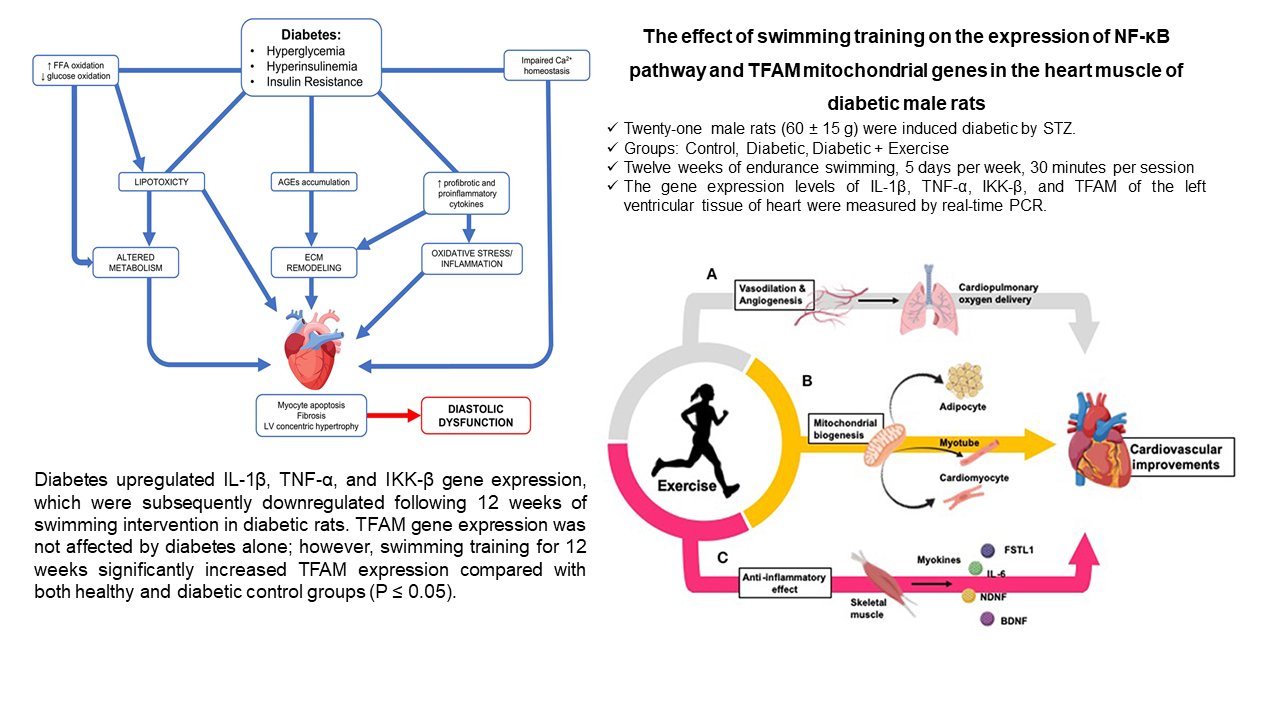
Background and purpose: Diabetes mellitus, by increasing inflammatory mediators, contributes to cardiovascular diseases, and exercise may modulate inflammatory factors and improve cardiac health. The present study aimed to investigate the effects of 12 weeks of swimming training on the expression of NF-κB pathway genes (TNF-α, IL-1β, IKK-β) and the mitochondrial TFAM gene in the cardiac tissue of diabetic rats.
Materials and methods: Twenty-one male rats (160 ± 10 g) were randomly divided into three groups: healthy control, diabetic control, and diabetic-training groups. Diabetes was induced via an intraperitoneal injection of streptozotocin (60 mg/kg). The training program consisted of swimming for 12 weeks, 5 days per week, 30 minutes per session. Forty-eight hours after the final training session, heart tissues were isolated for gene expression analysis using real-time PCR. Data were analyzed using SPSS version 21, with one-way ANOVA and Tukey’s post-hoc test, considering P< 0.05 as statistically significant.
Results: Diabetes increased the expression levels of IL-1β, TNF-α, and IKK-β genes, which were subsequently reduced compared to the diabetic control group after 12 weeks of swimming intervention. Diabetes did not significantly affect TFAM gene expression; however, 12 weeks of swimming training in diabetic rats led to a significant increase in TFAM expression compared to both healthy and diabetic control groups (P≤ 0.05).
Conclusion: Diabetes appears to elevate the expression of inflammatory genes in cardiac tissue, potentially leading to impaired mitochondrial function. Swimming training attenuates inflammation and may upregulate TFAM expression, thereby improving cardiac mitochondrial function in diabetic rats.
Materials and methods: Twenty-one male rats (160 ± 10 g) were randomly divided into three groups: healthy control, diabetic control, and diabetic-training groups. Diabetes was induced via an intraperitoneal injection of streptozotocin (60 mg/kg). The training program consisted of swimming for 12 weeks, 5 days per week, 30 minutes per session. Forty-eight hours after the final training session, heart tissues were isolated for gene expression analysis using real-time PCR. Data were analyzed using SPSS version 21, with one-way ANOVA and Tukey’s post-hoc test, considering P< 0.05 as statistically significant.
Results: Diabetes increased the expression levels of IL-1β, TNF-α, and IKK-β genes, which were subsequently reduced compared to the diabetic control group after 12 weeks of swimming intervention. Diabetes did not significantly affect TFAM gene expression; however, 12 weeks of swimming training in diabetic rats led to a significant increase in TFAM expression compared to both healthy and diabetic control groups (P≤ 0.05).
Conclusion: Diabetes appears to elevate the expression of inflammatory genes in cardiac tissue, potentially leading to impaired mitochondrial function. Swimming training attenuates inflammation and may upregulate TFAM expression, thereby improving cardiac mitochondrial function in diabetic rats.
Type of Study: Research(Original) |
Subject:
Sport Physiology
Send email to the article author
| Rights and permissions | |
 |
This work is licensed under a Creative Commons Attribution-NonCommercial 4.0 International License. |

Articles Copyright © The Author(s). Owned by Mazandaran University of Medical Sciences.
Contact Us
Address: Journal Office, Building No. 2, Mazandaran University of Medical Sciences, Moallem Square, Sari.Tel: +98 (011)34484874 Postal code: 48175-866 E-Mail: jmums@mazums.ac.ir Telefax: +98 (011)33262679
