

Volume 36, Issue 257 (5-2026)
J Mazandaran Univ Med Sci 2026, 36(257): 160-172 |
Back to browse issues page


Download citation:
BibTeX | RIS | EndNote | Medlars | ProCite | Reference Manager | RefWorks
Send citation to:


BibTeX | RIS | EndNote | Medlars | ProCite | Reference Manager | RefWorks
Send citation to:
Ahmadi Y, Khorsandi B, Jafari N, Asadi L. Efficacy and Safety of Relugolix for Endometriosis-Associated Pelvic Pain: A Systematic Review. , J Mazandaran Univ Med Sci. 2026; 36 (257) :160-172
URL: http://jmums.mazums.ac.ir/article-1-22360-en.html
URL: http://jmums.mazums.ac.ir/article-1-22360-en.html


Abstract: (1464 Views)
Background and Purpose:: Endometriosis is a common gynecological condition affecting women of reproductive age. Management is primarily aimed at alleviating symptoms and improving quality of life, while preserving fertility through medical or surgical interventions. Relugolix, a novel oral gonadotropin-releasing hormone (GnRH) antagonist, has recently emerged as a promising therapeutic option. This study aimed to evaluate the efficacy and safety of oral relugolix to assess its clinical role in the management of endometriosis-associated pain.
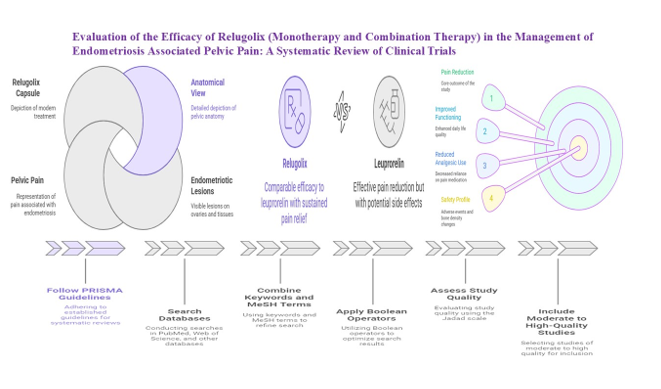
Materials and Methods: This systematic review followed PRISMA guidelines. A comprehensive literature search was conducted in Scopus, PubMed, and Web of Science for studies published between 2020 and May 2025 using relevant keywords and MeSH terms, including “endometriosis,” “relugolix,” “GnRH antagonist,” and “clinical trial.” Study quality was assessed using the Jadad scale, and only studies of moderate to high quality were included.
Results: Six studies involving a total of 3,659 premenopausal women met the inclusion criteria. Oral relugolix (10-40 mg), administered alone or combined with estradiol and norethisterone acetate, was compared with leuprorelin or placebo. The primary outcome was pain reduction in endometriosis-associated pain, assessed using VAS or NRS scales, with some studies also evaluating quality of life and work productivity outcomes. Relugolix 40 mg demonstrated efficacy comparable to leuprorelin in reducing pelvic pain, dysmenorrhea, and non-menstrual pelvic pain. Long-term follow-up of up to 104 weeks showed sustained pain relief and improved daily functioning, along with a reduced use of analgesics and need for surgery. Safety outcomes were generally comparable to leuprorelin, with commonly reported adverse events including hot flushes, headache, menstrual irregularities, and an initial decrease in bone mineral density, which later stabilised.
Conclusion: Current evidence suggests that relugolix is an effective and well-tolerated option for managing endometriosis-related pain and may be suitable for long-term use. As an oral alternative to injectable GnRH agonists, it may enhance patient-centred care; however, further long-term studies and cost-effectiveness evaluations are needed to optimise its clinical application.
Materials and Methods: This systematic review followed PRISMA guidelines. A comprehensive literature search was conducted in Scopus, PubMed, and Web of Science for studies published between 2020 and May 2025 using relevant keywords and MeSH terms, including “endometriosis,” “relugolix,” “GnRH antagonist,” and “clinical trial.” Study quality was assessed using the Jadad scale, and only studies of moderate to high quality were included.
Results: Six studies involving a total of 3,659 premenopausal women met the inclusion criteria. Oral relugolix (10-40 mg), administered alone or combined with estradiol and norethisterone acetate, was compared with leuprorelin or placebo. The primary outcome was pain reduction in endometriosis-associated pain, assessed using VAS or NRS scales, with some studies also evaluating quality of life and work productivity outcomes. Relugolix 40 mg demonstrated efficacy comparable to leuprorelin in reducing pelvic pain, dysmenorrhea, and non-menstrual pelvic pain. Long-term follow-up of up to 104 weeks showed sustained pain relief and improved daily functioning, along with a reduced use of analgesics and need for surgery. Safety outcomes were generally comparable to leuprorelin, with commonly reported adverse events including hot flushes, headache, menstrual irregularities, and an initial decrease in bone mineral density, which later stabilised.
Conclusion: Current evidence suggests that relugolix is an effective and well-tolerated option for managing endometriosis-related pain and may be suitable for long-term use. As an oral alternative to injectable GnRH agonists, it may enhance patient-centred care; however, further long-term studies and cost-effectiveness evaluations are needed to optimise its clinical application.
Type of Study: Review |
Subject:
Gynecology and Infertility
Send email to the article author
| Rights and permissions | |
 |
This work is licensed under a Creative Commons Attribution-NonCommercial 4.0 International License. |

Articles Copyright © The Author(s). Owned by Mazandaran University of Medical Sciences.
Contact Us
Address: Journal Office, Building No. 2, Mazandaran University of Medical Sciences, Moallem Square, Sari.Tel: +98 (011)34484874 Postal code: 48175-866 E-Mail: jmums@mazums.ac.ir Telefax: +98 (011)33262679
