

Volume 36, Issue 262 (Special Issue 2026)
J Mazandaran Univ Med Sci 2026, 36(262): 235-246 |
Back to browse issues page



Download citation:
BibTeX | RIS | EndNote | Medlars | ProCite | Reference Manager | RefWorks
Send citation to:


BibTeX | RIS | EndNote | Medlars | ProCite | Reference Manager | RefWorks
Send citation to:
Paymozd F, Vadadhir A, Naeij E, Khani S. Aging: A Burden or an Opportunity for Development? A Scoping Review. , J Mazandaran Univ Med Sci. 2026; 36 (262) :235-246
URL: http://jmums.mazums.ac.ir/article-1-22477-en.html
URL: http://jmums.mazums.ac.ir/article-1-22477-en.html


Abstract: (41 Views)
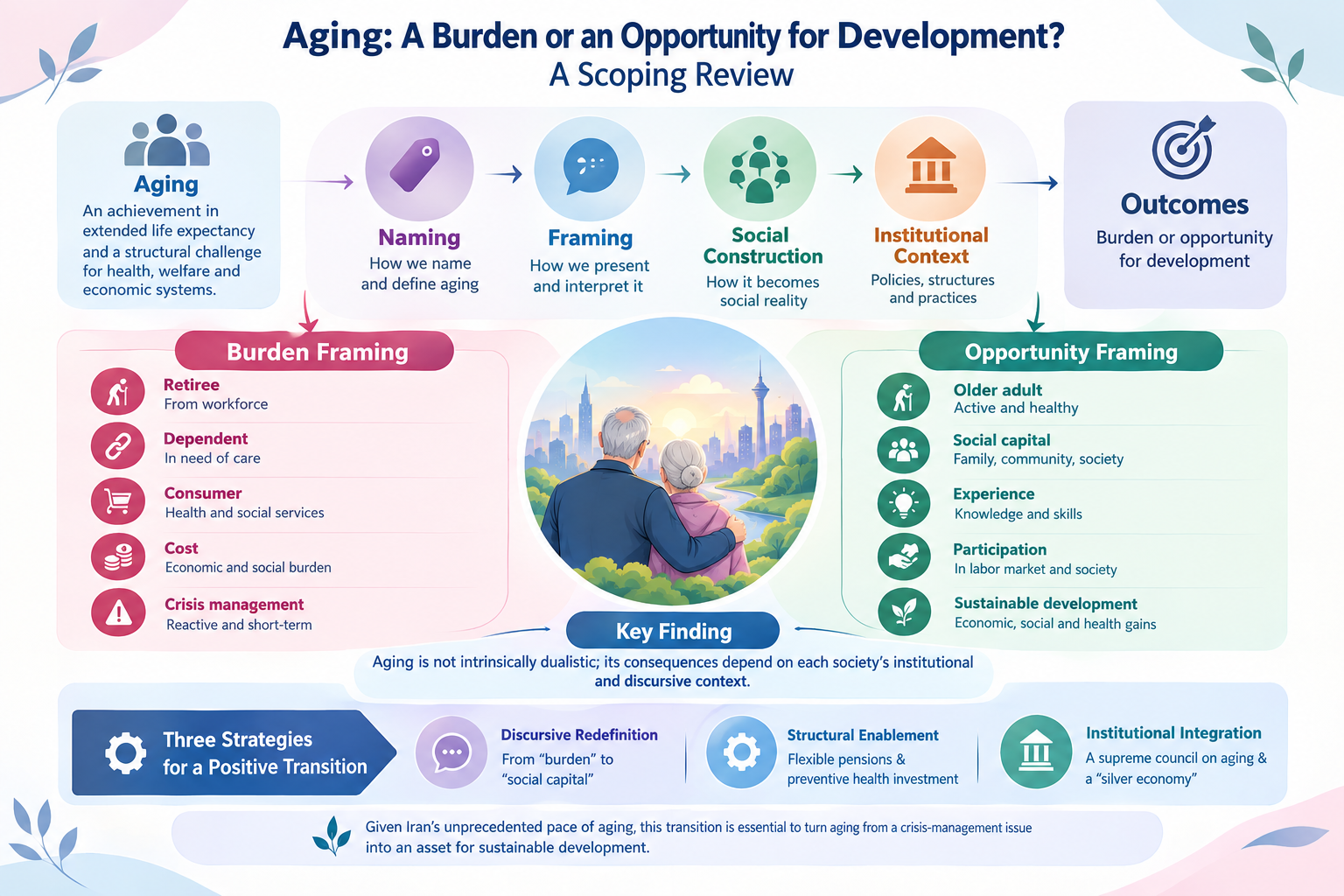
Background and purpose: Population aging reflects both the achievement of increased life expectancy and a major structural challenge for health, welfare, and economic systems. Previous studies have largely examined its economic, medical, and sociological dimensions in isolation. This scoping review examined whether population aging constitutes a burden or an opportunity for development.
Materials and methods: This scoping review followed the Arksey and O’Malley framework and the PRISMA-ScR guidelines. Two independent reviewers searched PubMed, Web of Science, Scopus, ProQuest, SID, Magiran, and Google Scholar without language restrictions. Study screening was conducted in three stages, and data extraction was performed independently. Disagreements were resolved by a third reviewer. The findings were narratively synthesised according to discursive orientation (opportunity or challenge) and level of analysis (micro, meso, or macro).
Results: Of the 12 included studies, seven framed population aging as an opportunity. Findings included evidence that workforce skill upgrading in China offset the decline in labour force size; an analysis of 109 countries found no evidence that population aging adversely affected economic performance; firm-level labour productivity increased by approximately 1.47% for every 1% increase in the ageing ratio; and the value of older adults’ non-market activities was estimated at approximately 7% of GDP. Five studies framed population aging as a challenge. In a panel analysis of 142 countries, the negative effect on economic growth became statistically significant only when the proportion of older people exceeded 10%. In Iran, an increase in the proportion of the population aged 65 and over was associated with lower long-term per capita GDP growth (coefficient: -1.37). Each 1% increase in the elderly healthcare burden was associated with a 0.083% reduction in GDP growth, while each additional older household member increased the odds of catastrophic health expenditure by a factor of 1.34.
Conclusion: Population aging is not inherently a burden or an opportunity; rather, its consequences appear to depend on each society’s institutional context and the way aging is framed in public discourse. Shifting from a “burden” to an “opportunity” discourse may require three complementary strategies: discursive redefinition (from “liability” to “social capital”), structural enablement (through flexible pension arrangements and investment in preventive healthcare), and institutional integration (through a supreme council on aging and development of the “silver economy”). Given Iran’s rapidly aging population, this transition may help shift aging from a crisis-management issue towards an opportunity for sustainable development.
Type of Study: Review |
Subject:
Policy and Management
Send email to the article author
| Rights and permissions | |
 |
This work is licensed under a Creative Commons Attribution-NonCommercial 4.0 International License. |

Articles Copyright © The Author(s). Owned by Mazandaran University of Medical Sciences.
Contact Us
Address: Journal Office, Building No. 2, Mazandaran University of Medical Sciences, Moallem Square, Sari.Tel: +98 (011)34484874 Postal code: 48175-866 E-Mail: jmums@mazums.ac.ir Telefax: +98 (011)33262679
