

Volume 36, Issue 258 (7-2026)
J Mazandaran Univ Med Sci 2026, 36(258): 145-152 |
Back to browse issues page



Download citation:
BibTeX | RIS | EndNote | Medlars | ProCite | Reference Manager | RefWorks
Send citation to:


BibTeX | RIS | EndNote | Medlars | ProCite | Reference Manager | RefWorks
Send citation to:
Moradi A, Jand A, Aqerkakli K, Abolghazi M. A Rare Case of a Hydatid Cyst Adjacent to the Stomach in an Elderly Patient Presenting with Peripheral Edema and Sepsis. J Mazandaran Univ Med Sci 2026; 36 (258) :145-152
URL: http://jmums.mazums.ac.ir/article-1-22492-en.html
URL: http://jmums.mazums.ac.ir/article-1-22492-en.html


Abstract: (716 Views)
Background and purpose: Hydatid cyst is a parasitic disease caused by infection with the tapeworm Echinococcus granulosus. This study presents a rare case of a hydatid cyst located adjacent to the stomach in an elderly patient presenting with peripheral edema and sepsis.
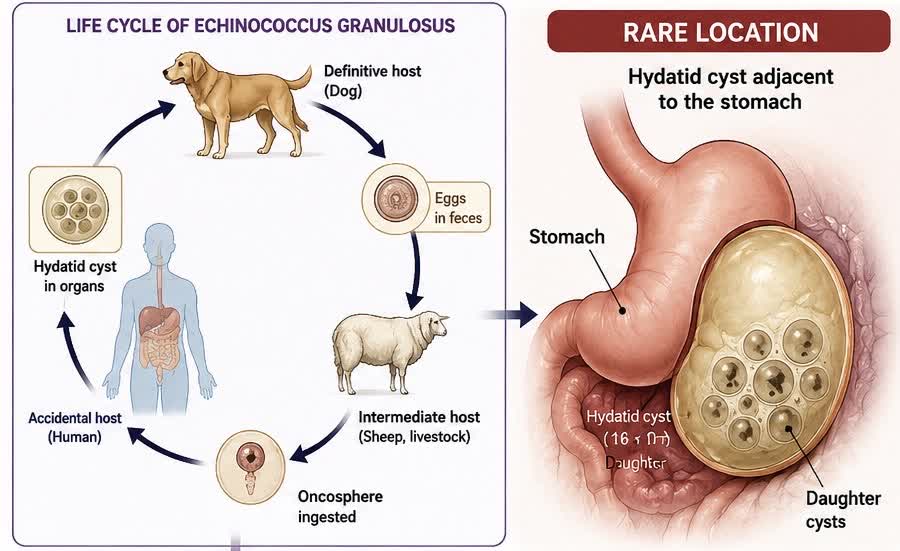
Case presentation: An 80-year-old male patient with no known underlying diseases presented to the hospital with a complaint of ankle edema. Initial evaluations resulted in diagnoses of sepsis and acute kidney injury. Abdominal ultrasonography revealed a hydatid cyst located adjacent to the stomach. Initial treatment included broad-spectrum antibiotics (linezolid, meropenem, and clindamycin) administered for seven days, dexamethasone, and supportive measures, including leg elevation and compression stockings. Following infection control (with a reduction in C-reactive protein from +3 to negative) and stabilization of the patient's condition, surgery was performed. Intraoperatively, due to the large size of the cyst (16 cm) and its proximity to the stomach, the cyst contents were first aspirated to minimize the risk of damage to adjacent vital organs, followed by complete excision of the cyst wall. Pathological examination revealed a laminated membrane containing protoscolices, confirming the diagnosis of E. granulosus. Although the patient's critical clinical condition precluded preoperative administration of albendazole, a full course of the drug was initiated postoperatively. The patient recovered uneventfully and was discharged in good condition.
Conclusion: This case highlights a rare hydatid cyst located adjacent to the stomach in an elderly patient presenting with peripheral edema, sepsis, and renal dysfunction. Although a definitive causal relationship between these clinical manifestations and the hydatid cyst could not be established, this case underscores the importance of considering atypical presentations of hydatid disease and performing comprehensive diagnostic evaluations in patients with complex clinical findings.
Case presentation: An 80-year-old male patient with no known underlying diseases presented to the hospital with a complaint of ankle edema. Initial evaluations resulted in diagnoses of sepsis and acute kidney injury. Abdominal ultrasonography revealed a hydatid cyst located adjacent to the stomach. Initial treatment included broad-spectrum antibiotics (linezolid, meropenem, and clindamycin) administered for seven days, dexamethasone, and supportive measures, including leg elevation and compression stockings. Following infection control (with a reduction in C-reactive protein from +3 to negative) and stabilization of the patient's condition, surgery was performed. Intraoperatively, due to the large size of the cyst (16 cm) and its proximity to the stomach, the cyst contents were first aspirated to minimize the risk of damage to adjacent vital organs, followed by complete excision of the cyst wall. Pathological examination revealed a laminated membrane containing protoscolices, confirming the diagnosis of E. granulosus. Although the patient's critical clinical condition precluded preoperative administration of albendazole, a full course of the drug was initiated postoperatively. The patient recovered uneventfully and was discharged in good condition.
Conclusion: This case highlights a rare hydatid cyst located adjacent to the stomach in an elderly patient presenting with peripheral edema, sepsis, and renal dysfunction. Although a definitive causal relationship between these clinical manifestations and the hydatid cyst could not be established, this case underscores the importance of considering atypical presentations of hydatid disease and performing comprehensive diagnostic evaluations in patients with complex clinical findings.
Type of Study: Case Report |
Subject:
Colorectal Surgery
Send email to the article author
| Rights and permissions | |
 |
This work is licensed under a Creative Commons Attribution-NonCommercial 4.0 International License. |

Articles Copyright © The Author(s). Owned by Mazandaran University of Medical Sciences.
Contact Us
Address: Journal Office, Building No. 2, Mazandaran University of Medical Sciences, Moallem Square, Sari.Tel: +98 (011)34484874 Postal code: 48175-866 E-Mail: jmums@mazums.ac.ir Telefax: +98 (011)33262679
