

Volume 36, Issue 258 (7-2026)
J Mazandaran Univ Med Sci 2026, 36(258): 66-76 |
Back to browse issues page



Download citation:
BibTeX | RIS | EndNote | Medlars | ProCite | Reference Manager | RefWorks
Send citation to:


BibTeX | RIS | EndNote | Medlars | ProCite | Reference Manager | RefWorks
Send citation to:
Asnaashari H, Aghaie E. Modelling the Relationship Between Loneliness and Internet Addiction: The Mediating Roles of Emotion Regulation and Subjective Well-Being Among Female High School Students. J Mazandaran Univ Med Sci 2026; 36 (258) :66-76
URL: http://jmums.mazums.ac.ir/article-1-22535-en.html
URL: http://jmums.mazums.ac.ir/article-1-22535-en.html


Abstract: (693 Views)
Background and purpose: Internet addiction among adolescents has become an increasing concern. Given the growing reliance on the internet after the COVID-19 pandemic, this study aimed to examine the relationship between loneliness and internet addiction by investigating the mediating roles of emotion regulation and subjective well-being.
Materials and methods: In this correlational study, the statistical population consisted of all female students enrolled in high schools in Districts 4 and 8 of Tehran. Using cluster random sampling, 320 questionnaires were collected, and after excluding incomplete responses, 301 questionnaires were retained for analysis. Data were collected using the Persian versions of Young’s Internet Addiction Test (IAT), the Subjective Well-Being Scale (SWS) developed by Keyes and Magyar-Moe, the Emotion Regulation Questionnaire developed by Gross, and Russell’s UCLA Loneliness Scale. Data analysis was performed using path analysis and confirmatory factor analysis through AMOS-24 and SPSS-26 statistical software.
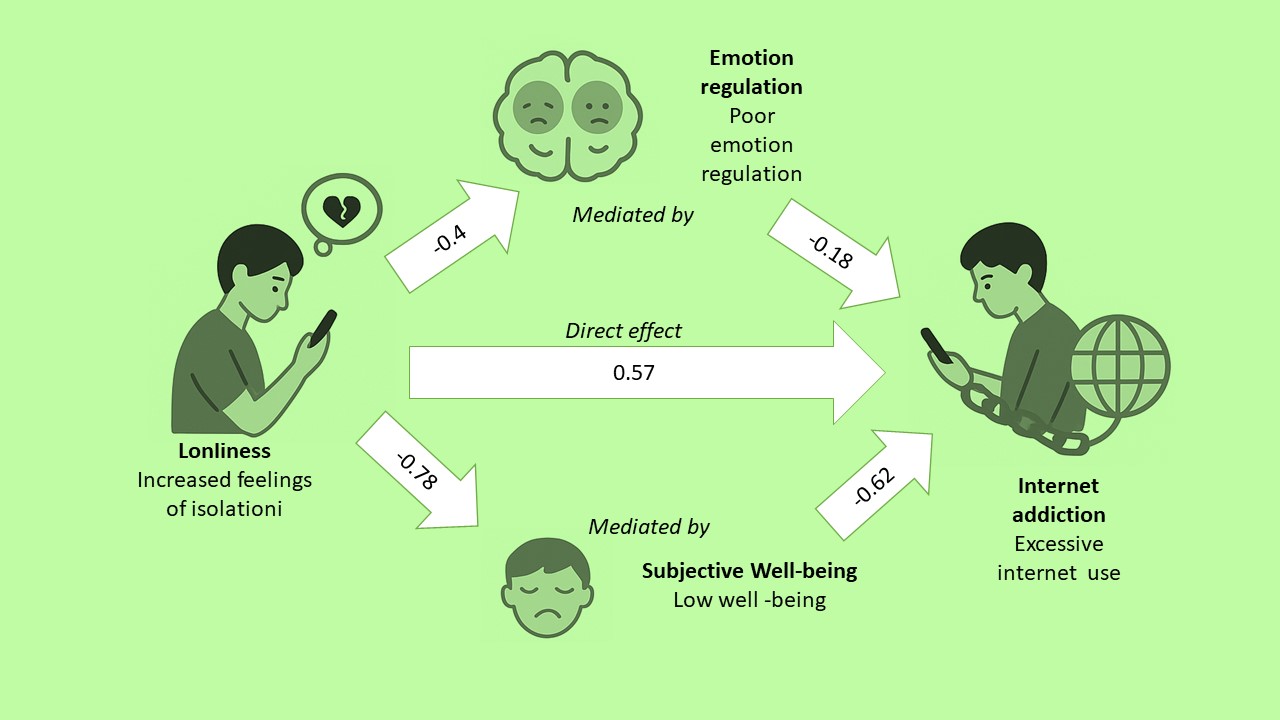
Results: The hypothesised model showed an acceptable fit to the data. Path analysis revealed a significant positive direct association between loneliness and internet addiction (β = 0.57). Furthermore, loneliness was found to contribute to internet addiction both directly and indirectly through impaired emotion regulation (β = 0.071) and decreased subjective well-being (β = 0.483), demonstrating the significant mediating roles of these two variables.
Conclusion: The findings of this study indicate that loneliness contributes to adolescents’ internet addiction both directly and indirectly through lower levels of emotion regulation and subjective well-being. Among the examined mediators, subjective well-being demonstrated a stronger mediating effect than emotion regulation, suggesting that adolescents’ overall psychological well-being and quality of social relationships may play an important role in vulnerability to internet addiction. These findings could inform the development of targeted interventions focused on strengthening emotional regulation skills and promoting psychological well-being to reduce internet addiction among adolescents.
Materials and methods: In this correlational study, the statistical population consisted of all female students enrolled in high schools in Districts 4 and 8 of Tehran. Using cluster random sampling, 320 questionnaires were collected, and after excluding incomplete responses, 301 questionnaires were retained for analysis. Data were collected using the Persian versions of Young’s Internet Addiction Test (IAT), the Subjective Well-Being Scale (SWS) developed by Keyes and Magyar-Moe, the Emotion Regulation Questionnaire developed by Gross, and Russell’s UCLA Loneliness Scale. Data analysis was performed using path analysis and confirmatory factor analysis through AMOS-24 and SPSS-26 statistical software.
Results: The hypothesised model showed an acceptable fit to the data. Path analysis revealed a significant positive direct association between loneliness and internet addiction (β = 0.57). Furthermore, loneliness was found to contribute to internet addiction both directly and indirectly through impaired emotion regulation (β = 0.071) and decreased subjective well-being (β = 0.483), demonstrating the significant mediating roles of these two variables.
Conclusion: The findings of this study indicate that loneliness contributes to adolescents’ internet addiction both directly and indirectly through lower levels of emotion regulation and subjective well-being. Among the examined mediators, subjective well-being demonstrated a stronger mediating effect than emotion regulation, suggesting that adolescents’ overall psychological well-being and quality of social relationships may play an important role in vulnerability to internet addiction. These findings could inform the development of targeted interventions focused on strengthening emotional regulation skills and promoting psychological well-being to reduce internet addiction among adolescents.
Type of Study: Research(Original) |
Subject:
psychology
Send email to the article author
| Rights and permissions | |
 |
This work is licensed under a Creative Commons Attribution-NonCommercial 4.0 International License. |

Articles Copyright © The Author(s). Owned by Mazandaran University of Medical Sciences.
Contact Us
Address: Journal Office, Building No. 2, Mazandaran University of Medical Sciences, Moallem Square, Sari.Tel: +98 (011)34484874 Postal code: 48175-866 E-Mail: jmums@mazums.ac.ir Telefax: +98 (011)33262679
