

Volume 36, Issue 258 (7-2026)
J Mazandaran Univ Med Sci 2026, 36(258): 105-112 |
Back to browse issues page



Download citation:
BibTeX | RIS | EndNote | Medlars | ProCite | Reference Manager | RefWorks
Send citation to:


BibTeX | RIS | EndNote | Medlars | ProCite | Reference Manager | RefWorks
Send citation to:
Abdollahnejad Banaderi A, Rafieirad M, Edalatmanesh M A, Forouzanfar M. Hesperidin Modulates the JNK-c-Jun-AP-1 Signaling Pathway to Mitigate Hippocampal Inflammation in a Reserpine-Induced Model of Parkinson's Disease. J Mazandaran Univ Med Sci 2026; 36 (258) :105-112
URL: http://jmums.mazums.ac.ir/article-1-22566-en.html
URL: http://jmums.mazums.ac.ir/article-1-22566-en.html


Abstract: (688 Views)
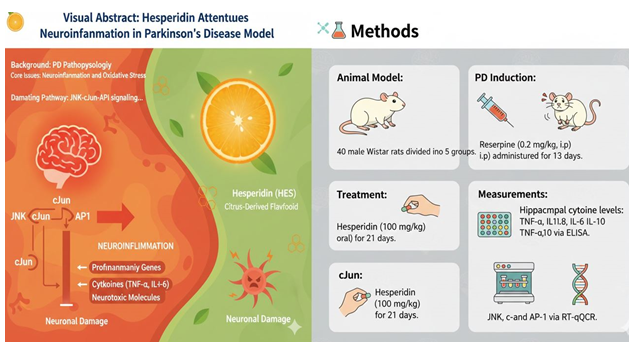
Background and purpose: Neuroinflammation and oxidative stress are major contributors to the pathogenesis and progression of Parkinson's disease (PD). The JNK-cJun-AP1 signaling pathway regulates the transcription of pro-inflammatory genes, cytokines, and neurotoxic mediators, thereby promoting neuronal damage in vulnerable brain regions such as the hippocampus. The present study aimed to evaluate the potential neuroprotective effects of hesperidin (HES), a citrus-derived flavonoid, on the modulation of the JNK-cJun-AP1 pathway and hippocampal inflammatory responses in a reserpine-induced experimental model of PD.
Materials and methods: In this controlled experimental study, forty adult male Wistar rats were randomly assigned to five groups: control, vehicle + saline (VR+NS), reserpine + saline (RES+NS), hesperidin + vehicle (HES+VR), and reserpine + hesperidin (RES+HES). Reserpine (0.2 mg/kg, intraperitoneally) was administered for 13 consecutive days to induce parkinsonian-like symptoms. Subsequently, HES (100 mg/kg, orally) was administered for 21 days. At the end of the experimental period, hippocampal concentrations of TNF-α, IL-1β, IL-6, and IL-10 were measured using ELISA. Relative gene expression levels of the JNK, c-Jun, and AP-1 genes were quantified by RT-qPCR.
Results: Reserpine significantly elevated hippocampal levels of TNF-α, IL-1β, and IL-6 while reducing IL-10 compared with the control group (P < 0.001). HES treatment reversed these alterations, significantly decreasing IL-1β and IL-6, increasing IL-10, and improving the hippocampal inflammatory profile (P < 0.001). Moreover, JNK, c-Jun, and AP-1 gene expression levels were markedly upregulated in the RES+NS group (P < 0.01), whereas HES administration significantly downregulated their expression (P < 0.05).
Conclusion: Hesperidin exerts neuroprotective effects in reserpine-induced PD by modulating the JNK-cJun-AP1 signaling pathway and attenuating hippocampal inflammation, highlighting its potential as a therapeutic agent for PD and other neurodegenerative disorders.
Materials and methods: In this controlled experimental study, forty adult male Wistar rats were randomly assigned to five groups: control, vehicle + saline (VR+NS), reserpine + saline (RES+NS), hesperidin + vehicle (HES+VR), and reserpine + hesperidin (RES+HES). Reserpine (0.2 mg/kg, intraperitoneally) was administered for 13 consecutive days to induce parkinsonian-like symptoms. Subsequently, HES (100 mg/kg, orally) was administered for 21 days. At the end of the experimental period, hippocampal concentrations of TNF-α, IL-1β, IL-6, and IL-10 were measured using ELISA. Relative gene expression levels of the JNK, c-Jun, and AP-1 genes were quantified by RT-qPCR.
Results: Reserpine significantly elevated hippocampal levels of TNF-α, IL-1β, and IL-6 while reducing IL-10 compared with the control group (P < 0.001). HES treatment reversed these alterations, significantly decreasing IL-1β and IL-6, increasing IL-10, and improving the hippocampal inflammatory profile (P < 0.001). Moreover, JNK, c-Jun, and AP-1 gene expression levels were markedly upregulated in the RES+NS group (P < 0.01), whereas HES administration significantly downregulated their expression (P < 0.05).
Conclusion: Hesperidin exerts neuroprotective effects in reserpine-induced PD by modulating the JNK-cJun-AP1 signaling pathway and attenuating hippocampal inflammation, highlighting its potential as a therapeutic agent for PD and other neurodegenerative disorders.
Type of Study: Brief Report |
Subject:
physiology
Send email to the article author
| Rights and permissions | |
 |
This work is licensed under a Creative Commons Attribution-NonCommercial 4.0 International License. |

Articles Copyright © The Author(s). Owned by Mazandaran University of Medical Sciences.
Contact Us
Address: Journal Office, Building No. 2, Mazandaran University of Medical Sciences, Moallem Square, Sari.Tel: +98 (011)34484874 Postal code: 48175-866 E-Mail: jmums@mazums.ac.ir Telefax: +98 (011)33262679
