

Volume 36, Issue 259 (8-2026)
J Mazandaran Univ Med Sci 2026, 36(259): 297-308 |
Back to browse issues page



Download citation:
BibTeX | RIS | EndNote | Medlars | ProCite | Reference Manager | RefWorks
Send citation to:


BibTeX | RIS | EndNote | Medlars | ProCite | Reference Manager | RefWorks
Send citation to:
Chaboki A, Ahmadi A. Population Attributable Fraction: Concepts, Calculation Methods, and Public Health Applications. J Mazandaran Univ Med Sci 2026; 36 (259) :297-308
URL: http://jmums.mazums.ac.ir/article-1-22772-en.html
URL: http://jmums.mazums.ac.ir/article-1-22772-en.html


Abstract: (576 Views)
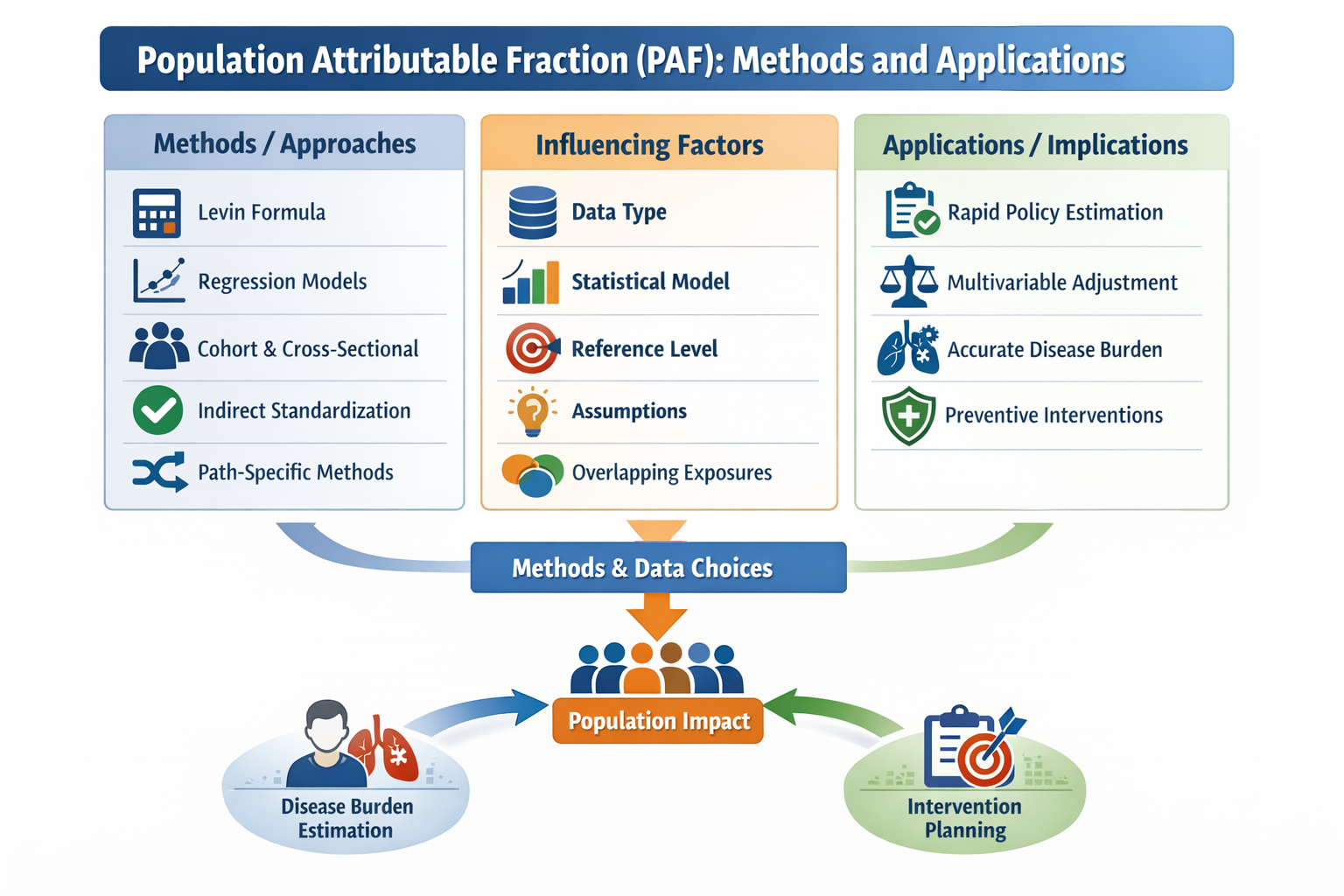
Background and purpose: The Population Attributable Fraction (PAF) is a key epidemiological measure that quantifies the proportion of disease burden in a population that could theoretically be prevented if one or more causal risk factors were eliminated. Because PAF incorporates both effect size and exposure prevalence, it is widely used for prioritizing preventive interventions and informing health policy. This study aimed to review and compare methodological approaches for calculating PAF and to examine their conceptual and practical implications for epidemiological research and health system planning.
Materials and methods: A narrative review was conducted by searching national and international databases for articles published between 2000 and 2025 using keywords related to PAF, epidemiology, and methodology. After screening and removing duplicates, 12 studies representing diverse methodological approaches, including Levin’s classical formula, multivariable regression models, cohort-based survival models, multilevel logistic models, and indirect standardization, were included in the qualitative synthesis.
Results: The findings indicated that PAF estimates depend more on methodological choices, data structure, statistical modelling, choice of reference level, and causal assumptions than on the magnitude of risk factors alone. While Levin’s formula provides a simple and transparent estimate, it cannot adjust for confounding or interactions. Regression-based and advanced modelling approaches allow adjustment for confounders, multivariable PAF estimation, and assessment of population inequalities. Overlapping exposures can substantially inflate PAF estimates, and weighted or low-risk scenario approaches often yield more conservative and realistic estimates.
Conclusion: PAF is not a fixed quantity but depends on the methodological approach used, and its interpretation requires careful consideration of causal assumptions, the type of data available, and the analytic purpose. Transparent reporting of methods and reference levels is essential for producing valid and policy-relevant PAF estimates for health systems.
Materials and methods: A narrative review was conducted by searching national and international databases for articles published between 2000 and 2025 using keywords related to PAF, epidemiology, and methodology. After screening and removing duplicates, 12 studies representing diverse methodological approaches, including Levin’s classical formula, multivariable regression models, cohort-based survival models, multilevel logistic models, and indirect standardization, were included in the qualitative synthesis.
Results: The findings indicated that PAF estimates depend more on methodological choices, data structure, statistical modelling, choice of reference level, and causal assumptions than on the magnitude of risk factors alone. While Levin’s formula provides a simple and transparent estimate, it cannot adjust for confounding or interactions. Regression-based and advanced modelling approaches allow adjustment for confounders, multivariable PAF estimation, and assessment of population inequalities. Overlapping exposures can substantially inflate PAF estimates, and weighted or low-risk scenario approaches often yield more conservative and realistic estimates.
Conclusion: PAF is not a fixed quantity but depends on the methodological approach used, and its interpretation requires careful consideration of causal assumptions, the type of data available, and the analytic purpose. Transparent reporting of methods and reference levels is essential for producing valid and policy-relevant PAF estimates for health systems.
Type of Study: Review |
Subject:
Epidemiology
Send email to the article author
| Rights and permissions | |
 |
This work is licensed under a Creative Commons Attribution-NonCommercial 4.0 International License. |

Articles Copyright © The Author(s). Owned by Mazandaran University of Medical Sciences.
Contact Us
Address: Journal Office, Building No. 2, Mazandaran University of Medical Sciences, Moallem Square, Sari.Tel: +98 (011)34484874 Postal code: 48175-866 E-Mail: jmums@mazums.ac.ir Telefax: +98 (011)33262679
