

Volume 36, Issue 263 (11-2026)
J Mazandaran Univ Med Sci 2026, 36(263): 230-237 |
Back to browse issues page



Download citation:
BibTeX | RIS | EndNote | Medlars | ProCite | Reference Manager | RefWorks
Send citation to:


BibTeX | RIS | EndNote | Medlars | ProCite | Reference Manager | RefWorks
Send citation to:
Abzirakan Aslanduz A, Aghaei S, Jalili J, Vahedi A. Fatal Course Associated with Suspected Pulmonary Thromboembolism in a Patient with Disseminated Peritoneal Leiomyomatosis: A Case Report. , J Mazandaran Univ Med Sci. 2026; 36 (263) :230-237
URL: http://jmums.mazums.ac.ir/article-1-22846-en.html
URL: http://jmums.mazums.ac.ir/article-1-22846-en.html


Abstract: (13 Views)
Disseminated peritoneal leiomyomatosis (DPL) is a rare, generally benign condition characterized by multiple peritoneal nodules of smooth muscle origin, often occurring in association with previous gynaecological surgery. Although malignant transformation is exceedingly rare, extensive disease may cause significant mechanical and systemic complications.
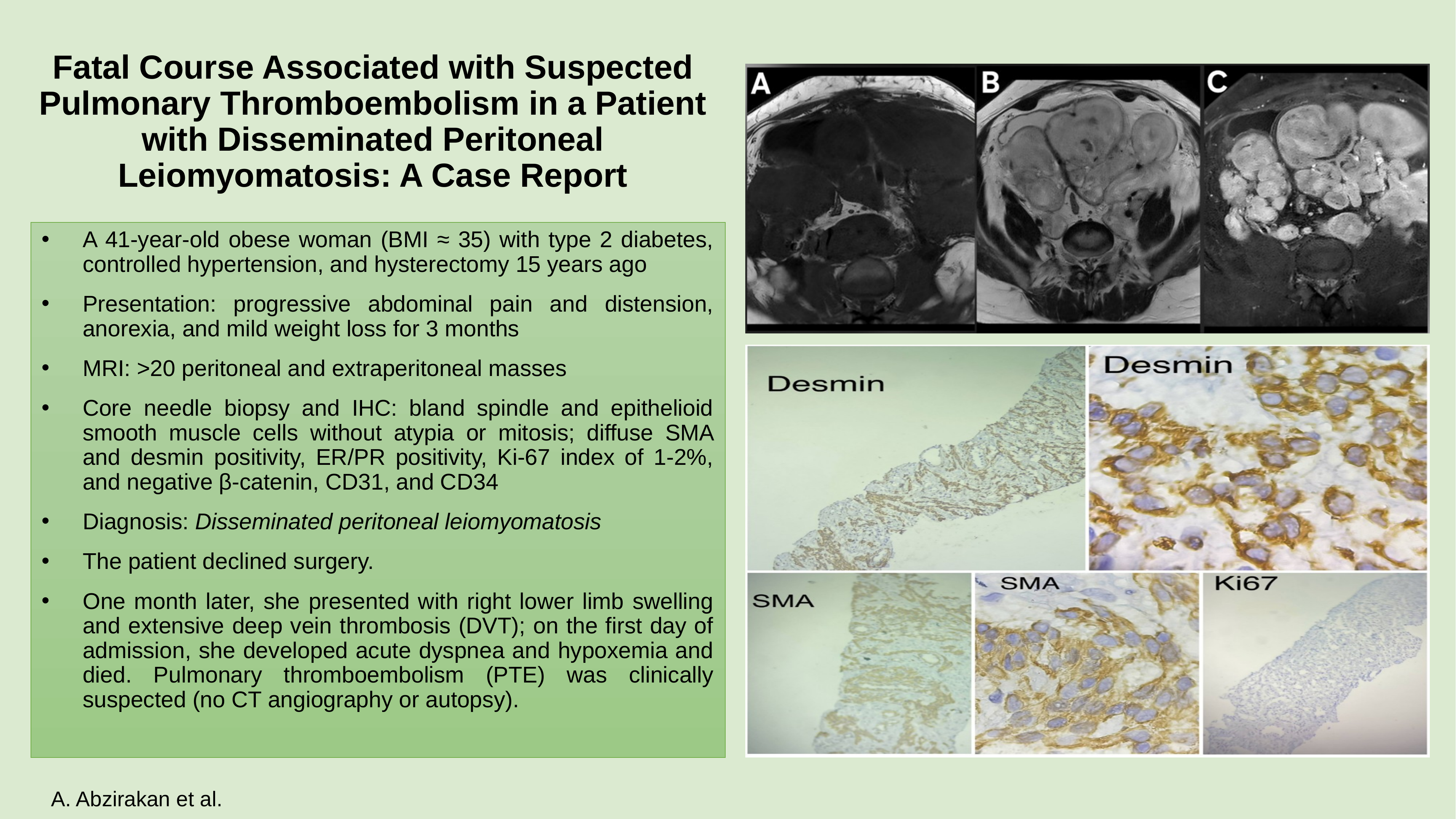
A 41-year-old obese woman (body mass index, approximately 35 kg/m²) with type 2 diabetes mellitus and controlled hypertension, with a history of hysterectomy 15 years earlier for abnormal uterine bleeding associated with multiple uterine leiomyomas, presented with a 3-month history of progressive abdominal pain and distension, anorexia and mild weight loss. Magnetic resonance imaging revealed more than 20 discrete peritoneal and extraperitoneal masses throughout the abdominopelvic cavity, without intravascular extension. Core needle biopsy demonstrated bland spindle and epithelioid cells of smooth muscle origin, with no cytological atypia or mitotic activity. Immunohistochemistry revealed diffuse expression of smooth muscle actin and desmin, positivity for oestrogen and progesterone receptors, a low Ki-67 proliferation index (1-2%), and negative staining for β-catenin, CD31 and CD34, supporting the diagnosis of DPL. The patient declined surgical intervention. One month later, she presented with right lower-limb swelling, and Doppler ultrasonography confirmed extensive deep vein thrombosis (DVT). On the first day of admission, despite receiving intravenous heparin, she developed acute dyspnoea, tachycardia and hypoxaemia and subsequently died. Pulmonary thromboembolism (PTE) was clinically suspected in view of the acute cardiopulmonary deterioration and confirmed extensive DVT. However, computed tomography pulmonary angiography could not be performed, and no post-mortem examination was undertaken; therefore, PTE could not be definitively confirmed.
This case illustrates a rare and fatal clinical course in a patient with extensive DPL and suspected PTE. It highlights the importance of individualised venous thromboembolism risk assessment and appropriate consideration of thromboprophylaxis, particularly in patients with extensive peritoneal disease and additional thrombotic risk factors, such as obesity and diabetes mellitus.
Keywords: disseminated peritoneal leiomyomatosis, venous thromboembolism, pulmonary embolism, leiomyoma
Type of Study: Case Report |
Subject:
Psychiatric Nursing
Send email to the article author
| Rights and permissions | |
 |
This work is licensed under a Creative Commons Attribution-NonCommercial 4.0 International License. |

Articles Copyright © The Author(s). Owned by Mazandaran University of Medical Sciences.
Contact Us
Address: Journal Office, Building No. 2, Mazandaran University of Medical Sciences, Moallem Square, Sari.Tel: +98 (011)34484874 Postal code: 48175-866 E-Mail: jmums@mazums.ac.ir Telefax: +98 (011)33262679
