

Volume 36, Issue 259 (8-2026)
J Mazandaran Univ Med Sci 2026, 36(259): 281-296 |
Back to browse issues page



Download citation:
BibTeX | RIS | EndNote | Medlars | ProCite | Reference Manager | RefWorks
Send citation to:


BibTeX | RIS | EndNote | Medlars | ProCite | Reference Manager | RefWorks
Send citation to:
Abedi G, Malekzadeh R, Momeni K, Amin Poor E. A Systematic Review of the Underlying Drivers of Discharge Against Medical Advice in Iran. J Mazandaran Univ Med Sci 2026; 36 (259) :281-296
URL: http://jmums.mazums.ac.ir/article-1-22859-en.html
URL: http://jmums.mazums.ac.ir/article-1-22859-en.html


Abstract: (571 Views)
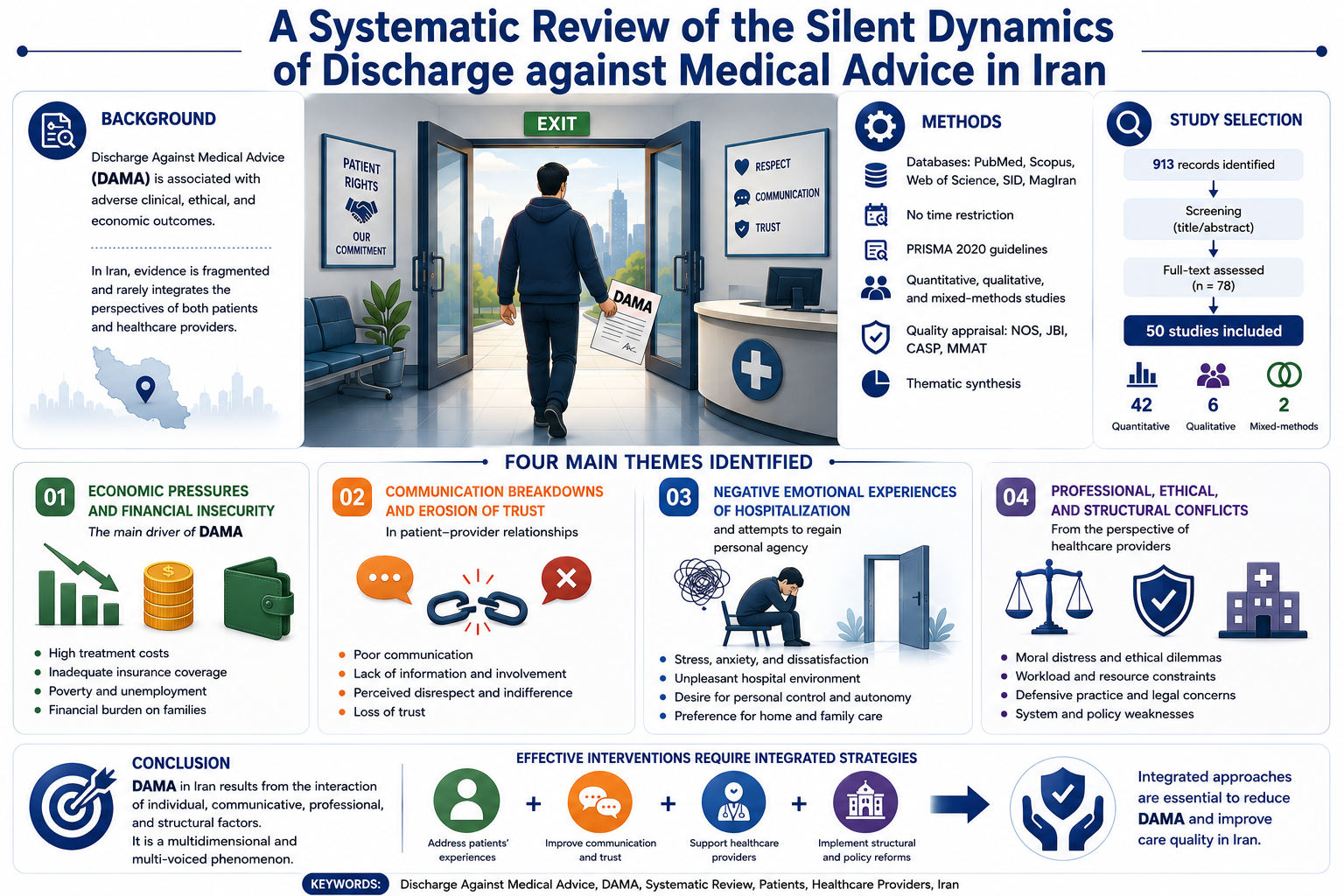
Background and purpose: Discharge Against Medical Advice (DAMA) is a major challenge for health systems, with significant adverse clinical, ethical, and economic outcomes. In Iran, numerous studies have examined this phenomenon; however, the available evidence is fragmented and seldom integrates the perspectives of both patients and healthcare providers. This study aimed to systematically review DAMA in Iran from the perspectives of patients and healthcare providers.
Materials and methods: This systematic review was conducted according to the PRISMA 2020 guidelines. A comprehensive search was performed across PubMed, Scopus, Web of Science, SID, and MagIran without any time restriction. The PubMed search formula was: ((("Discharge Against Medical Advice"[Mesh]) OR ("Against Medical Advice"[tiab]) OR ("DAMA"[tiab])) AND ("Iran"[Mesh] OR "Iran"[tiab])) NOT ("Editorial"[pt] OR "Letter"[pt] OR "Comment"[pt]). Boolean operators AND, OR, and NOT were applied. Quantitative, qualitative, and mixed-methods studies addressing DAMA in Iran were included. Study quality was assessed using the NOS, JBI, CASP, and MMAT assessment tools. Two independent reviewers extracted the data and synthesized the findings using a thematic approach.
Results: A total of 50 studies met the eligibility criteria, including 42 quantitative, 6 qualitative, and 2 mixed-methods studies, and were included in the review. Thematic synthesis revealed four main themes: (1) economic pressures and financial insecurity as the primary driver of DAMA; (2) communication breakdowns and the erosion of trust in patient-provider relationships; (3) negative emotional experiences during hospitalisation and attempts to regain personal agency; and (4) professional, ethical, and structural conflicts from the perspective of healthcare providers. Overall, the findings demonstrated that DAMA in Iran is a multidimensional and multifaceted phenomenon.
Conclusion: DAMA in Iran results from the interaction of individual, communicative, professional, and structural factors. Effective interventions require integrated strategies that simultaneously address patients' experiences, healthcare providers' challenges, and structural barriers to reduce the incidence of DAMA.
Materials and methods: This systematic review was conducted according to the PRISMA 2020 guidelines. A comprehensive search was performed across PubMed, Scopus, Web of Science, SID, and MagIran without any time restriction. The PubMed search formula was: ((("Discharge Against Medical Advice"[Mesh]) OR ("Against Medical Advice"[tiab]) OR ("DAMA"[tiab])) AND ("Iran"[Mesh] OR "Iran"[tiab])) NOT ("Editorial"[pt] OR "Letter"[pt] OR "Comment"[pt]). Boolean operators AND, OR, and NOT were applied. Quantitative, qualitative, and mixed-methods studies addressing DAMA in Iran were included. Study quality was assessed using the NOS, JBI, CASP, and MMAT assessment tools. Two independent reviewers extracted the data and synthesized the findings using a thematic approach.
Results: A total of 50 studies met the eligibility criteria, including 42 quantitative, 6 qualitative, and 2 mixed-methods studies, and were included in the review. Thematic synthesis revealed four main themes: (1) economic pressures and financial insecurity as the primary driver of DAMA; (2) communication breakdowns and the erosion of trust in patient-provider relationships; (3) negative emotional experiences during hospitalisation and attempts to regain personal agency; and (4) professional, ethical, and structural conflicts from the perspective of healthcare providers. Overall, the findings demonstrated that DAMA in Iran is a multidimensional and multifaceted phenomenon.
Conclusion: DAMA in Iran results from the interaction of individual, communicative, professional, and structural factors. Effective interventions require integrated strategies that simultaneously address patients' experiences, healthcare providers' challenges, and structural barriers to reduce the incidence of DAMA.
Keywords: Discharge against Medical Advice, DAMA, systematic review, patients, healthcare professionals, Iran
Type of Study: Review |
Subject:
Health Services Management
Send email to the article author
| Rights and permissions | |
 |
This work is licensed under a Creative Commons Attribution-NonCommercial 4.0 International License. |

Articles Copyright © The Author(s). Owned by Mazandaran University of Medical Sciences.
Contact Us
Address: Journal Office, Building No. 2, Mazandaran University of Medical Sciences, Moallem Square, Sari.Tel: +98 (011)34484874 Postal code: 48175-866 E-Mail: jmums@mazums.ac.ir Telefax: +98 (011)33262679
