

Volume 36, Issue 263 (11-2026)
J Mazandaran Univ Med Sci 2026, 36(263): 285-300 |
Back to browse issues page



Download citation:
BibTeX | RIS | EndNote | Medlars | ProCite | Reference Manager | RefWorks
Send citation to:


BibTeX | RIS | EndNote | Medlars | ProCite | Reference Manager | RefWorks
Send citation to:
Gholamian-Moghri Z, Pakdin Parizi A, Mohammadi H, Khodashenas A, Mogharabi-Manzari M. Recent Advances in Bacterial Cellulose Production, Modification, and Biomedical Applications: A Review. , J Mazandaran Univ Med Sci. 2026; 36 (263) :285-300
URL: http://jmums.mazums.ac.ir/article-1-22954-en.html
URL: http://jmums.mazums.ac.ir/article-1-22954-en.html
Zahra Gholamian-Moghri 
 , Ali Pakdin Parizi , Hamidreza Mohammadi , Amirali Khodashenas , Mehdi Mogharabi-Manzari *
Abstract: (6 Views)
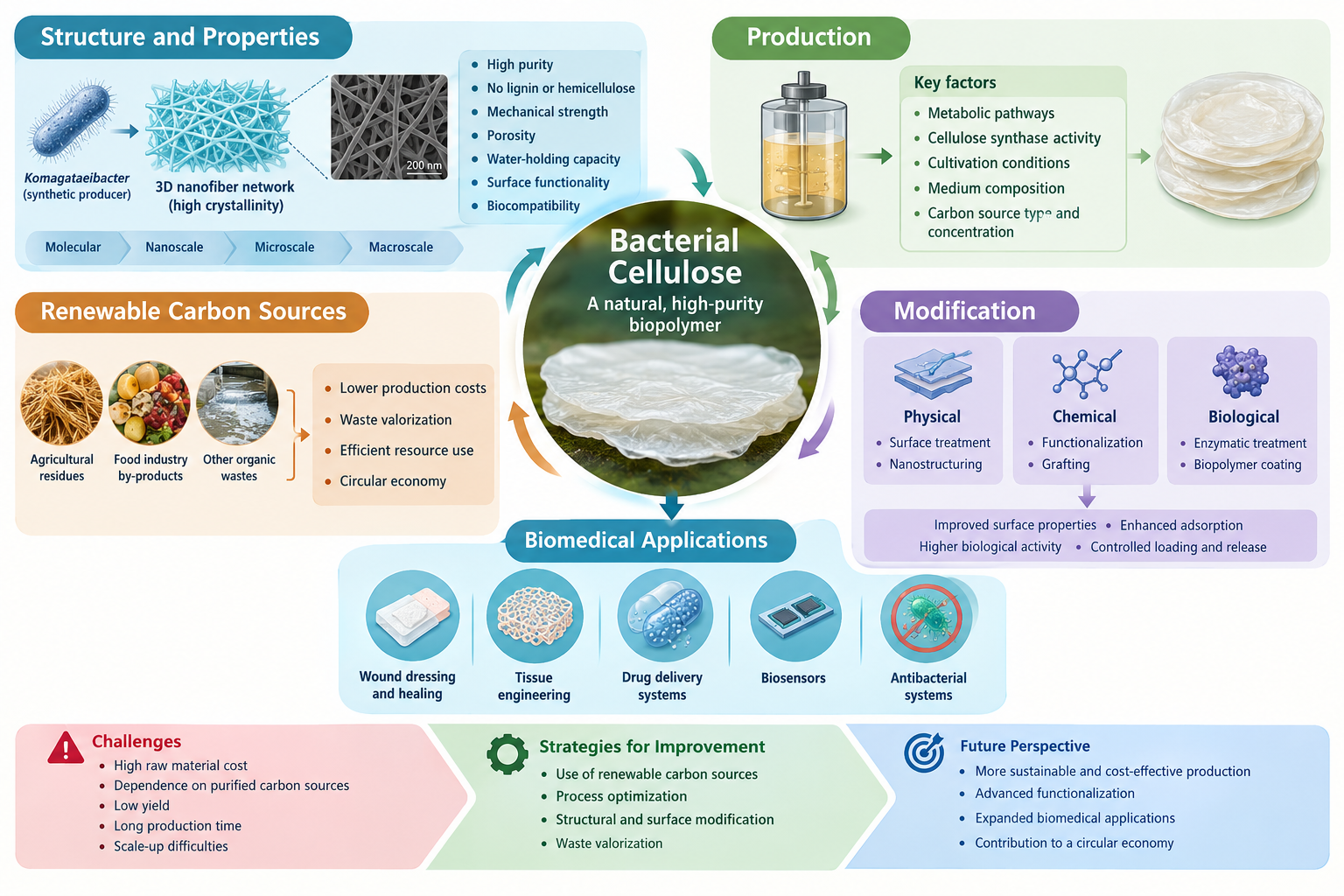
Bacterial cellulose is an important natural biopolymer produced mainly by aerobic bacteria of the genus Komagataeibacter. Owing to its high purity and lack of lignin and hemicellulose, bacterial cellulose possesses a more uniform and highly organized structure and distinct functional properties compared with plant-derived cellulose. It consists of a three-dimensional network of cellulose nanofibres with a high degree of crystallinity, contributing to its distinctive mechanical, physicochemical and biological properties. The hierarchical structure of bacterial cellulose, ranging from the molecular to the nanoscale, is a key determinant of its surface characteristics, water-holding capacity, porosity, mechanical strength and ability to interact with cells. Its biosynthesis is governed by metabolic pathways, the activity of the cellulose synthase enzyme complex, cultivation conditions, medium composition, and the type and concentration of the carbon source. Despite its desirable properties, the large-scale production of bacterial cellulose still faces several limitations, including high raw material costs, reliance on refined carbon sources, relatively low yields, long production cycles and challenges in scaling up production. The use of agricultural residues as alternative substrates can reduce production costs while promoting waste valorisation, improving resource efficiency and supporting the development of a circular economy. In addition, physical, chemical and biological modification approaches enable the regulation of bacterial cellulose's structural and surface properties, thereby enhancing its adsorption capacity, biological activity and potential for the loading and controlled release of active compounds. Owing to its biocompatibility, biodegradability, porosity, water-holding capacity and versatility for surface modification, bacterial cellulose has attracted considerable attention as a biomaterial for various biomedical applications, including wound dressings, tissue engineering, drug delivery and biosensors. This review examines the relationships between the structure and properties of bacterial cellulose, its biosynthetic mechanisms and production using renewable carbon sources. It also discusses strategies for improving production and modifying its structure, biomedical applications, current challenges, recent advances and future perspectives for the development and use of this versatile biomaterial.
Keywords: bacterial cellulose, Komagataeibacter, biopolymer, biocompatibility, tissue engineering, wound dressing, drug delivery
Type of Study: Review |
Subject:
Biotechnology
| Rights and permissions | |
 |
This work is licensed under a Creative Commons Attribution-NonCommercial 4.0 International License. |

Articles Copyright © The Author(s). Owned by Mazandaran University of Medical Sciences.
Contact Us
Address: Journal Office, Building No. 2, Mazandaran University of Medical Sciences, Moallem Square, Sari.Tel: +98 (011)34484874 Postal code: 48175-866 E-Mail: jmums@mazums.ac.ir Telefax: +98 (011)33262679
