

Volume 36, Issue 261 (10-2026)
J Mazandaran Univ Med Sci 2026, 36(261): 260-273 |
Back to browse issues page



Download citation:
BibTeX | RIS | EndNote | Medlars | ProCite | Reference Manager | RefWorks
Send citation to:


BibTeX | RIS | EndNote | Medlars | ProCite | Reference Manager | RefWorks
Send citation to:
Naghavi-Konjin Z, Raeisvand S, Gholami-Borujeni F. Systematic Review and Meta-Analysis of Bisphenol A Concentrations in Thermal Paper Receipts and Dermal Exposure Health Risks in General and Occupational Populations. J Mazandaran Univ Med Sci 2026; 36 (261) :260-273
URL: http://jmums.mazums.ac.ir/article-1-22963-en.html
URL: http://jmums.mazums.ac.ir/article-1-22963-en.html


Abstract: (18 Views)
Background and purpose: Bisphenol A (BPA), which is used as a color developer in thermal paper receipts, is an important source of non-dietary dermal exposure to this endocrine-disrupting chemical. This study aimed to estimate BPA concentrations in thermal paper receipts and assess the health risks associated with dermal exposure across general age-sex groups and occupational groups using Monte Carlo simulation under three scenarios: dry, wet, and greasy hands.
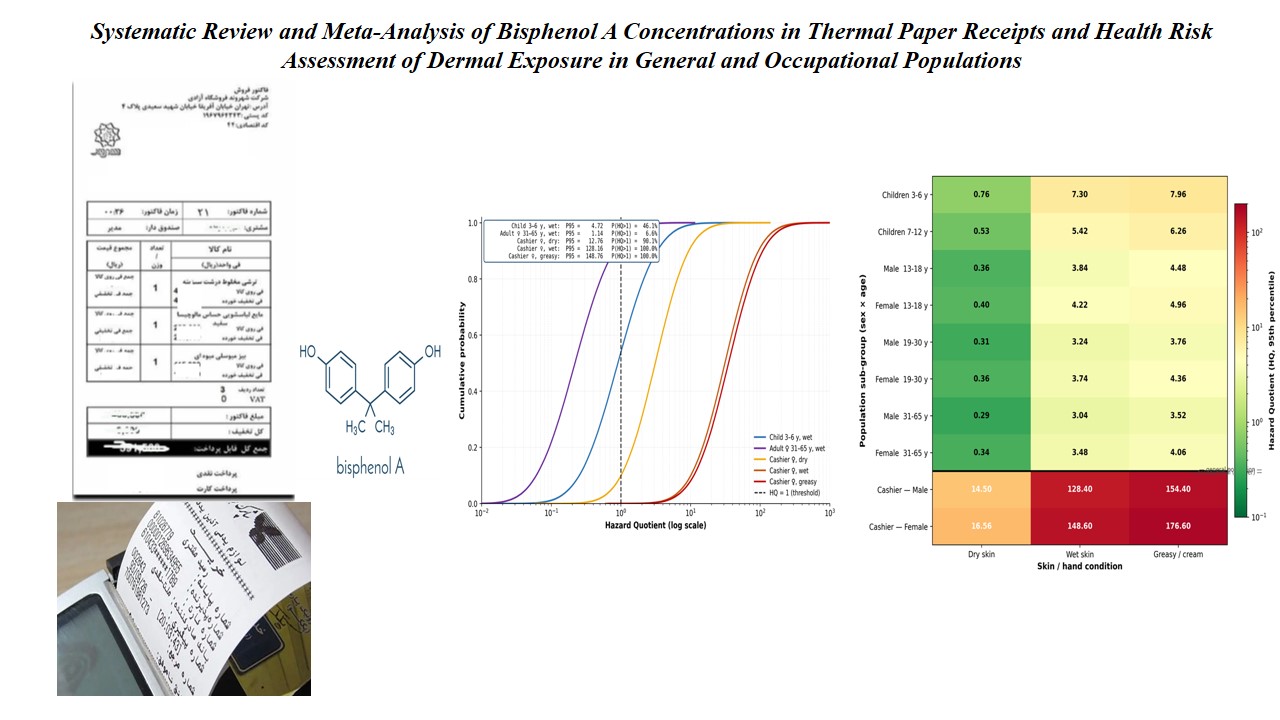
Materials and methods: A systematic search was conducted in PubMed, Scopus, Web of Science, ScienceDirect, and Google Scholar up to March 2026, following the PRISMA 2020 statement. Thirty-five independent studies comprising more than 2,800 samples were included in the analysis. Probabilistic risk assessment was performed using 10,000 Monte Carlo iterations in Crystal Ball software for six general age-sex groups and two occupational groups (female and male cashiers). The hazard quotient (HQ) was calculated based on the reference dose (RfD) of 5 × 10⁻⁵ mg/kg/day established by the US Environmental Protection Agency (EPA).
Results: The pooled mean BPA concentration in thermal paper receipts was 6.8 ± 3.9 mg/g. The highest concentrations were reported in Bangladesh, the United States (pre-ban), and Turkey, while the lowest were observed in Switzerland and the United Kingdom (post-ban). In the general population, the 95th percentile HQ under the dry-hand scenario was below 1 (indicating a lower level of risk); however, under the wet- and greasy-hand scenarios, HQ values in children reached 7.3 and 8.0, respectively, indicating higher levels of risk. In the occupational group, the 95th percentile HQ under the greasy-hand scenario reached 176.6 in females and 154.4 in males, indicating substantially elevated exposure risk.
Conclusion: Thermal paper receipts represent an important source of dermal BPA exposure. Wet or greasy hands may increase BPA transfer by up to 25-fold, potentially resulting in substantial exposure among occupationally exposed groups. Potential risk-reduction measures include limiting BPA concentrations in thermal paper, consistent with the 0.02% restriction under the EU REACH regulation, promoting appropriate protective measures for cashiers, and advising individuals to handle receipts with dry hands.
Materials and methods: A systematic search was conducted in PubMed, Scopus, Web of Science, ScienceDirect, and Google Scholar up to March 2026, following the PRISMA 2020 statement. Thirty-five independent studies comprising more than 2,800 samples were included in the analysis. Probabilistic risk assessment was performed using 10,000 Monte Carlo iterations in Crystal Ball software for six general age-sex groups and two occupational groups (female and male cashiers). The hazard quotient (HQ) was calculated based on the reference dose (RfD) of 5 × 10⁻⁵ mg/kg/day established by the US Environmental Protection Agency (EPA).
Results: The pooled mean BPA concentration in thermal paper receipts was 6.8 ± 3.9 mg/g. The highest concentrations were reported in Bangladesh, the United States (pre-ban), and Turkey, while the lowest were observed in Switzerland and the United Kingdom (post-ban). In the general population, the 95th percentile HQ under the dry-hand scenario was below 1 (indicating a lower level of risk); however, under the wet- and greasy-hand scenarios, HQ values in children reached 7.3 and 8.0, respectively, indicating higher levels of risk. In the occupational group, the 95th percentile HQ under the greasy-hand scenario reached 176.6 in females and 154.4 in males, indicating substantially elevated exposure risk.
Conclusion: Thermal paper receipts represent an important source of dermal BPA exposure. Wet or greasy hands may increase BPA transfer by up to 25-fold, potentially resulting in substantial exposure among occupationally exposed groups. Potential risk-reduction measures include limiting BPA concentrations in thermal paper, consistent with the 0.02% restriction under the EU REACH regulation, promoting appropriate protective measures for cashiers, and advising individuals to handle receipts with dry hands.
Keywords: bisphenol A, thermal paper, risk assessment, dermal exposure, Monte Carlo simulation, systematic review
Type of Study: Review |
Subject:
Environmental Health
Send email to the article author
| Rights and permissions | |
 |
This work is licensed under a Creative Commons Attribution-NonCommercial 4.0 International License. |

Articles Copyright © The Author(s). Owned by Mazandaran University of Medical Sciences.
Contact Us
Address: Journal Office, Building No. 2, Mazandaran University of Medical Sciences, Moallem Square, Sari.Tel: +98 (011)34484874 Postal code: 48175-866 E-Mail: jmums@mazums.ac.ir Telefax: +98 (011)33262679
