

Volume 36, Issue 264 (11-2026)
J Mazandaran Univ Med Sci 2026, 36(264): 198-203 |
Back to browse issues page



Download citation:
BibTeX | RIS | EndNote | Medlars | ProCite | Reference Manager | RefWorks
Send citation to:


BibTeX | RIS | EndNote | Medlars | ProCite | Reference Manager | RefWorks
Send citation to:
Mirzaeiyan M, Akhavan A, Khanahmad H, Sharifonnasabi Z. Logistic Regression Analysis of Dosimetric Parameters and VEGF Levels for Predicting Radiation‑Induced Rectal Toxicity in Prostate Cancer Patients. , J Mazandaran Univ Med Sci. 2026; 36 (264) :198-203
URL: http://jmums.mazums.ac.ir/article-1-23004-en.html
URL: http://jmums.mazums.ac.ir/article-1-23004-en.html


Abstract: (18 Views)
Background and purpose: Radiation‑induced rectal toxicity remains a significant complication in prostate cancer radiotherapy. Identifying predictive factors could help personalize treatment planning and reduce complications. This study aimed to evaluate the predictive value of serum vascular endothelial growth factor (VEGF) levels and dosimetric parameters (DPs) for rectal toxicity using logistic regression analysis.
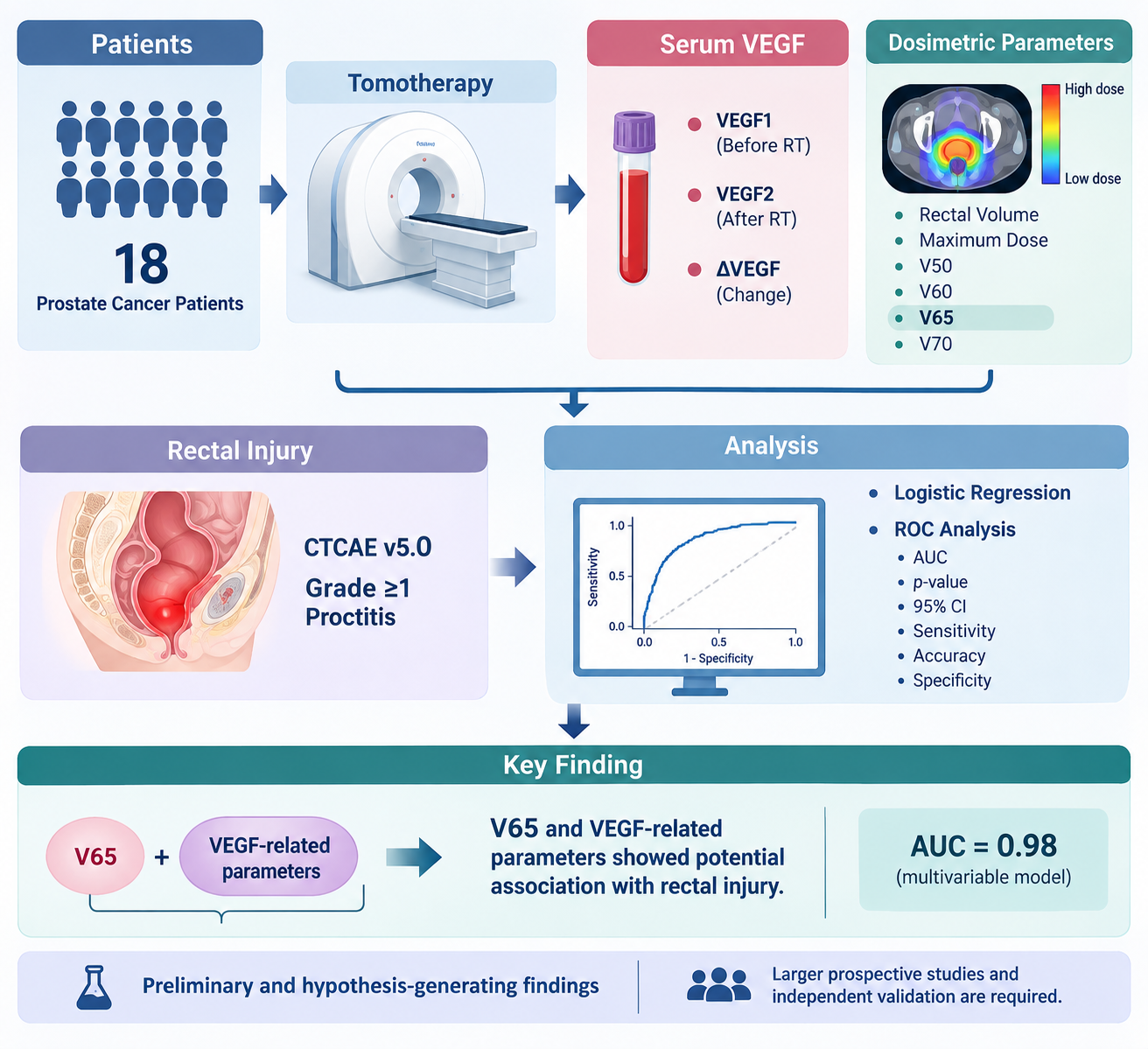
Materials and methods: Eighteen prostate cancer patients treated with helical tomotherapy were included in this study. Serum VEGF levels were measured before and after radiotherapy. DPs including rectal volume, maximum dose, V50, V60, V65, and V70 were extracted from treatment plans. Rectal toxicity was defined as grade ≥1 radiation proctitis. Logistic regression analysis was performed to evaluate the association between VEGF levels, ΔVEGF, dosimetric parameters, and rectal toxicity.
Results: Among the univariate models, baseline VEGF (VEGF1; AUC = 0.74, sensitivity = 0.89, accuracy = 0.67, and specificity = 0.44) and V65 (AUC = 0.76, sensitivity = 0.78, accuracy = 0.78, and specificity = 0.78) showed the best predictive performance. In multivariate analysis, the model combining VEGF1, ΔVEGF, and DPs achieved the highest predictive power, with an AUC of 0.98, sensitivity of 0.89, accuracy of 0.83, and specificity of 0.78.
Conclusion: Biological markers such as VEGF, when used alone or in combination with DPs, may improve the prediction of radiation therapy–induced complications. Integrating biological and dosimetric factors could contribute to more accurate risk assessment and support the development of personalized radiotherapy strategies, potentially leading to improved treatment outcomes.
Type of Study: Brief Report |
Subject:
Medical physics
| Rights and permissions | |
 |
This work is licensed under a Creative Commons Attribution-NonCommercial 4.0 International License. |

Articles Copyright © The Author(s). Owned by Mazandaran University of Medical Sciences.
Contact Us
Address: Journal Office, Building No. 2, Mazandaran University of Medical Sciences, Moallem Square, Sari.Tel: +98 (011)34484874 Postal code: 48175-866 E-Mail: jmums@mazums.ac.ir Telefax: +98 (011)33262679
