

Volume 36, Issue 259 (8-2026)
J Mazandaran Univ Med Sci 2026, 36(259): 252-236 |
Back to browse issues page



Download citation:
BibTeX | RIS | EndNote | Medlars | ProCite | Reference Manager | RefWorks
Send citation to:


BibTeX | RIS | EndNote | Medlars | ProCite | Reference Manager | RefWorks
Send citation to:
Hosseinzadeh F, Kazemi S S, Rezai M S. Health Education Models and Theories for Promoting Awareness and Acceptance of HPV Vaccination in Adolescents and Young Adults: A Narrative Review with focus on Research Gaps in Iran. J Mazandaran Univ Med Sci 2026; 36 (259) :252-236
URL: http://jmums.mazums.ac.ir/article-1-23019-en.html
URL: http://jmums.mazums.ac.ir/article-1-23019-en.html


Abstract: (653 Views)
Background and purpose: Vaccination against human papillomavirus (HPV) is one of the most effective primary prevention strategies for reducing the incidence of cervical cancer and certain anogenital and oropharyngeal malignancies. Despite strong evidence of vaccine efficacy, HPV vaccine uptake in Iran remains low - a gap that cannot be explained by limited awareness alone but rather reflects a combination of cultural, economic, structural, public trust, and programme-related factors. This study aimed to critically analyse health education models and theories used to promote HPV vaccination and to identify gaps in the existing research in Iran.
Materials and methods: This analytical narrative review was conducted in accordance with the SANRA criteria. Persian and English articles published between January 2016 and March 2026 were retrieved from PubMed, Scopus, ScienceDirect, SID, and Magiran. Health education and behaviour-change models were classified into four clusters (individual-focused, social-cognitive, structural/systemic, and vaccine-hesitancy models) and analysed with respect to their applicability, limitations, adaptability to the Iranian context, and ability to explain the intention-behaviour gap.
Results: Individual models such as the Health Belief Model (HBM) and Theory of Planned Behaviour (TPB) remain among the most frequently applied frameworks in HPV interventions; however, they predominantly address beliefs, attitudes, and behavioural intention and have limited capacity to explain structural barriers such as vaccine cost, lack of insurance coverage, the absence of a national immunisation programme, social stigma, and limited active recommendation of vaccination by healthcare providers. In contrast, the COM-B framework, the Theoretical Domains Framework (TDF), the 5C model, and the Social-Ecological Model (SEM) demonstrate greater potential for analysing behaviour at multiple levels and informing the design of implementable interventions.
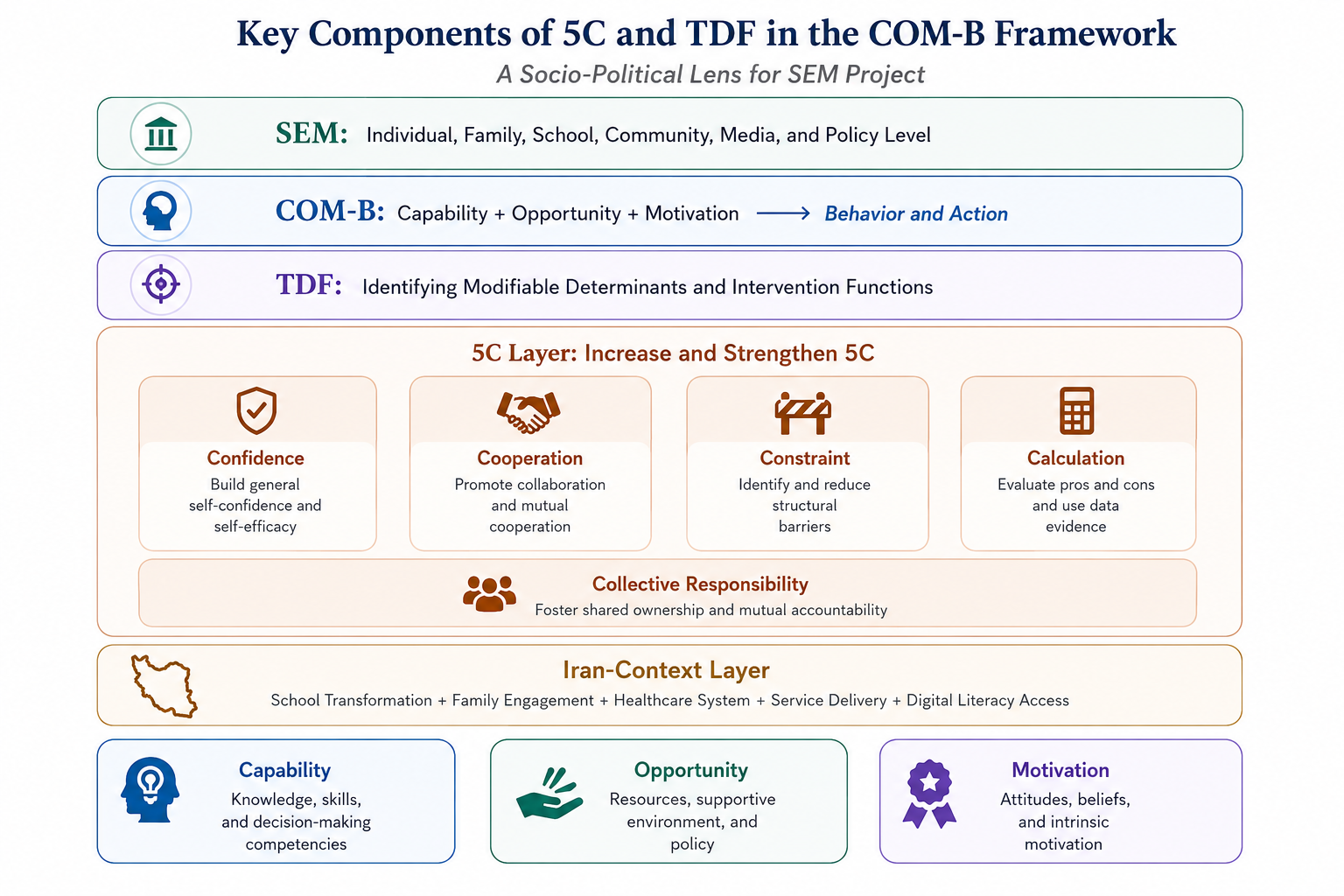
Conclusion: Improving HPV vaccination in Iran requires a paradigm shift from purely educational approaches and cognitive models towards multilevel, culturally grounded, and implementation-oriented interventions. The conceptual framework proposed in this article uses SEM as the macro-level lens, COM-B as the operational core, TDF to identify modifiable barriers, and the 5C model to analyse vaccine hesitancy. This integrated framework can serve as a basis for designing school-based, family-based, provider-based, and policy-based programmes in Iran.
Materials and methods: This analytical narrative review was conducted in accordance with the SANRA criteria. Persian and English articles published between January 2016 and March 2026 were retrieved from PubMed, Scopus, ScienceDirect, SID, and Magiran. Health education and behaviour-change models were classified into four clusters (individual-focused, social-cognitive, structural/systemic, and vaccine-hesitancy models) and analysed with respect to their applicability, limitations, adaptability to the Iranian context, and ability to explain the intention-behaviour gap.
Results: Individual models such as the Health Belief Model (HBM) and Theory of Planned Behaviour (TPB) remain among the most frequently applied frameworks in HPV interventions; however, they predominantly address beliefs, attitudes, and behavioural intention and have limited capacity to explain structural barriers such as vaccine cost, lack of insurance coverage, the absence of a national immunisation programme, social stigma, and limited active recommendation of vaccination by healthcare providers. In contrast, the COM-B framework, the Theoretical Domains Framework (TDF), the 5C model, and the Social-Ecological Model (SEM) demonstrate greater potential for analysing behaviour at multiple levels and informing the design of implementable interventions.
Conclusion: Improving HPV vaccination in Iran requires a paradigm shift from purely educational approaches and cognitive models towards multilevel, culturally grounded, and implementation-oriented interventions. The conceptual framework proposed in this article uses SEM as the macro-level lens, COM-B as the operational core, TDF to identify modifiable barriers, and the 5C model to analyse vaccine hesitancy. This integrated framework can serve as a basis for designing school-based, family-based, provider-based, and policy-based programmes in Iran.
Keywords: HPV, vaccination, health education, Health Belief Model, Theory of Planned Behaviour, COM-B, TDF, 5C model, Social-Ecological Model, Iran
Type of Study: Review |
Subject:
Health Education
Send email to the article author
| Rights and permissions | |
 |
This work is licensed under a Creative Commons Attribution-NonCommercial 4.0 International License. |

Articles Copyright © The Author(s). Owned by Mazandaran University of Medical Sciences.
Contact Us
Address: Journal Office, Building No. 2, Mazandaran University of Medical Sciences, Moallem Square, Sari.Tel: +98 (011)34484874 Postal code: 48175-866 E-Mail: jmums@mazums.ac.ir Telefax: +98 (011)33262679
