

Volume 36, Issue 261 (10-2026)
J Mazandaran Univ Med Sci 2026, 36(261): 151-157 |
Back to browse issues page



Download citation:
BibTeX | RIS | EndNote | Medlars | ProCite | Reference Manager | RefWorks
Send citation to:


BibTeX | RIS | EndNote | Medlars | ProCite | Reference Manager | RefWorks
Send citation to:
Edalat M, Bidram P, Kaveh A, Shojaei P. Effect of Ezetimibe on the Prevention of Contrast-Induced Nephropathy Following Angiography. J Mazandaran Univ Med Sci 2026; 36 (261) :151-157
URL: http://jmums.mazums.ac.ir/article-1-23030-en.html
URL: http://jmums.mazums.ac.ir/article-1-23030-en.html


Abstract: (20 Views)
Background and purpose: Contrast-induced nephropathy (CIN) is an important complication of angiographic procedures. This study aimed to evaluate the effect of a single dose of ezetimibe on the incidence of CIN and changes in renal function indices following exposure to contrast media.
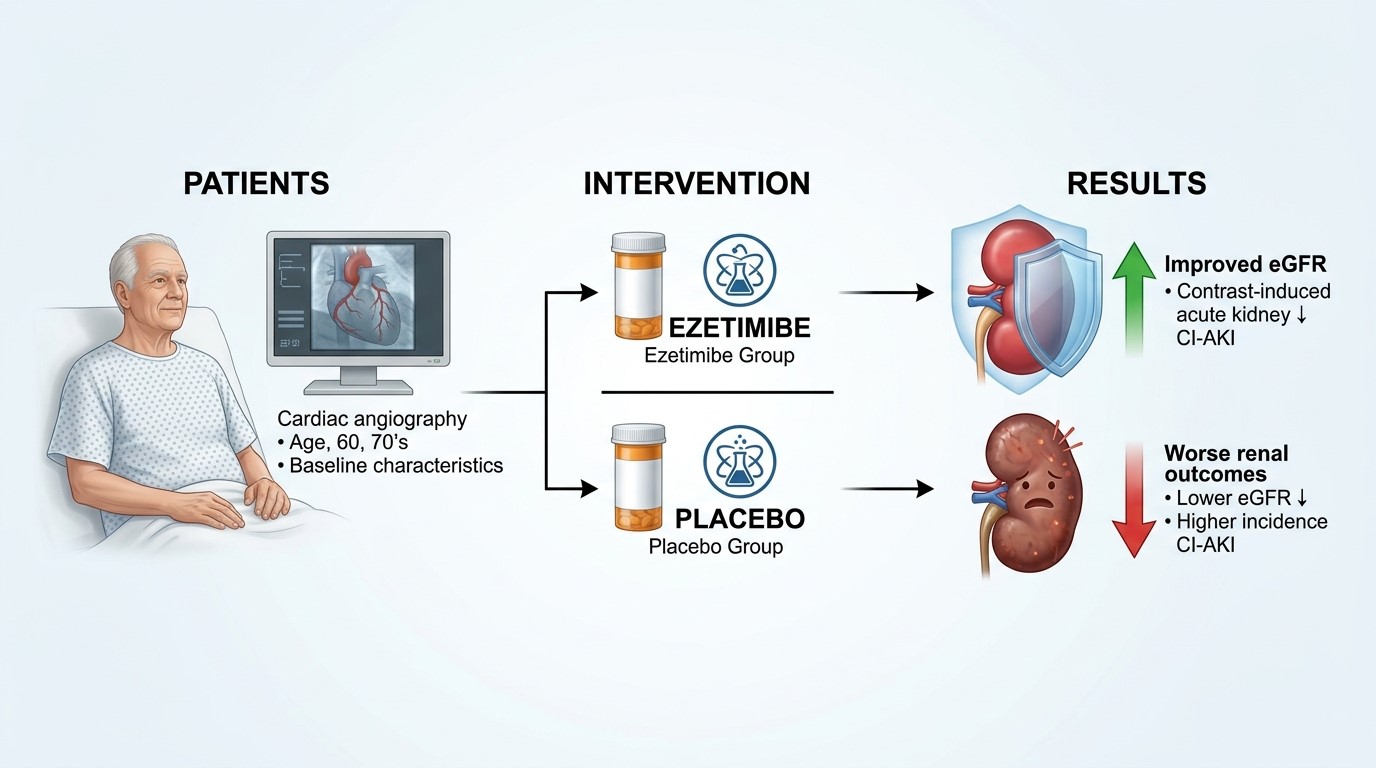
Materials and methods: This double-blind clinical trial was conducted in 144 patients undergoing coronary angiography, who were randomly assigned to receive ezetimibe (n = 73) or placebo (n = 71). Serum creatinine and glomerular filtration rate (GFR) were measured before the intervention and 48-72 hours after the intervention. The primary outcome was the incidence of CIN, defined as an increase in serum creatinine of at least 0.3 mg/dL or at least 1.5 times the baseline value within 48-72 hours of contrast exposure. CIN incidence was compared using Fisher's exact test, and the effect size was expressed as the risk ratio (RR) with a 95% confidence interval (CI). Analysis of covariance (ANCOVA) was used to compare post-intervention serum creatinine and GFR between the groups after adjustment for baseline values.
Results: CIN occurred in one patient (1.4%) in the ezetimibe group and three patients (4.2%) in the placebo group. Although CIN was less frequent in the ezetimibe group, the difference was not statistically significant (Fisher's exact test, P = 0.363; RR = 0.324; 95% CI: 0.035–3.040). After adjustment for baseline creatinine, post-intervention creatinine was significantly lower in the ezetimibe group (F = 7.349, P = 0.008, partial η² = 0.050). Similarly, after adjustment for baseline GFR, post-intervention GFR was significantly higher in the ezetimibe group (F = 14.348, P < 0.001, partial η² = 0.092).
Conclusion: In this study, ezetimibe was associated with significantly more favourable changes in renal function indices, including serum creatinine and GFR, after adjustment for baseline values. These findings suggest a potential beneficial effect of ezetimibe on renal function following contrast exposure; however, further studies are needed to confirm this effect.
Materials and methods: This double-blind clinical trial was conducted in 144 patients undergoing coronary angiography, who were randomly assigned to receive ezetimibe (n = 73) or placebo (n = 71). Serum creatinine and glomerular filtration rate (GFR) were measured before the intervention and 48-72 hours after the intervention. The primary outcome was the incidence of CIN, defined as an increase in serum creatinine of at least 0.3 mg/dL or at least 1.5 times the baseline value within 48-72 hours of contrast exposure. CIN incidence was compared using Fisher's exact test, and the effect size was expressed as the risk ratio (RR) with a 95% confidence interval (CI). Analysis of covariance (ANCOVA) was used to compare post-intervention serum creatinine and GFR between the groups after adjustment for baseline values.
Results: CIN occurred in one patient (1.4%) in the ezetimibe group and three patients (4.2%) in the placebo group. Although CIN was less frequent in the ezetimibe group, the difference was not statistically significant (Fisher's exact test, P = 0.363; RR = 0.324; 95% CI: 0.035–3.040). After adjustment for baseline creatinine, post-intervention creatinine was significantly lower in the ezetimibe group (F = 7.349, P = 0.008, partial η² = 0.050). Similarly, after adjustment for baseline GFR, post-intervention GFR was significantly higher in the ezetimibe group (F = 14.348, P < 0.001, partial η² = 0.092).
Conclusion: In this study, ezetimibe was associated with significantly more favourable changes in renal function indices, including serum creatinine and GFR, after adjustment for baseline values. These findings suggest a potential beneficial effect of ezetimibe on renal function following contrast exposure; however, further studies are needed to confirm this effect.
(Clinical Trials Registry Number: IRCT20250702066339N1)
Keywords: ezetimibe, contrast-induced nephropathy, angiography, acute kidney injury, older adults, renal function
Type of Study: Brief Report |
Subject:
Cardiovascular
Send email to the article author
| Rights and permissions | |
 |
This work is licensed under a Creative Commons Attribution-NonCommercial 4.0 International License. |

Articles Copyright © The Author(s). Owned by Mazandaran University of Medical Sciences.
Contact Us
Address: Journal Office, Building No. 2, Mazandaran University of Medical Sciences, Moallem Square, Sari.Tel: +98 (011)34484874 Postal code: 48175-866 E-Mail: jmums@mazums.ac.ir Telefax: +98 (011)33262679
