

Volume 36, Issue 262 (Special Issue 2026)
J Mazandaran Univ Med Sci 2026, 36(262): 15-25 |
Back to browse issues page



Download citation:
BibTeX | RIS | EndNote | Medlars | ProCite | Reference Manager | RefWorks
Send citation to:


BibTeX | RIS | EndNote | Medlars | ProCite | Reference Manager | RefWorks
Send citation to:
Ziar A, Mohammadi H, Shokrzadeh M. Effects of Naringin in Combination with Cisplatin on Cell Viability and Oxidative Stress Markers in HeLa Cervical Cancer Cells. , J Mazandaran Univ Med Sci. 2026; 36 (262) :15-25
URL: http://jmums.mazums.ac.ir/article-1-23037-en.html
URL: http://jmums.mazums.ac.ir/article-1-23037-en.html


Abstract: (31 Views)
Abstract
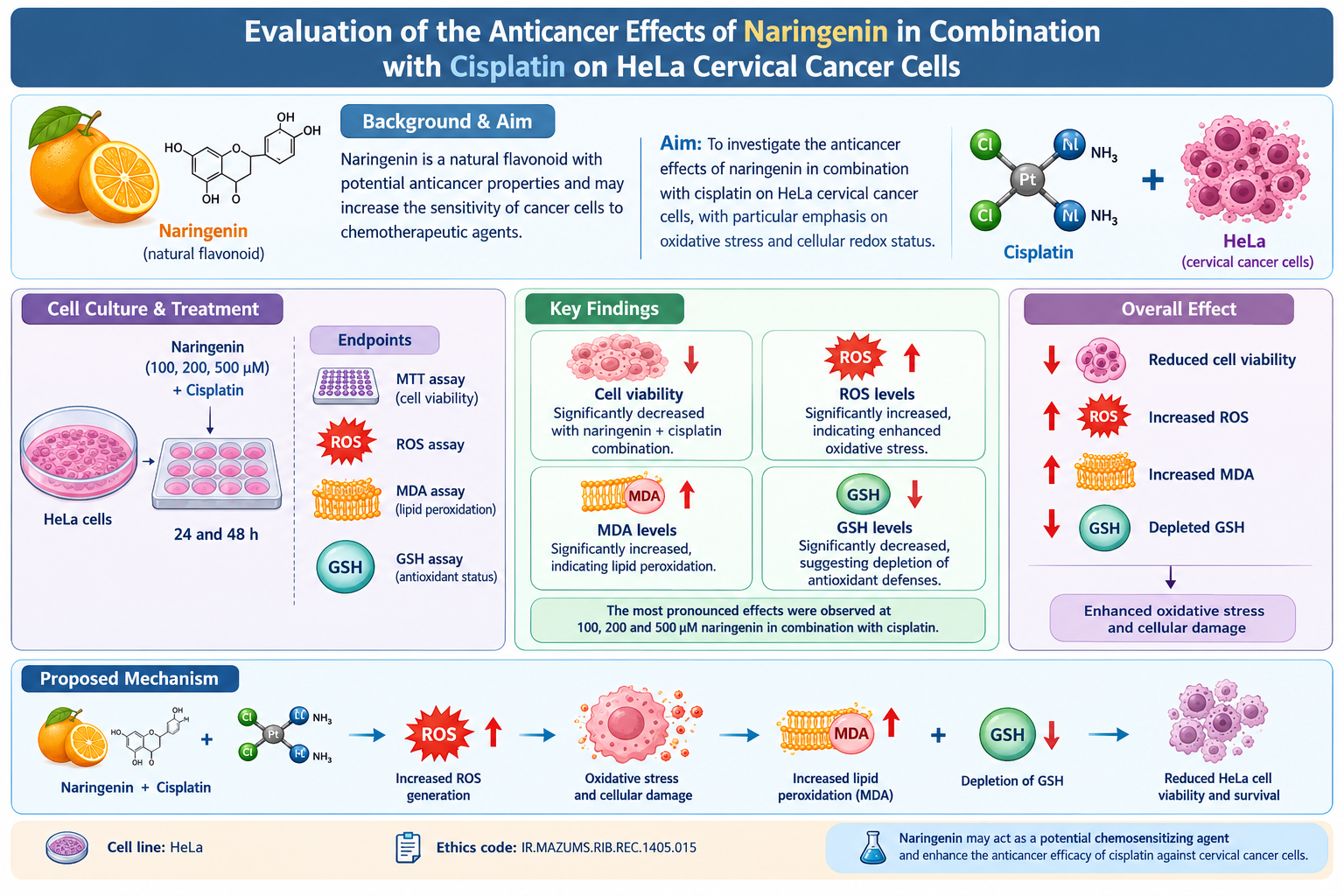
Background and purpose: Cancer comprises a group of diseases characterized by the uncontrolled growth and proliferation of abnormal cells, which disrupt the normal structure and function of tissues and organs. Chemotherapy is a mainstay of cancer treatment; however, the development of drug resistance and the adverse effects associated with chemotherapy have prompted the search for effective, less toxic compounds. Naringin, a plant-derived flavonoid, exhibits a broad range of biological activities, including antioxidant and anticancer effects. This study aimed to investigate the effects of naringin, alone and in combination with cisplatin, on cell viability and oxidative stress markers in HeLa cervical cancer cells.
Materials and methods: HeLa cells were cultured and treated for 24 h with naringin at concentrations of 100, 200, and 500 μM, either alone or in combination with cisplatin (12.5 μM). Cell viability was assessed using the MTT assay. Oxidative stress was evaluated by measuring malondialdehyde (MDA) levels as an indicator of lipid peroxidation, reactive oxygen species (ROS) levels, and reduced glutathione (GSH) levels.
Results: Combined treatment with naringin and cisplatin reduced cell viability and increased oxidative stress markers in HeLa cells across all three naringin concentrations (100, 200, and 500 μM). The magnitude of these effects varied with the naringin concentration, with the most pronounced changes observed following combined treatment.
Conclusion: Under the experimental conditions, naringin, particularly when combined with cisplatin, reduced HeLa cell viability and increased markers of oxidative stress, suggesting that it may enhance the cytotoxic effects of cisplatin. However, further studies incorporating standardised combination-effect analyses, including calculation of the combination index (CI), are needed to characterise the interaction between naringin and cisplatin and determine whether their combined effects are additive or synergistic.
Type of Study: Research(Original) |
Subject:
toxicology
Send email to the article author
| Rights and permissions | |
 |
This work is licensed under a Creative Commons Attribution-NonCommercial 4.0 International License. |

Articles Copyright © The Author(s). Owned by Mazandaran University of Medical Sciences.
Contact Us
Address: Journal Office, Building No. 2, Mazandaran University of Medical Sciences, Moallem Square, Sari.Tel: +98 (011)34484874 Postal code: 48175-866 E-Mail: jmums@mazums.ac.ir Telefax: +98 (011)33262679
