

Volume 36, Issue 261 (10-2026)
J Mazandaran Univ Med Sci 2026, 36(261): 72-83 |
Back to browse issues page



Download citation:
BibTeX | RIS | EndNote | Medlars | ProCite | Reference Manager | RefWorks
Send citation to:


BibTeX | RIS | EndNote | Medlars | ProCite | Reference Manager | RefWorks
Send citation to:
Shobeiri S S, Tahmasbi Fard M, Hasanpour K, Dehnavi A M, Mohammadi F, Salehipour H, et al . Temporal Trends and the Epidemiological Transition of Meningitis Burden in Iran (1990–2023): A Joinpoint Regression Analysis and Its Association with the Human Development Index. J Mazandaran Univ Med Sci 2026; 36 (261) :72-83
URL: http://jmums.mazums.ac.ir/article-1-23127-en.html
URL: http://jmums.mazums.ac.ir/article-1-23127-en.html
Saeideh Sadat Shobeiri 
 , Mina Tahmasbi Fard , Kazem Hasanpour , Amir Mohammad Dehnavi , Fatemeh Mohammadi , Hassan Salehipour , Elham Pouraslan , Afsaneh Kaffash , Nima Ghazal , Zaher Khazaei
, Mina Tahmasbi Fard , Kazem Hasanpour , Amir Mohammad Dehnavi , Fatemeh Mohammadi , Hassan Salehipour , Elham Pouraslan , Afsaneh Kaffash , Nima Ghazal , Zaher Khazaei
Abstract: (23 Views)
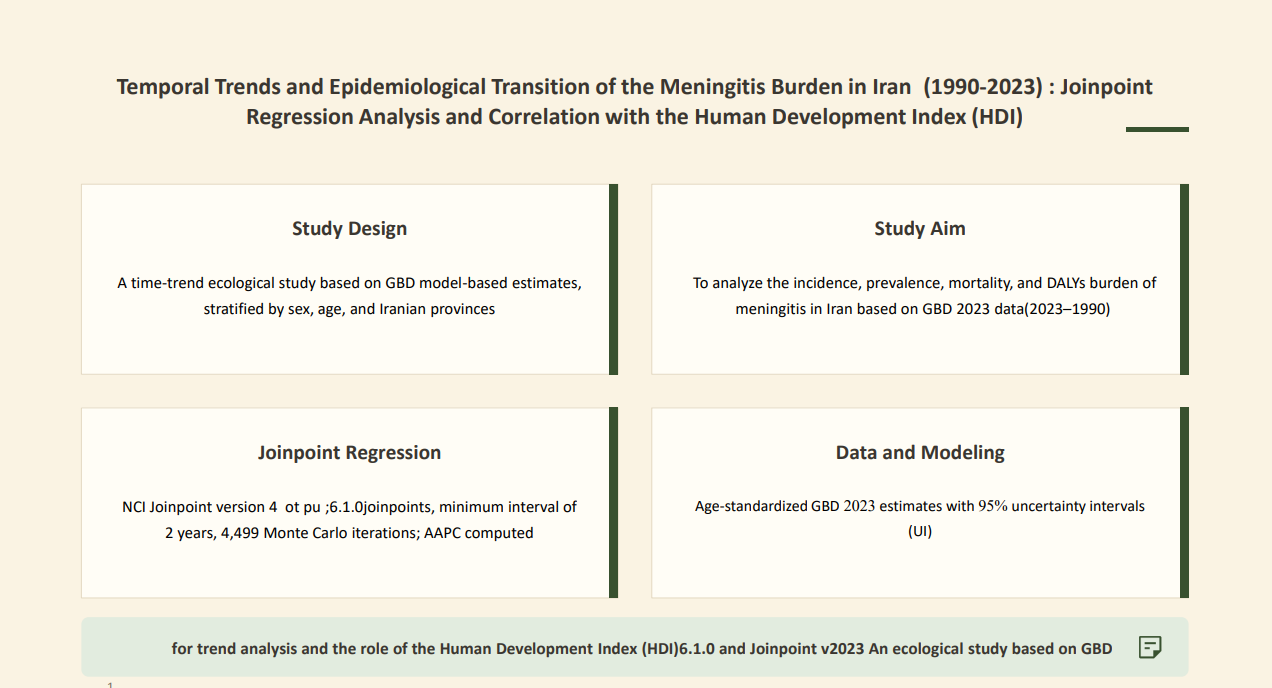
Background and Aims: Meningitis remains a major global cause of mortality and disability, and evaluating its long-term epidemiological shifts alongside contextual factors is essential for health policy. Given the scarcity of comprehensive evidence on the trends of meningitis alongside socio-economic development in Iran, this study aimed to analyze the temporal trends of the meningitis burden in Iran from 1990 to 2023 and evaluate its correlation with the Human Development Index (HDI).
Materials and methods: This descriptive-analytical ecological study utilized secondary data from the Global Burden of Disease (GBD) 2023 study. Age-standardized incidence (ASIR), prevalence (ASPR), and mortality (ASMR) rates were analyzed using Joinpoint regression to calculate the Average Annual Percent Change (AAPC). Furthermore, the correlation between these epidemiological indices and the Human Development Index (HDI) was assessed via linear regression.
Results: Between 1990 and 2023, significant declining trends were observed across all epidemiological metrics. The AAPC values for ASIR were −0.65% (95% UI: −0.68 to −0.63) in males and −0.66% (95% UI: −0.69 to −0.63) in females. For ASPR, the AAPC was −0.68% (95% UI: −0.71 to −0.65) in males and −0.66% (95% UI: −0.69 to −0.63) in females, while for ASMR, it was −0.77% (95% UI: −0.87 to −0.53) in males and −0.83% (95% UI: −0.90 to −0.73) in females. The highest overall disease burden was observed among children under 5 years of age, whereas mortality peaked among individuals aged 70 years and older. Improvements in the HDI were strongly and inversely associated with ASIR (R² = 0.96, P < 0.001), ASMR (R² = 0.94, P < 0.001), DALYs (R² = 0.95, P < 0.001), YLLs (R² = 0.94, P < 0.001), and YLDs (R² = 0.93, P < 0.001).
Conclusion: The epidemiological burden of meningitis in Iran declined substantially over the past three decades, with a strong inverse association between HDI and disease burden. Nonetheless, young children and older adults continue to bear the highest burden, highlighting the need for targeted vaccination and preventive strategies.
Materials and methods: This descriptive-analytical ecological study utilized secondary data from the Global Burden of Disease (GBD) 2023 study. Age-standardized incidence (ASIR), prevalence (ASPR), and mortality (ASMR) rates were analyzed using Joinpoint regression to calculate the Average Annual Percent Change (AAPC). Furthermore, the correlation between these epidemiological indices and the Human Development Index (HDI) was assessed via linear regression.
Results: Between 1990 and 2023, significant declining trends were observed across all epidemiological metrics. The AAPC values for ASIR were −0.65% (95% UI: −0.68 to −0.63) in males and −0.66% (95% UI: −0.69 to −0.63) in females. For ASPR, the AAPC was −0.68% (95% UI: −0.71 to −0.65) in males and −0.66% (95% UI: −0.69 to −0.63) in females, while for ASMR, it was −0.77% (95% UI: −0.87 to −0.53) in males and −0.83% (95% UI: −0.90 to −0.73) in females. The highest overall disease burden was observed among children under 5 years of age, whereas mortality peaked among individuals aged 70 years and older. Improvements in the HDI were strongly and inversely associated with ASIR (R² = 0.96, P < 0.001), ASMR (R² = 0.94, P < 0.001), DALYs (R² = 0.95, P < 0.001), YLLs (R² = 0.94, P < 0.001), and YLDs (R² = 0.93, P < 0.001).
Conclusion: The epidemiological burden of meningitis in Iran declined substantially over the past three decades, with a strong inverse association between HDI and disease burden. Nonetheless, young children and older adults continue to bear the highest burden, highlighting the need for targeted vaccination and preventive strategies.
Keywords: meningitis, Human Development Index, joinpoint regression analysis, Global Burden of Disease, Iran
Type of Study: Research(Original) |
Subject:
Epidemiology
Send email to the article author
| Rights and permissions | |
 |
This work is licensed under a Creative Commons Attribution-NonCommercial 4.0 International License. |

Articles Copyright © The Author(s). Owned by Mazandaran University of Medical Sciences.
Contact Us
Address: Journal Office, Building No. 2, Mazandaran University of Medical Sciences, Moallem Square, Sari.Tel: +98 (011)34484874 Postal code: 48175-866 E-Mail: jmums@mazums.ac.ir Telefax: +98 (011)33262679
