

Volume 36, Issue 261 (10-2026)
J Mazandaran Univ Med Sci 2026, 36(261): 309-326 |
Back to browse issues page



Download citation:
BibTeX | RIS | EndNote | Medlars | ProCite | Reference Manager | RefWorks
Send citation to:


BibTeX | RIS | EndNote | Medlars | ProCite | Reference Manager | RefWorks
Send citation to:
Nouri R, Yeganeh Sefidan F. Gut Microbiota Modulation in Colorectal Cancer: Mechanisms of Pathogenesis and Emerging Therapeutic Strategies. J Mazandaran Univ Med Sci 2026; 36 (261) :309-326
URL: http://jmums.mazums.ac.ir/article-1-23133-en.html
URL: http://jmums.mazums.ac.ir/article-1-23133-en.html


Abstract: (13 Views)
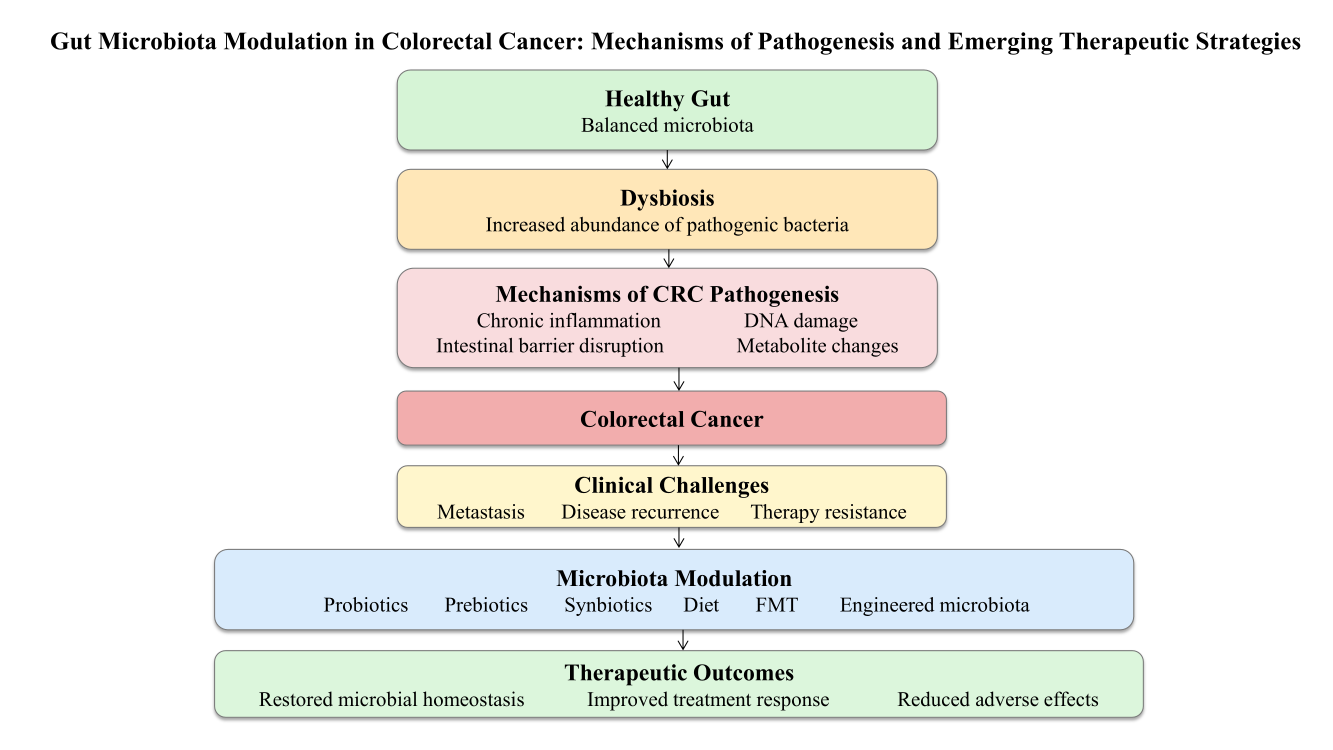
Colorectal cancer (CRC) is one of the most common malignancies worldwide and, owing to its high incidence and substantial mortality, remains a major public health challenge. Despite significant advances in diagnosis and treatment, metastasis, disease recurrence, and treatment resistance remain among the main challenges to achieving optimal therapeutic outcomes. In recent years, the gut microbiota has been recognised as one of the key factors in the pathogenesis of CRC and as a potential therapeutic target. Scientific evidence suggests that gut microbial dysbiosis, through mechanisms such as chronic inflammation, DNA damage, disruption of the intestinal mucosal barrier, and modulation of immune responses, plays an important role in tumour initiation and progression. In contrast, microbiota-modulating strategies, including probiotics, prebiotics, synbiotics, targeted dietary interventions, and faecal microbiota transplantation (FMT), have been proposed as promising approaches to improving treatment outcomes. Furthermore, existing evidence indicates that the composition and function of the gut microbiota may influence responses to chemotherapy, radiotherapy, and immunotherapy and may therefore serve as potential biomarkers of treatment response. Emerging microbiome-engineering approaches, including engineered probiotics and CRISPR-Cas-based technologies, have demonstrated potential for selectively targeting microorganisms and delivering therapeutic agents to the tumour microenvironment, although their clinical application remains limited by safety and technical challenges. Given the growing body of scientific evidence and variability in findings across studies, the present study aims to review the role of gut microbiota modulation in the management and treatment of CRC and to elucidate the underlying mechanisms and clinical applications of these approaches.
Keywords: colorectal cancer, gut microbiota, dysbiosis, gut microbiota modulation, pathogenesis, treatment response
Type of Study: Review |
Subject:
Microbiology
Send email to the article author
| Rights and permissions | |
 |
This work is licensed under a Creative Commons Attribution-NonCommercial 4.0 International License. |

Articles Copyright © The Author(s). Owned by Mazandaran University of Medical Sciences.
Contact Us
Address: Journal Office, Building No. 2, Mazandaran University of Medical Sciences, Moallem Square, Sari.Tel: +98 (011)34484874 Postal code: 48175-866 E-Mail: jmums@mazums.ac.ir Telefax: +98 (011)33262679
