

Volume 36, Issue 262 (Special Issue 2026)
J Mazandaran Univ Med Sci 2026, 36(262): 247-256 |
Back to browse issues page



Download citation:
BibTeX | RIS | EndNote | Medlars | ProCite | Reference Manager | RefWorks
Send citation to:


BibTeX | RIS | EndNote | Medlars | ProCite | Reference Manager | RefWorks
Send citation to:
Nasiri Formi E, Tabatabaei Aghda S J, Tabatabaei Aghda S A. Association Between Obesity and Constipation in Adults: A Systematic Review and Meta-analysis. , J Mazandaran Univ Med Sci. 2026; 36 (262) :247-256
URL: http://jmums.mazums.ac.ir/article-1-23147-en.html
URL: http://jmums.mazums.ac.ir/article-1-23147-en.html


Abstract: (15 Views)
Background and purpose: Although the association between obesity and constipation has been increasingly studied, uncertainty remains regarding this relationship.
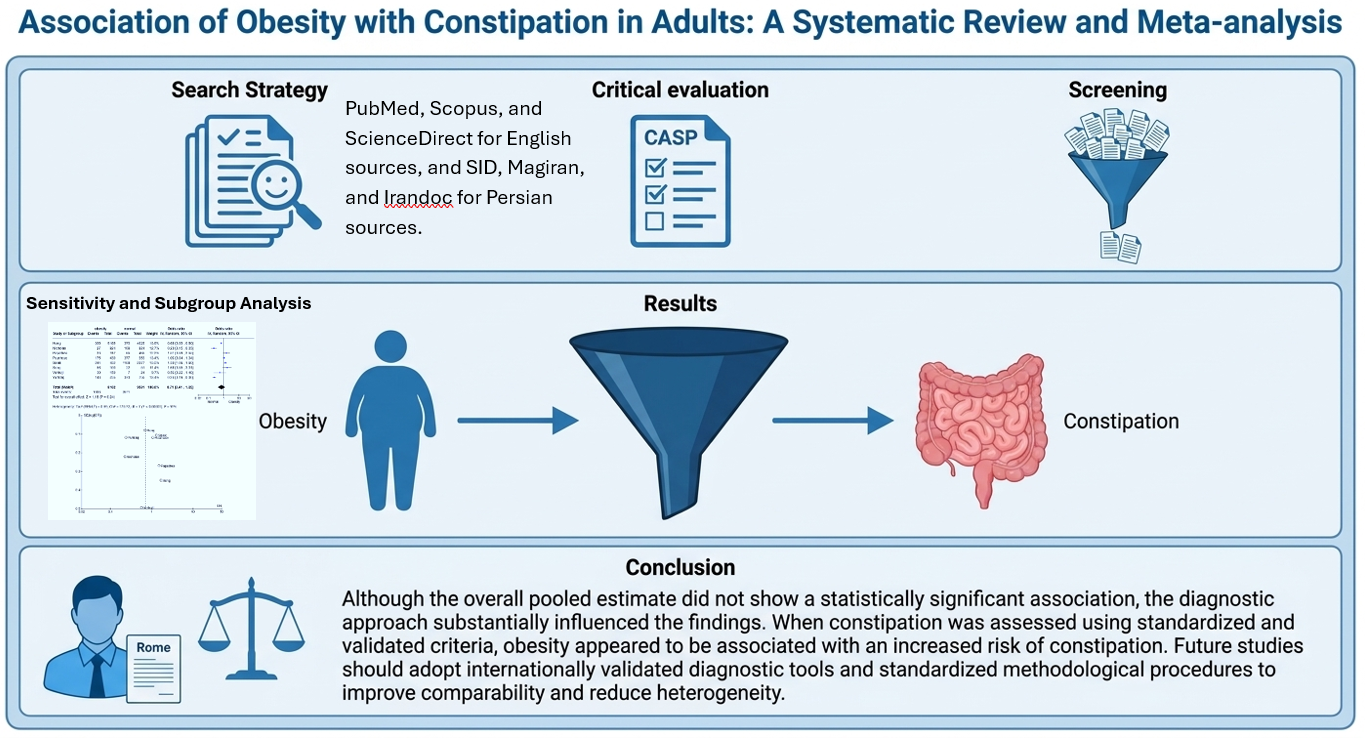
Materials and methods: A comprehensive search was conducted of relevant electronic databases to identify studies evaluating the association between obesity and constipation in adults. Two reviewers independently screened the titles and abstracts of the retrieved records and assessed the full texts of potentially eligible articles. Data extraction and methodological quality assessment were performed using the CASP checklist. The findings of the included studies were synthesized qualitatively, and a random-effects model was used for the quantitative synthesis. Subgroup analyses were conducted according to the diagnostic criteria or tools used to define constipation.
Results: Following the screening and eligibility assessment, 10 studies were included in the qualitative synthesis, of which 8 provided sufficient data for meta-analysis. The initial pooled analysis did not demonstrate a statistically significant association between obesity and constipation. However, subgroup analysis revealed a substantial difference according to the diagnostic criteria used to assess constipation. In studies that applied standardized tools, including internationally recognized criteria such as the Rome criteria, obesity was significantly associated with an increased risk of constipation. In contrast, studies using non-standardized or poorly defined criteria showed inverse associations and considerable heterogeneity. The dispersion and asymmetry of the funnel plot appeared to be largely attributable to methodological differences in the definition and assessment of constipation rather than to a consistent underlying association.
Conclusion: Although the overall pooled estimate did not show a statistically significant association, the diagnostic approach substantially influenced the findings. When constipation was assessed using standardized and validated criteria, obesity appeared to be associated with an increased risk of constipation. Future studies should adopt internationally validated diagnostic tools and standardized methodological approaches to improve comparability and reduce heterogeneity.
Send email to the article author
| Rights and permissions | |
 |
This work is licensed under a Creative Commons Attribution-NonCommercial 4.0 International License. |

Articles Copyright © The Author(s). Owned by Mazandaran University of Medical Sciences.
Contact Us
Address: Journal Office, Building No. 2, Mazandaran University of Medical Sciences, Moallem Square, Sari.Tel: +98 (011)34484874 Postal code: 48175-866 E-Mail: jmums@mazums.ac.ir Telefax: +98 (011)33262679
