

Volume 36, Issue 261 (10-2026)
J Mazandaran Univ Med Sci 2026, 36(261): 347-353 |
Back to browse issues page



Download citation:
BibTeX | RIS | EndNote | Medlars | ProCite | Reference Manager | RefWorks
Send citation to:


BibTeX | RIS | EndNote | Medlars | ProCite | Reference Manager | RefWorks
Send citation to:
Karami H, Jalali H, Badipour S, Naderisorki M. The Need to Establish a G6PD Deficiency Patient Registry in Mazandaran Province: A Policy Brief. J Mazandaran Univ Med Sci 2026; 36 (261) :347-353
URL: http://jmums.mazums.ac.ir/article-1-23166-en.html
URL: http://jmums.mazums.ac.ir/article-1-23166-en.html


Abstract: (17 Views)
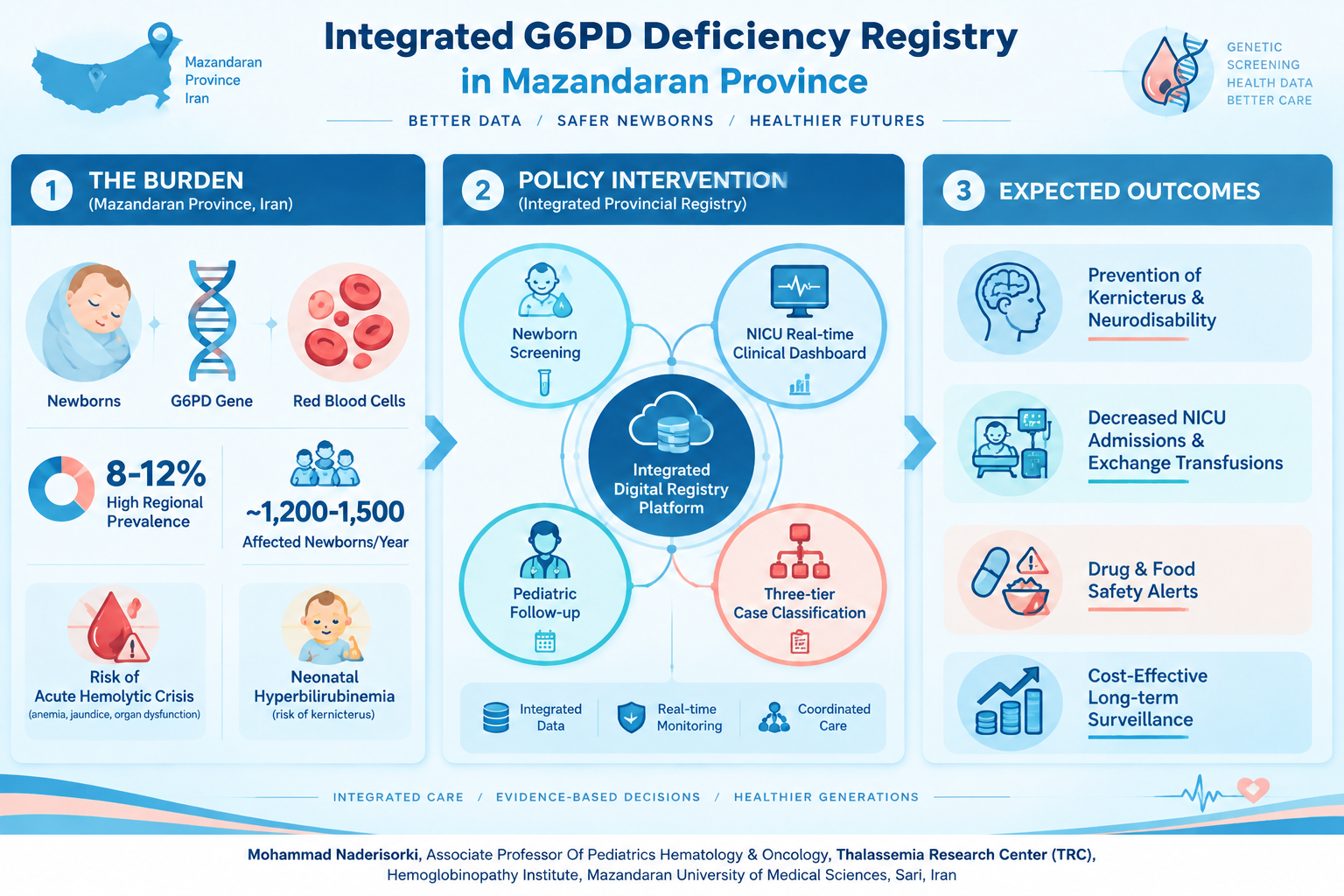
G6PD deficiency is an X-linked recessive disorder affecting more than 500 million people worldwide. The enzyme plays a critical role in generating NADPH, thereby protecting red blood cells against oxidative stress; exposure to fava beans, certain drugs, and infections can trigger acute hemolysis and, in neonates, severe jaundice and hyperbilirubinemic encephalopathy. In Mazandaran, there is a need for an integrated provincial G6PD registry and policy recommendations to improve case identification, longitudinal follow-up, prevention of complications, and data collection. This policy analysis was based on a review of available evidence and national and international experiences with disease registries. The prevalence of G6PD deficiency in Mazandaran is 8-12%, with the Mediterranean mutation predominating. With more than 30,000 births annually, at least 1,200-1,500 neonates with G6PD deficiency are born each year. The condition is a major contributor to neonatal admissions for severe hyperbilirubinemia requiring phototherapy or exchange transfusion in neonatal intensive care units (NICUs), while existing data are fragmented and do not provide adequate longitudinal follow-up.
Three options were considered: maintaining the status quo, creating a sentinel registry, and establishing an integrated, population-based provincial registry covering the universities of Mazandaran and Babol. The preferred option would be aligned with the Agency for Healthcare Research and Quality (AHRQ) and the PARENT framework and linked to newborn screening and a NICU dashboard. Its structure would include a three-tier classification: suspected or under evaluation, confirmed positive, and longitudinal follow-up. Recommendations include establishing a joint steering committee; piloting the registry in hub hospitals, followed by provincial scale-up; developing a real-time dashboard; providing community and staff education; introducing a drug and food warning card; and monitoring performance indicators. Expected outcomes include reduced encephalopathy and neurodisability, prevention of acute hemolysis and transfusion, lower NICU and rehabilitation costs, strengthened research infrastructure, and the development of a model for a national registry. Such a registry would also facilitate timely counselling of families and support informed decision-making within health services. Establishing an integrated provincial G6PD registry in Mazandaran is therefore considered feasible and potentially cost-effective and is expected to improve the identification, follow-up, and prevention of complications associated with G6PD deficiency.
Three options were considered: maintaining the status quo, creating a sentinel registry, and establishing an integrated, population-based provincial registry covering the universities of Mazandaran and Babol. The preferred option would be aligned with the Agency for Healthcare Research and Quality (AHRQ) and the PARENT framework and linked to newborn screening and a NICU dashboard. Its structure would include a three-tier classification: suspected or under evaluation, confirmed positive, and longitudinal follow-up. Recommendations include establishing a joint steering committee; piloting the registry in hub hospitals, followed by provincial scale-up; developing a real-time dashboard; providing community and staff education; introducing a drug and food warning card; and monitoring performance indicators. Expected outcomes include reduced encephalopathy and neurodisability, prevention of acute hemolysis and transfusion, lower NICU and rehabilitation costs, strengthened research infrastructure, and the development of a model for a national registry. Such a registry would also facilitate timely counselling of families and support informed decision-making within health services. Establishing an integrated provincial G6PD registry in Mazandaran is therefore considered feasible and potentially cost-effective and is expected to improve the identification, follow-up, and prevention of complications associated with G6PD deficiency.
Keywords: G6PD deficiency, registry, hyperbilirubinemic encephalopathy, neonatal health, Mazandaran, health policy, acute hemolysis
Type of Study: Policy Brief |
Subject:
Policy and Management
Send email to the article author
| Rights and permissions | |
 |
This work is licensed under a Creative Commons Attribution-NonCommercial 4.0 International License. |

Articles Copyright © The Author(s). Owned by Mazandaran University of Medical Sciences.
Contact Us
Address: Journal Office, Building No. 2, Mazandaran University of Medical Sciences, Moallem Square, Sari.Tel: +98 (011)34484874 Postal code: 48175-866 E-Mail: jmums@mazums.ac.ir Telefax: +98 (011)33262679
