

Volume 36, Issue 263 (11-2026)
J Mazandaran Univ Med Sci 2026, 36(263): 36-49 |
Back to browse issues page



Download citation:
BibTeX | RIS | EndNote | Medlars | ProCite | Reference Manager | RefWorks
Send citation to:


BibTeX | RIS | EndNote | Medlars | ProCite | Reference Manager | RefWorks
Send citation to:
Aliasghari Jelodar S, Ghanbari-Niaki A, Naghizadeh Qomi M. Effects of Honey, Jujube Syrup, and Dextrose Solutions Ingestion on Interleukin-6, Asprosin, and Acylated Ghrelin Responses Following a Single Bout of High-Intensity Exercise in Young Male Soccer Players. , J Mazandaran Univ Med Sci. 2026; 36 (263) :36-49
URL: http://jmums.mazums.ac.ir/article-1-23174-en.html
URL: http://jmums.mazums.ac.ir/article-1-23174-en.html


Abstract: (67 Views)
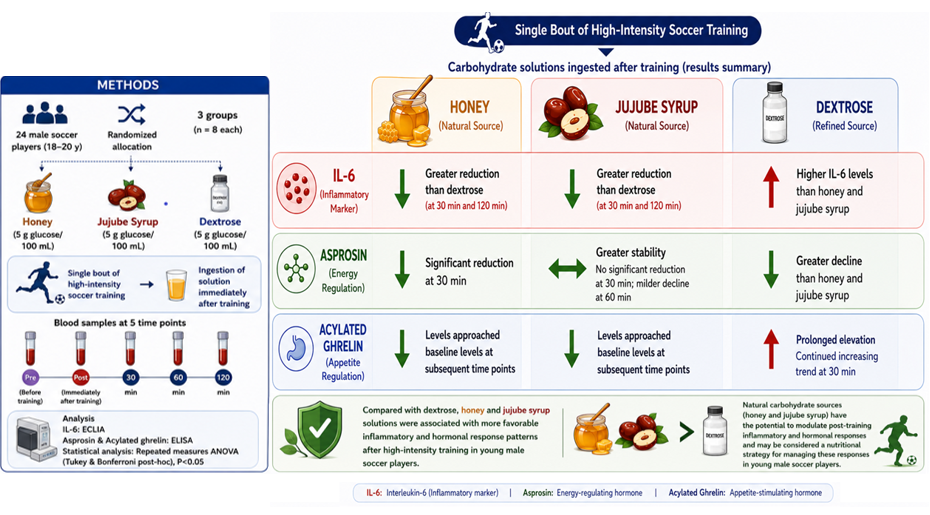
Background and purpose: High-intensity exercise can induce metabolic stress, inflammatory responses, and changes in hormonal regulation. The type of carbohydrate consumed during recovery may influence these responses. This study aimed to compare the effects of honey, jujube syrup, and dextrose consumption on interleukin-6 (IL-6), asprosin, and acylated ghrelin responses following a single bout of high-intensity exercise in male soccer players.
Materials and methods: This quasi-experimental study included 24 male soccer players, who were divided into three equal groups and assigned to receive honey, jujube syrup, and dextrose. The test solutions were standardised to provide equivalent glucose concentrations and were consumed immediately after exercise. Blood samples were collected before exercise, immediately after exercise, and 30, 60, and 120 minutes after consumption of the assigned solution. Serum IL-6 concentrations were measured using electrochemiluminescence immunoassay (ECLIA), while asprosin and acylated ghrelin concentrations were determined using enzyme-linked immunosorbent assays (ELISAs). Data were analysed using repeated-measures analysis of variance (ANOVA), with Tukey’s and Bonferroni post hoc tests, as appropriate. Statistical significance was set at P < 0.05.
Results: Significant time-by-group interaction effects were observed for IL-6, asprosin, and acylated ghrelin (P < 0.05). IL-6 concentrations decreased more in the honey and jujube syrup groups than in the dextrose group from 30 minutes onwards (P < 0.001). Asprosin responses differed across groups: at 30 minutes, concentrations in the jujube syrup group did not decrease significantly relative to the immediate post-exercise measurement, whereas decreases were observed in the other two groups. At 60 minutes, the reduction in asprosin was less pronounced in the jujube syrup group, while significant decreases were observed in the honey and dextrose groups (P ≤ 0.001). Acylated ghrelin concentrations increased immediately after exercise in all groups. This increase persisted at 30 minutes in the dextrose group (P < 0.01), whereas concentrations in the honey and jujube syrup groups subsequently moved towards pre-exercise levels.
Conclusion: Honey, jujube syrup, and dextrose were associated with different short-term patterns of inflammatory and hormonal responses following high-intensity exercise in male soccer players. The findings suggest that the source of carbohydrate consumed after exercise may influence the post-exercise responses of IL-6, asprosin, and acylated ghrelin. However, the clinical and physiological significance of these differences remains uncertain. Larger studies incorporating measures of physical recovery and subsequent exercise performance are needed to determine whether these biomarker responses translate into meaningful recovery benefits.
Type of Study: Research(Original) |
Subject:
Sport Physiology
Send email to the article author
| Rights and permissions | |
 |
This work is licensed under a Creative Commons Attribution-NonCommercial 4.0 International License. |

Articles Copyright © The Author(s). Owned by Mazandaran University of Medical Sciences.
Contact Us
Address: Journal Office, Building No. 2, Mazandaran University of Medical Sciences, Moallem Square, Sari.Tel: +98 (011)34484874 Postal code: 48175-866 E-Mail: jmums@mazums.ac.ir Telefax: +98 (011)33262679
