

Volume 36, Issue 263 (11-2026)
J Mazandaran Univ Med Sci 2026, 36(263): 218-229 |
Back to browse issues page


Download citation:
BibTeX | RIS | EndNote | Medlars | ProCite | Reference Manager | RefWorks
Send citation to:


BibTeX | RIS | EndNote | Medlars | ProCite | Reference Manager | RefWorks
Send citation to:
Mohammadi-Sarab S, Ghamari D, Amani S, Nikouei M, Ahmadipour N, Aghaei A. Association Between Self-Compassion and Mental Health Among Older Adults Residing in a Nursing Home in Sanandaj, Iran (2021): A Cross-Sectional Study. , J Mazandaran Univ Med Sci. 2026; 36 (263) :218-229
URL: http://jmums.mazums.ac.ir/article-1-23191-en.html
URL: http://jmums.mazums.ac.ir/article-1-23191-en.html
Soma Mohammadi-Sarab 
 , Darya Ghamari , Saeideh Amani , Maziar Nikouei , Narges Ahmadipour , Abbas Aghaei *
Abstract: (19 Views)
Background and purpose: Mental health is a key component of healthy ageing. Self-compassion has been recognised as a psychological resource associated with mental health; however, evidence regarding this relationship among institutionalised older adults remains limited. This study aimed to investigate the association between self-compassion and mental health among older adults residing in a nursing home in Sanandaj, Iran.
Materials and methods: This cross-sectional study was conducted in 2021 among 101 older adults residing in a nursing home in Sanandaj, who were recruited using census sampling. Data were collected using a demographic checklist, the Self-Compassion Scale-Short Form, and the General Health Questionnaire (GHQ-28). As most quantitative variables were not normally distributed, as determined by the Kolmogorov-Smirnov test, Spearman's rank correlation, the Mann-Whitney U test, and the Kruskal-Wallis test were used for statistical analysis in SPSS. Statistical significance was set at P < 0.05.
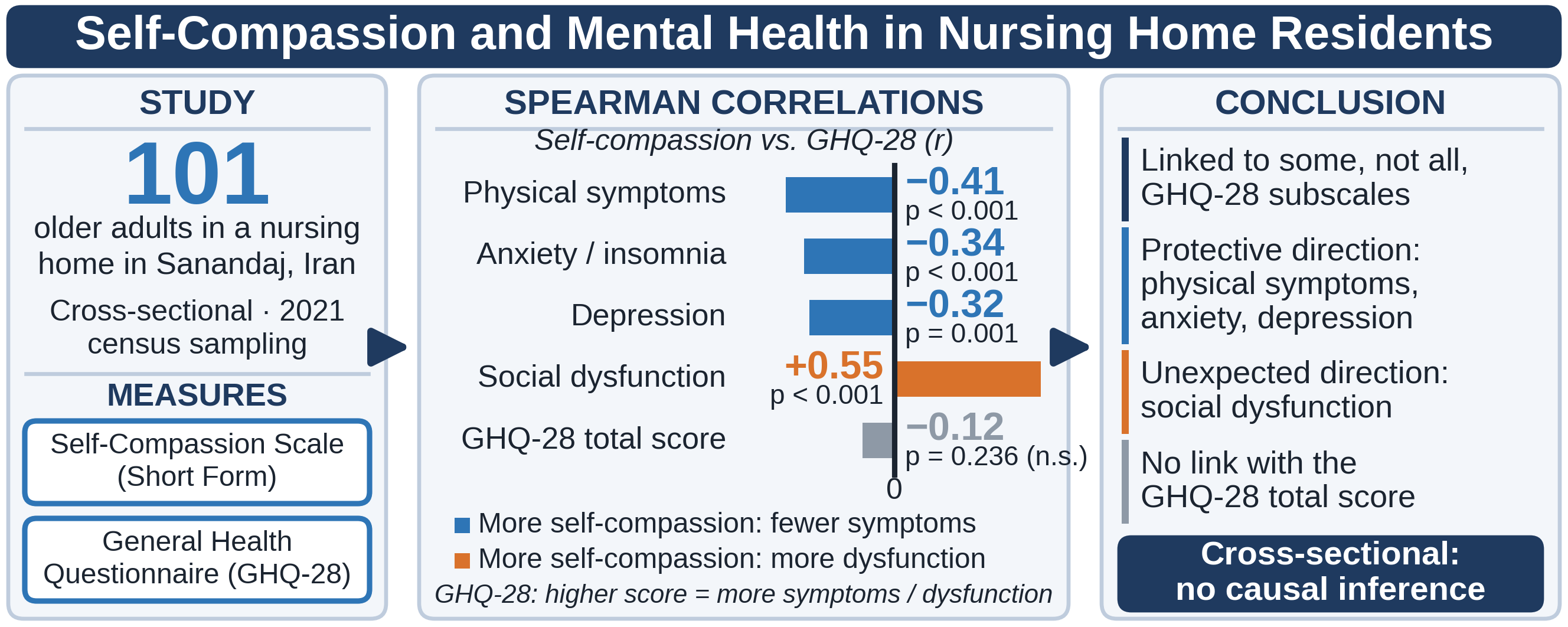
Results: The mean age of participants was 74.84 ± 9.99 years, and 38.6% (n = 39) were women. The mean self-compassion score was 31.45 ± 7.72. Self-compassion was significantly inversely correlated with the physical symptoms (rₛ = -0.41, P < 0.001), anxiety and sleep disturbance (rₛ = -0.34, P < 0.001), and depression (rₛ = -0.32, P = 0.001) subscales, indicating that higher self-compassion scores were associated with fewer reported symptoms in these domains. In contrast, a significant positive correlation was observed between self-compassion and the social dysfunction subscale (rₛ = 0.55, P < 0.001), indicating an association between higher self-compassion scores and higher social dysfunction scores. No significant correlation was found between self-compassion and the GHQ-28 total score (rₛ = -0.12, P = 0.236). Although the GHQ-28 total score did not differ significantly by sex (P = 0.165), significant sex-based differences were observed in some subscale scores and self-compassion. Physical symptom scores were also inversely correlated with age (rₛ = -0.20, P = 0.044).
Conclusion: Self-compassion was significantly associated with three of the four GHQ-28 subscales, with inverse associations observed for physical symptoms, anxiety and sleep disturbance, and depression, and a positive association observed for social dysfunction. However, no significant association was found between self-compassion and the GHQ-28 total score. These findings suggest that the relationship between self-compassion and mental health may vary across different dimensions of psychological well-being. Given the cross-sectional design, causal relationships cannot be established. The unexpected positive association with social dysfunction warrants further investigation.
Type of Study: Research(Original) |
Subject:
health
Send email to the article author
| Rights and permissions | |
 |
This work is licensed under a Creative Commons Attribution-NonCommercial 4.0 International License. |
Articles Copyright © The Author(s). Owned by Mazandaran University of Medical Sciences.
Contact Us
Address: Journal Office, Building No. 2, Mazandaran University of Medical Sciences, Moallem Square, Sari.Tel: +98 (011)34484874 Postal code: 48175-866 E-Mail: jmums@mazums.ac.ir Telefax: +98 (011)33262679
