

Volume 36, Issue 261 (10-2026)
J Mazandaran Univ Med Sci 2026, 36(261): 290-308 |
Back to browse issues page



Download citation:
BibTeX | RIS | EndNote | Medlars | ProCite | Reference Manager | RefWorks
Send citation to:


BibTeX | RIS | EndNote | Medlars | ProCite | Reference Manager | RefWorks
Send citation to:
Rohani F, Nikookar S H, Fazeli Dinan M, Bizhan Kouchi F, Enayati A. Insecticide Resistance in Aedes albopictus: Mechanisms, Knowledge Gaps, and Implications for Vector Control. J Mazandaran Univ Med Sci 2026; 36 (261) :290-308
URL: http://jmums.mazums.ac.ir/article-1-23213-en.html
URL: http://jmums.mazums.ac.ir/article-1-23213-en.html
Faezeh Rohani 
 , Seyed Hassan Nikookar , Mahmoud Fazeli Dinan , Fatemeh Bizhan Kouchi , Ahmadali Enayati
, Seyed Hassan Nikookar , Mahmoud Fazeli Dinan , Fatemeh Bizhan Kouchi , Ahmadali Enayati
Abstract: (19 Views)
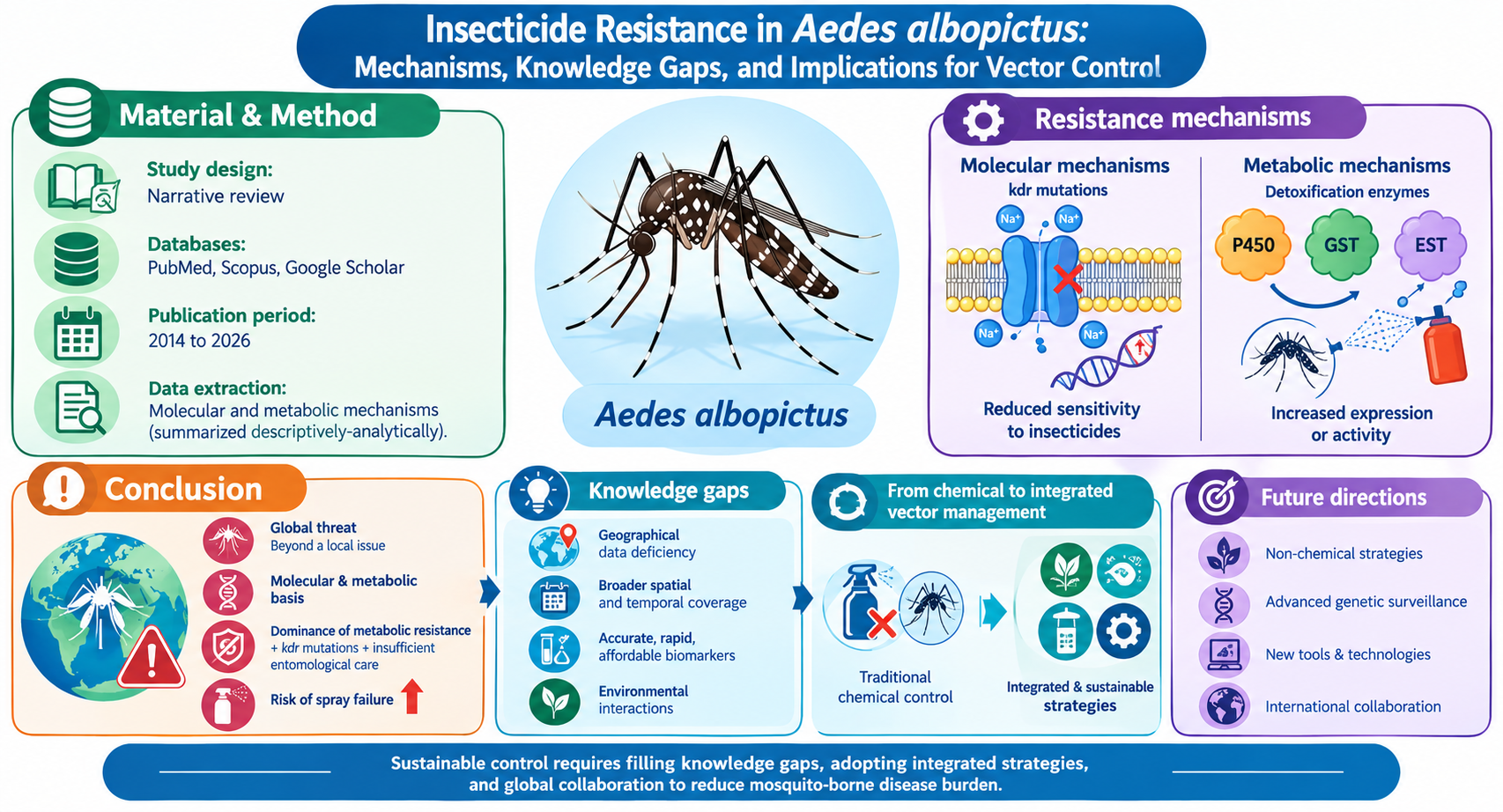
Background and purpose: Insecticide resistance in Aedes albopictus, an important vector of arboviral diseases such as dengue, chikungunya, and Zika, represents a major challenge for vector control. Its high adaptability and rapid spread in urban and semi-urban environments highlight the importance of resistance surveillance. This narrative review aimed to summarise the major resistance mechanisms, knowledge gaps, and consequences of insecticide resistance for vector control programmes.
Materials and methods: Studies published in Persian and English between 2014 and 2026 were reviewed using PubMed, Scopus, and Google Scholar. Relevant studies addressing insecticide resistance and its underlying mechanisms were selected based on their thematic relevance and scientific quality. Data on molecular and metabolic resistance mechanisms were extracted and synthesised descriptively and analytically.
Results: Insecticide resistance in Ae. albopictus develops through multiple, often co-occurring mechanisms. Major molecular mechanisms include knockdown resistance (kdr) mutations in the voltage-gated sodium channel, while metabolic resistance is associated with increased expression or altered activity of detoxification enzymes, including cytochrome P450 monooxygenases, glutathione S-transferases, and esterases. Available studies are predominantly concentrated in Asia, while data from some regions of Africa and Latin America remain limited. The influence of environmental and climatic factors and the limited availability of alternative vector control strategies represent important knowledge gaps. Insecticide resistance may reduce the effectiveness of chemical control and increase the risk of sustained arbovirus transmission and outbreaks.
Conclusion: Continuous molecular and biochemical surveillance of insecticide resistance, together with Insecticide Resistance Management (IRM) and alternative vector control strategies, is essential for the sustainable control of Ae. Albopictus.
Materials and methods: Studies published in Persian and English between 2014 and 2026 were reviewed using PubMed, Scopus, and Google Scholar. Relevant studies addressing insecticide resistance and its underlying mechanisms were selected based on their thematic relevance and scientific quality. Data on molecular and metabolic resistance mechanisms were extracted and synthesised descriptively and analytically.
Results: Insecticide resistance in Ae. albopictus develops through multiple, often co-occurring mechanisms. Major molecular mechanisms include knockdown resistance (kdr) mutations in the voltage-gated sodium channel, while metabolic resistance is associated with increased expression or altered activity of detoxification enzymes, including cytochrome P450 monooxygenases, glutathione S-transferases, and esterases. Available studies are predominantly concentrated in Asia, while data from some regions of Africa and Latin America remain limited. The influence of environmental and climatic factors and the limited availability of alternative vector control strategies represent important knowledge gaps. Insecticide resistance may reduce the effectiveness of chemical control and increase the risk of sustained arbovirus transmission and outbreaks.
Conclusion: Continuous molecular and biochemical surveillance of insecticide resistance, together with Insecticide Resistance Management (IRM) and alternative vector control strategies, is essential for the sustainable control of Ae. Albopictus.
Keywords: insecticide resistance, Aedes albopictus, kdr mutations, metabolic resistance, vector control, knowledge gaps
Type of Study: Review |
Subject:
Medical Entomology
Send email to the article author
| Rights and permissions | |
 |
This work is licensed under a Creative Commons Attribution-NonCommercial 4.0 International License. |

Articles Copyright © The Author(s). Owned by Mazandaran University of Medical Sciences.
Contact Us
Address: Journal Office, Building No. 2, Mazandaran University of Medical Sciences, Moallem Square, Sari.Tel: +98 (011)34484874 Postal code: 48175-866 E-Mail: jmums@mazums.ac.ir Telefax: +98 (011)33262679
