

Volume 36, Issue 264 (11-2026)
J Mazandaran Univ Med Sci 2026, 36(264): 178-184 |
Back to browse issues page



Download citation:
BibTeX | RIS | EndNote | Medlars | ProCite | Reference Manager | RefWorks
Send citation to:


BibTeX | RIS | EndNote | Medlars | ProCite | Reference Manager | RefWorks
Send citation to:
Soleymani Amiri H, Hosseini S H, Baghbanian M, Najafi M. Association of Anxiety and Depressive Symptoms with Muscle Strength and Functional Independence in Patients with Guillain-Barré Syndrome Approximately Six Months After Discharge: A Cross-Sectional Study. , J Mazandaran Univ Med Sci. 2026; 36 (264) :178-184
URL: http://jmums.mazums.ac.ir/article-1-21974-en.html
URL: http://jmums.mazums.ac.ir/article-1-21974-en.html


Abstract: (20 Views)
Background and purpose: Psychological symptoms may persist after the acute phase of Guillain-Barré syndrome (GBS), yet their association with physical recovery has not been adequately characterized. This study assessed the prevalence of elevated anxiety and depressive symptoms and examined their associations with muscle strength and functional independence approximately six months after discharge.
Materials and methods: In this analytical cross-sectional follow-up study, acute-phase clinical information was retrospectively extracted from medical records of adults admitted with definite or probable GBS to Booali Sina Teaching Hospital, Sari, Iran, between January 2017 and December 2022. At follow-up (mean 6.3±1.2 months; median 6.1; range 5.8-8.4), anxiety and depressive symptoms were assessed using the Hospital Anxiety and Depression Scale (HADS); muscle strength and functional independence were evaluated using the Medical Research Council sum score and the Functional Independence Measure (FIM), respectively. Correlation analyses and multivariable linear regression, adjusted for age, acute-phase muscle strength, and intensive care unit admission, were used to examine these associations.
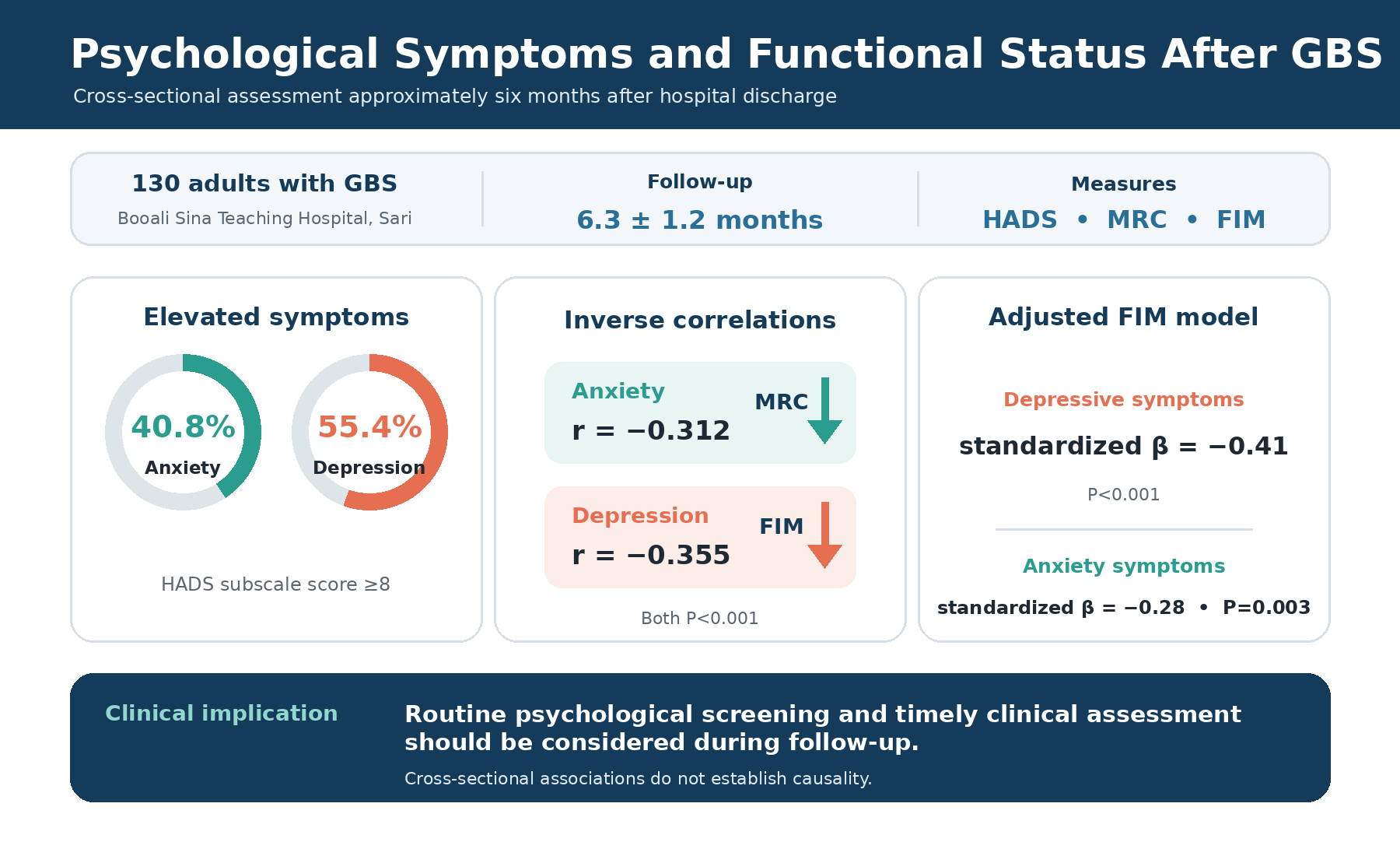
Results: Of 200 screened records, 130 participants were included (mean age 45.7±15.5 years; 62.3% men). Elevated anxiety symptoms (HADS-A≥8) were present in 53 participants (40.8%), and elevated depressive symptoms (HADS-D≥8) in 72 (55.4%). Higher anxiety scores were correlated with lower muscle strength (r=-0.312, P<0.001), and higher depressive symptom scores were correlated with lower functional independence (r=-0.355, P<0.001). In the multivariable model for FIM, depressive symptoms (standardized β=-0.41, P<0.001) and anxiety symptoms (standardized β=-0.28, P=0.003) remained inversely associated with functional independence.
Conclusion: Anxiety and depressive symptoms were common and were inversely associated with physical and functional status approximately six months after discharge among adults with GBS. Because the cross-sectional design precludes causal inference, these findings support routine symptom screening and timely clinical assessment rather than supporting a causal interpretation or implying that psychiatric treatment improves neurological recovery.
Keywords: Guillain-Barré syndrome, anxiety, depression, muscle strength, functional independence, HADS
Type of Study: Research(Original) |
Subject:
psychiatry
Send email to the article author
| Rights and permissions | |
 |
This work is licensed under a Creative Commons Attribution-NonCommercial 4.0 International License. |

Articles Copyright © The Author(s). Owned by Mazandaran University of Medical Sciences.
Contact Us
Address: Journal Office, Building No. 2, Mazandaran University of Medical Sciences, Moallem Square, Sari.Tel: +98 (011)34484874 Postal code: 48175-866 E-Mail: jmums@mazums.ac.ir Telefax: +98 (011)33262679
