

Volume 36, Issue 259 (8-2026)
J Mazandaran Univ Med Sci 2026, 36(259): 6-16 |
Back to browse issues page



Download citation:
BibTeX | RIS | EndNote | Medlars | ProCite | Reference Manager | RefWorks
Send citation to:


BibTeX | RIS | EndNote | Medlars | ProCite | Reference Manager | RefWorks
Send citation to:
Ahmadi S, Shokri-Afra H, Fakheri H, Taghvaei T, Maleki I, Valizadeh Toosi S M, et al . Efficacy and Safety of Tofacitinib in Patients with Ulcerative Colitis. J Mazandaran Univ Med Sci 2026; 36 (259) :6-16
URL: http://jmums.mazums.ac.ir/article-1-22447-en.html
URL: http://jmums.mazums.ac.ir/article-1-22447-en.html
Shapour Ahmadi 
 , Hajar Shokri-Afra , Hafez Fakheri , Tarang Taghvaei , Iradj Maleki , Seyed Mohammad Valizadeh Toosi , Reyhane Ebrahimi Shahabi , Mahboobe Ebrahimi
, Hajar Shokri-Afra , Hafez Fakheri , Tarang Taghvaei , Iradj Maleki , Seyed Mohammad Valizadeh Toosi , Reyhane Ebrahimi Shahabi , Mahboobe Ebrahimi
Abstract: (71 Views)
Background and purpose: Ulcerative colitis (UC) is a chronic inflammatory bowel disease that can be challenging to treat, particularly in patients who are refractory to conventional and biologic therapies. Tofacitinib, an oral Janus kinase inhibitor, has emerged as a treatment option for patients with moderately to severely active UC who have had an inadequate response or intolerance to conventional or biologic therapies.
Materials and methods: In this retrospective longitudinal study, the efficacy and safety of tofacitinib were evaluated in 26 patients with moderate to severe ulcerative colitis treated at the Gut and Liver Research Center, Mazandaran University of Medical Sciences, at 12, 26, and 52 weeks of follow-up.
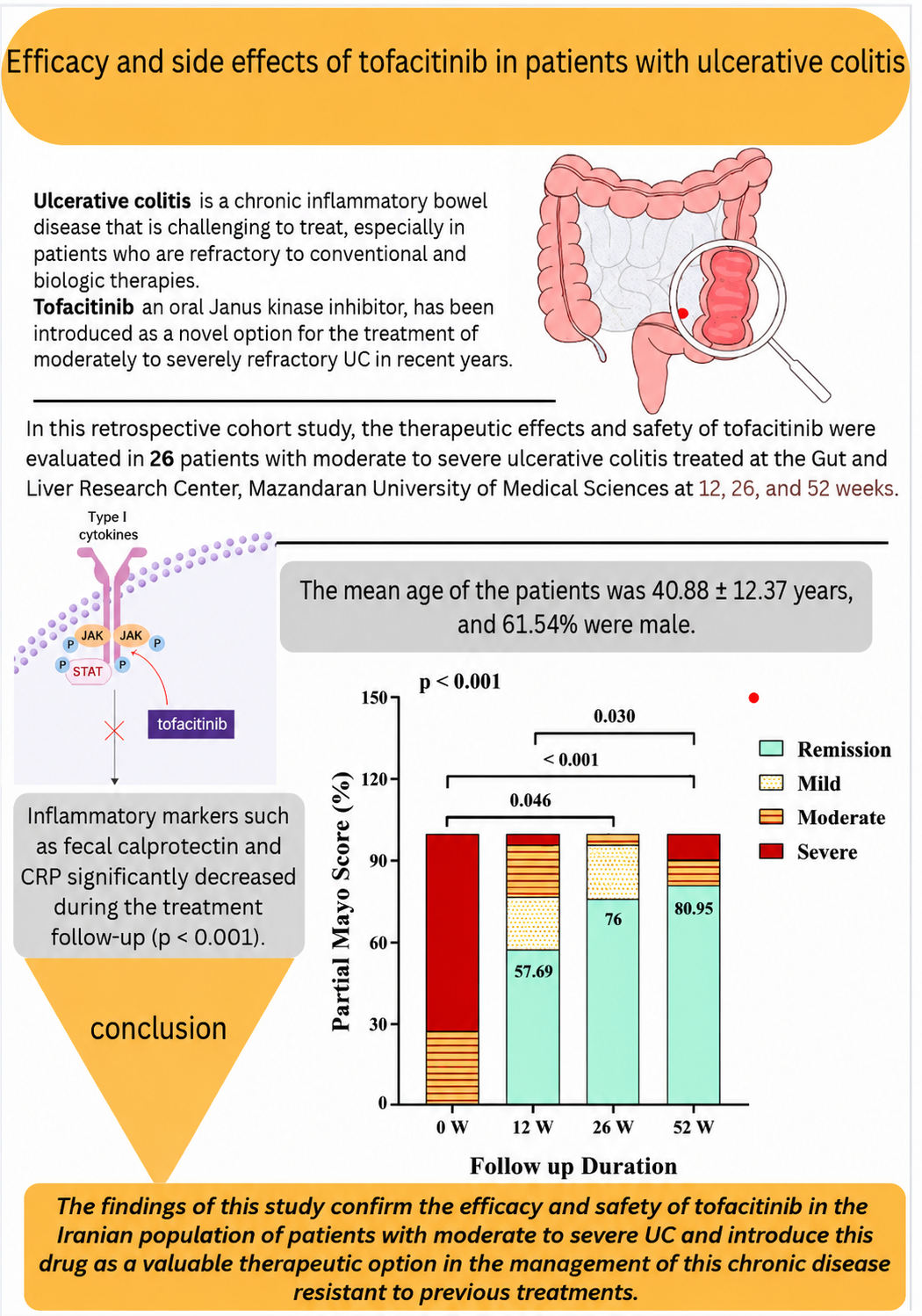
Results: The mean age of the patients was 40.88 ± 12.37 years, and 61.54% were male. At the end of the induction phase, the clinical response rate was 88.46%, and clinical remission based on the partial Mayo score was 57.69%. At weeks 26 and 52, 25 and 21 patients, respectively, remained in the maintenance phase, with clinical remission rates of 76% and 80.95%, respectively (P < 0.001). Secondary loss of response was observed in 20% of patients (P = 0.003). During follow-up, corticosteroids were required in 30.77% of patients, no patients underwent colectomy, and no serious drug-related adverse events were observed. Inflammatory markers, including faecal calprotectin and C-reactive protein (CRP), decreased significantly during follow-up (P < 0.001). Haemoglobin levels also increased significantly (P = 0.017). There was no significant association between clinical remission and age, sex, or corticosteroid use; however, a significant association was observed between clinical remission and reductions in inflammatory markers.
Conclusion: The findings suggest that tofacitinib may be an effective and well-tolerated treatment option for Iranian patients with moderate to severe UC who are refractory to previous therapies. Further studies with larger sample sizes and prospective designs are needed to confirm its efficacy and safety in this population.
Materials and methods: In this retrospective longitudinal study, the efficacy and safety of tofacitinib were evaluated in 26 patients with moderate to severe ulcerative colitis treated at the Gut and Liver Research Center, Mazandaran University of Medical Sciences, at 12, 26, and 52 weeks of follow-up.
Results: The mean age of the patients was 40.88 ± 12.37 years, and 61.54% were male. At the end of the induction phase, the clinical response rate was 88.46%, and clinical remission based on the partial Mayo score was 57.69%. At weeks 26 and 52, 25 and 21 patients, respectively, remained in the maintenance phase, with clinical remission rates of 76% and 80.95%, respectively (P < 0.001). Secondary loss of response was observed in 20% of patients (P = 0.003). During follow-up, corticosteroids were required in 30.77% of patients, no patients underwent colectomy, and no serious drug-related adverse events were observed. Inflammatory markers, including faecal calprotectin and C-reactive protein (CRP), decreased significantly during follow-up (P < 0.001). Haemoglobin levels also increased significantly (P = 0.017). There was no significant association between clinical remission and age, sex, or corticosteroid use; however, a significant association was observed between clinical remission and reductions in inflammatory markers.
Conclusion: The findings suggest that tofacitinib may be an effective and well-tolerated treatment option for Iranian patients with moderate to severe UC who are refractory to previous therapies. Further studies with larger sample sizes and prospective designs are needed to confirm its efficacy and safety in this population.
Type of Study: Research(Original) |
Subject:
Gastroenterology and Hepatology
Send email to the article author
| Rights and permissions | |
 |
This work is licensed under a Creative Commons Attribution-NonCommercial 4.0 International License. |

Articles Copyright © The Author(s). Owned by Mazandaran University of Medical Sciences.
Contact Us
Address: Journal Office, Building No. 2, Mazandaran University of Medical Sciences, Moallem Square, Sari.Tel: +98 (011)34484874 Postal code: 48175-866 E-Mail: jmums@mazums.ac.ir Telefax: +98 (011)33262679
