

Volume 36, Issue 262 (Special Issue 2026)
J Mazandaran Univ Med Sci 2026, 36(262): 91-104 |
Back to browse issues page



Download citation:
BibTeX | RIS | EndNote | Medlars | ProCite | Reference Manager | RefWorks
Send citation to:


BibTeX | RIS | EndNote | Medlars | ProCite | Reference Manager | RefWorks
Send citation to:
Dorfeshan P, Boodesh M, Karimy M, H. Pakpour A, Moradi M, Mohammadi S et al . Factors Associated with the Intention to Use Fertility Preservation Methods Among Women with Cancer: A Cross-Sectional Study Based on the Theory of Planned Behaviour. , J Mazandaran Univ Med Sci. 2026; 36 (262) :91-104
URL: http://jmums.mazums.ac.ir/article-1-22607-en.html
URL: http://jmums.mazums.ac.ir/article-1-22607-en.html
Parvin Dorfeshan 
 , Maryam Boodesh , Mahmood Karimy , Amir H. Pakpour , Maryam Moradi , Solmaz Mohammadi , Marzieh Araban *
Abstract: (37 Views)
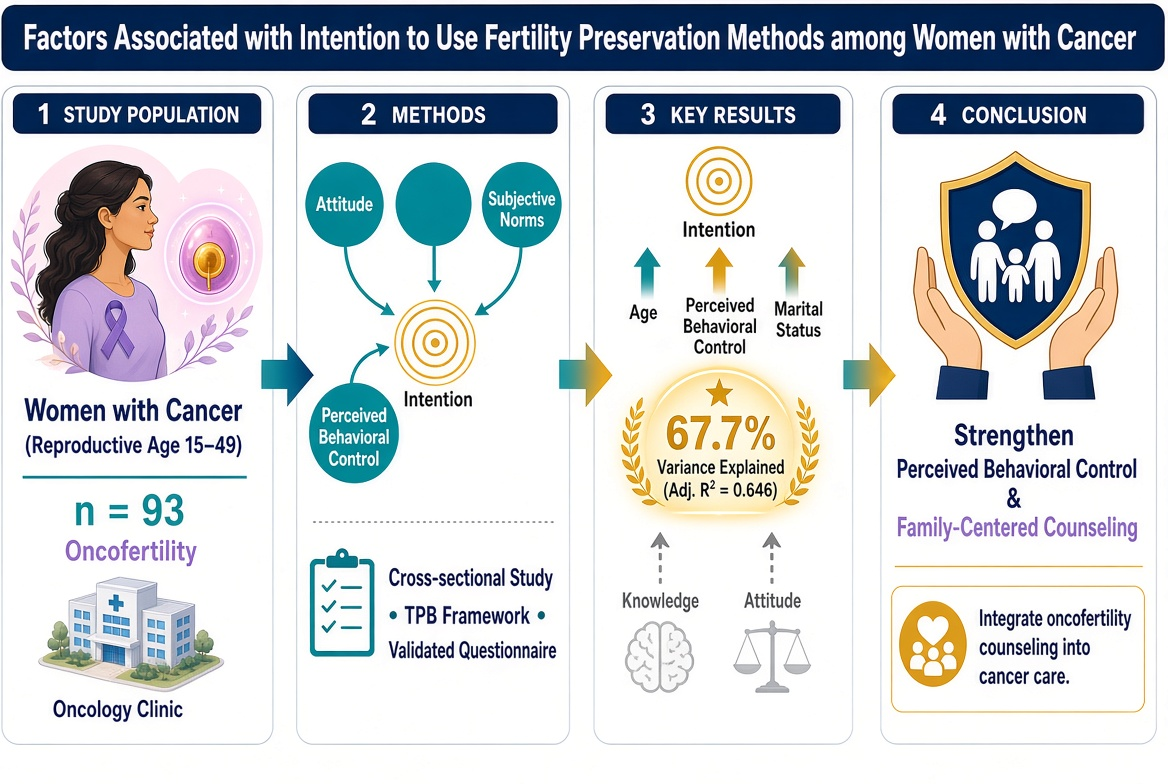
Background and purpose: Cancer treatment can compromise fertility in young women. Despite international recommendations, awareness of fertility preservation options remains limited among patients with cancer. This study aimed to identify factors associated with fertility preservation knowledge and the intention to use fertility preservation methods among women with cancer.
Materials and methods: This cross-sectional analytical study was conducted in the oncology clinics of the teaching hospitals affiliated with Jundishapur University of Medical Sciences in Ahvaz, Iran, from October 2022 to December 2023. A convenience sample of 93 women with cancer who met the eligibility criteria was recruited. Data were collected using a validated questionnaire based on the Theory of Planned Behavior (TPB). Statistical analyses were performed using SPSS version 23. Depending on the type and distribution of the variables, group comparisons and associations were examined using the Mann-Whitney U test, independent-samples t-test, chi-square test, and Spearman's rank or Pearson's correlation coefficient. Multiple linear regression was used to identify factors associated with behavioural intention. Statistical significance was set at P < 0.05.
Results: The mean total knowledge score was 9.58 ± 2.81 (out of 23), and the mean behavioural intention score was 8.53 ± 2.69. In the multiple linear regression analysis, age, perceived behavioural control, and marital status were significant predictors of intention to use fertility preservation methods. Together, these variables explained 67.7% of the variance in behavioural intention ( P < 0.001; adjusted R² = 0.646). Knowledge and attitude were not statistically significant predictors after adjustment for the other variables.
Conclusion: Perceived behavioural control, age, and marital status were independently associated with the intention to use fertility preservation methods among women with cancer. Given the cross-sectional design, causal relationships cannot be established. Future intervention studies should assess the effectiveness of educational programmes based on the Theory of Planned Behavior, particularly those designed to strengthen perceived behavioural control and support informed fertility preservation decisions.
Type of Study: Research(Original) |
Subject:
Midwifery
Send email to the article author
| Rights and permissions | |
 |
This work is licensed under a Creative Commons Attribution-NonCommercial 4.0 International License. |

Articles Copyright © The Author(s). Owned by Mazandaran University of Medical Sciences.
Contact Us
Address: Journal Office, Building No. 2, Mazandaran University of Medical Sciences, Moallem Square, Sari.Tel: +98 (011)34484874 Postal code: 48175-866 E-Mail: jmums@mazums.ac.ir Telefax: +98 (011)33262679
